ENEnglish
 LTLietuviškai
 DEDeutsch
 FRFrançais
 RUРусский
 ESEspañol
 PLPolski
 ITItaliano
 UKУкраїнська
 CSČeština
 PTPortuguês
 JA日本語
JA日本語 LVLatviešu valoda
 ETEesti
 HUMagyar
 IDBahasa Indonesia
 TRTürkçe
 HIहिन्दी
 ELΕλληνικά
 ARالعربية
 THไทย
THไทย VITiếng Việt
 RORomână
 MSBahasa Melayu
 BNবাংলা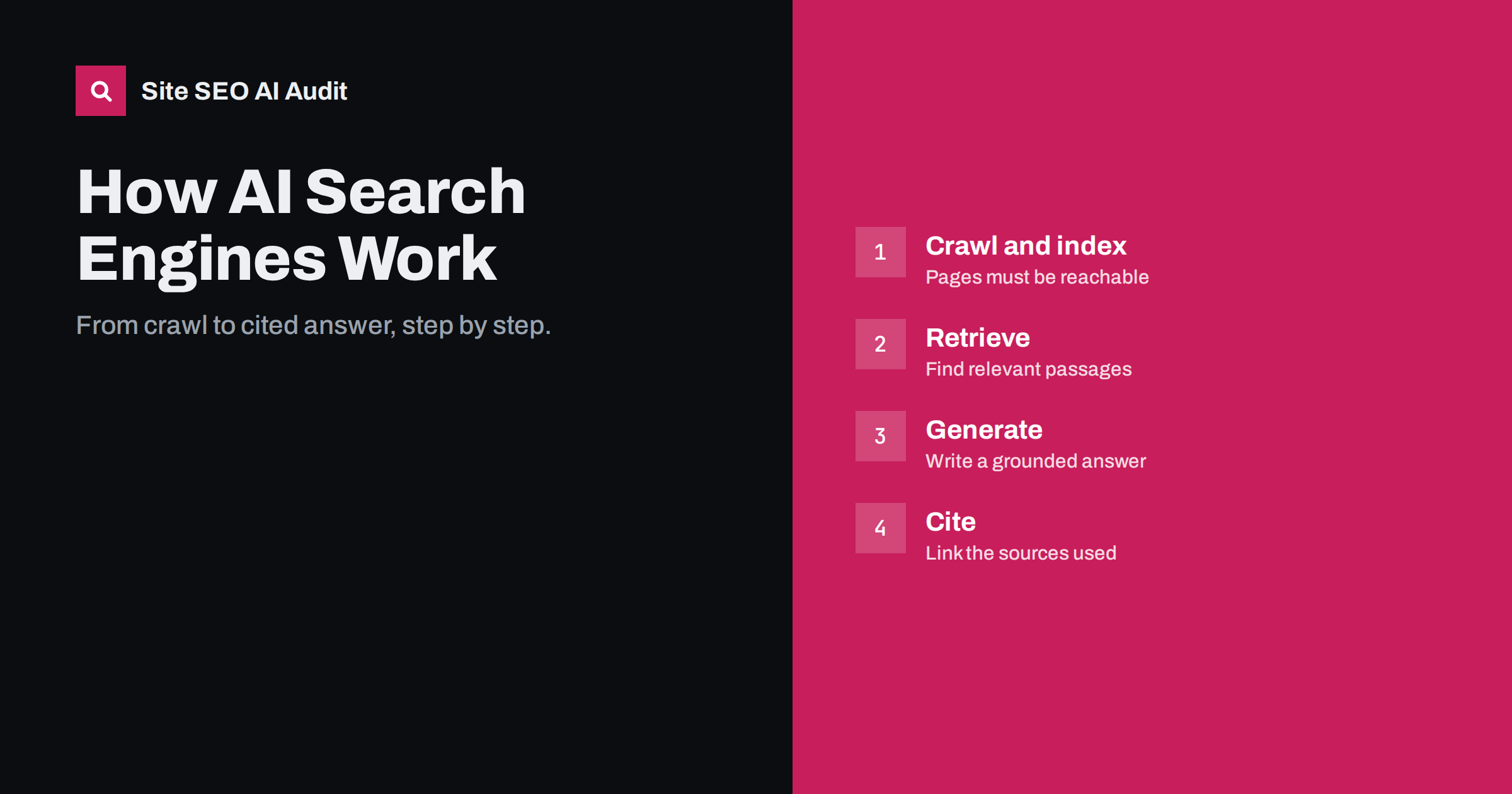
Short answer: AI search engines combine a classic search pipeline with a language model. Crawlers collect pages and an index stores them; when a user asks a question, the system rewrites it into one or more searches, retrieves relevant pages and passages, ranks them, and passes the best ones to a model that writes an answer grounded in those sources, usually with citations. Your site can only be cited if it survives every stage, which is why crawlability, indexing and clear passages matter more than any special trick.
Two kinds of knowledge
A language model on its own answers from what it learned during training: patterns absorbed from a large body of text up to a cut-off date. This knowledge is broad but fixed, sometimes outdated, and the model cannot reliably say where a fact came from. It also has no way to know about your latest price change or the article you published yesterday.
AI search adds a second kind of knowledge: live retrieval from the web. Instead of relying only on memory, the system searches, reads current sources and uses them to write its answer. This approach is widely known as retrieval-augmented generation, or RAG. It reduces outdated and invented answers and makes citations possible.
Most AI search products blend both. The model’s training shapes how it understands language and topics, while retrieval supplies the specific, current facts. For site owners, retrieval is the part you can influence directly, because it depends on your pages being found and read.
Stage 1: crawling
Everything starts with crawlers, automated programs that fetch web pages. Some AI products rely on the crawlers of an existing search engine; others run their own, such as OAI-SearchBot or PerplexityBot; many do both. Crawlers discover pages through links and sitemaps, request them, and store what they receive.
Several things can stop a page at this stage: robots.txt rules that disallow the crawler, CDN or firewall settings that block it, server errors, redirect loops, or pages that no link points to. Many AI crawlers also do not execute JavaScript, so content that appears only after scripts run may never be captured, even if the page itself is fetched.
Crawl frequency matters as well. Crawlers revisit popular and frequently updated pages more often, and rarely return to pages that seldom change or that few links point to. If an important page is updated but not recrawled, the index keeps the old version, and answers continue to reflect it. Sitemaps with accurate last-modified dates and good internal linking help crawlers notice changes sooner.
Stage 2: indexing
Fetched pages are processed and stored in an index, a structure designed for fast lookup. Processing typically includes extracting the main text, identifying the language, detecting duplicates and choosing a canonical URL, and recording signals about quality and relevance.
Modern indexes store more than keywords. They often store numerical representations of meaning, called embeddings, for pages or passages. Embeddings allow a system to find text that means the same thing as a query even when the words differ, so a page about “fixing a slow WordPress site” can match a question about “why my WordPress website loads slowly”.
Pages can drop out here too. Duplicate pages are folded into one canonical version, noindexed pages are excluded, and pages judged thin or low quality may be crawled but not indexed.
Indexing is also where language and region come in. A page correctly marked with its language and, for multilingual sites, linked to its translations is easier to match with questions asked in that language. Pages with mixed or unclear language signals may be retrieved for the wrong audience or not at all.
Stage 3: understanding the question
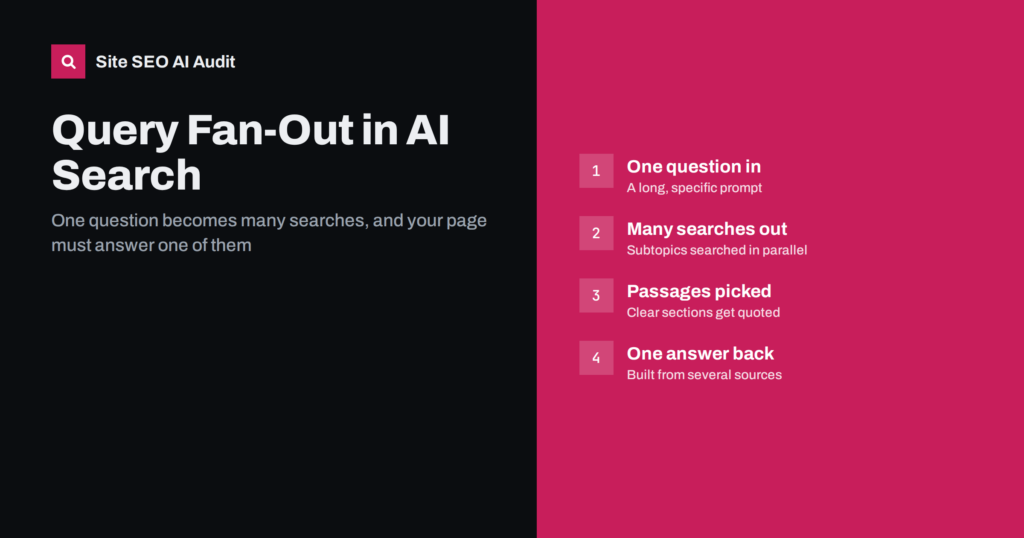
When a user asks something, the system first works out what to search for. Conversational questions are often long, vague or dependent on earlier messages. The system may rewrite the question into clearer search queries, split it into several subquestions, or add context from the conversation. Google has described this as a “query fan-out”, where one question triggers multiple related searches.
This has a practical consequence: your page may be retrieved for a subquestion you never targeted directly. A page that covers a topic and its natural follow-up questions has more opportunities to be found than one that answers a single narrow question.
Stage 4: retrieval and ranking
The system searches its index for candidate pages and passages, often combining keyword matching with meaning-based matching. It then ranks candidates, using signals similar to classic search: relevance to the query, quality and trust signals, freshness where it matters, and diversity of sources.
| Signal type | Examples | What you control |
|---|---|---|
| Relevance | Does the passage answer the question? | Clear headings, direct answers, specific content |
| Quality and trust | Reputation, accuracy, authorship | E-E-A-T signals, consistent facts, citations of sources |
| Freshness | Dates, recent updates | Visible dates, real updates |
| Accessibility | Was the text readable in the index? | Server-rendered HTML, crawler access |
| Diversity | Avoiding many results from one source | Little; it helps smaller sites appear alongside big ones |
Retrieval usually works at passage level. Long pages are split into chunks, and the best chunk is what gets selected. This is why self-contained paragraphs under descriptive headings are so useful.
Ranking systems in AI search are not published in detail, and they differ between products. But the signals in the table are the ones that search engines have described publicly for many years, and there is little reason to believe AI retrieval ignores them. If anything, the need to avoid wrong answers pushes systems towards sources that look reliable.
Stage 5: generating the answer
The selected passages are placed into the model’s working context along with the user’s question and instructions. The model writes an answer that should be grounded in those passages: summarising, combining and sometimes quoting them. Systems are designed to prefer the provided sources over the model’s memory, although mistakes still happen, especially when sources conflict or are ambiguous.
The quality of the input shapes the output. Passages that state facts plainly and name their subject are easy to use correctly. Passages full of vague claims, pronouns and marketing language are more likely to be ignored or misinterpreted.
Stage 6: citations and links
Most AI search products show some of the sources used, as inline references, a list of links or source cards. Which sources are shown depends on the product’s design: some show every source consulted, others only the most relevant. Being cited brings visibility and sometimes clicks; being used without citation still shapes how your brand or topic is described.
Because answers are generated fresh, they vary. The same question can produce different sources for different users, at different times or after small wording changes. That is why single checks are unreliable and patterns over time matter more.
This variability also explains why tracking “rankings” in AI answers is harder than in classic search. There is no fixed position to record. A more useful measure is how often, across many questions and several weeks, your site is cited or your brand is named.
What this means for your site
Each stage suggests a concrete task:
- Crawling: allow the crawlers you want, check CDN and firewall settings, fix errors and redirects, and put content in server-rendered HTML.
- Indexing: use correct canonicals, avoid accidental noindex, consolidate duplicates and keep sitemaps clean, including in Bing.
- Understanding: cover topics thoroughly, including follow-up questions.
- Retrieval: write descriptive headings and self-contained, specific passages.
- Generation: state facts plainly, name things explicitly and keep information consistent.
- Citations: build trust with authorship, dates and a clear brand, and measure referrals and mentions over time.
How Site SEO AI Audit helps
Site SEO AI Audit covers the first stages, where most problems hide. It crawls your site like a search engine, checking status codes, robots.txt, noindex, canonicals, sitemaps and links, and its AI visibility area checks AI crawler access, llms.txt, content that needs JavaScript, and the structure and dates that AI answers quote. Issues are ranked by how many score points each fix adds. You can run a free audit to see where your pages drop out.
Related reading
- What Is Generative Engine Optimization? A Plain Guide
- How to Write Content That AI Answers Actually Quote
- AI Search Visibility Checklist: 25 Things to Audit
- JavaScript SEO Basics: How Search Engines Render Your Pages
The bottom line
AI search is a pipeline: crawl, index, understand, retrieve, generate and cite. Your page must pass every stage to appear in an answer. Make it reachable and readable, keep it indexed, cover topics thoroughly, write clear passages with specific facts and build trust. There are no shortcuts around the pipeline, but each stage has practical fixes.
FAQ
What is retrieval-augmented generation?
It is a method where a system retrieves relevant documents or passages and gives them to a language model, which writes an answer based on them. It keeps answers more current and makes citations possible.
Do AI search engines use their own index?
Some do, some rely on existing search engines such as Google or Bing, and many combine both. Operators rarely publish full details, and the mix can change over time.
Why do AI answers differ between users?
Answers are generated fresh each time, and retrieval can vary with wording, context, location and time. Small differences in retrieved sources lead to different answers and citations.
Do AI search engines read whole pages?
They usually process pages in passages or chunks and select the most relevant ones. That is why clear headings and self-contained paragraphs improve your chances of being used.
Can a page be used without being cited?
Yes. Some products show only a subset of the sources consulted. Your content can influence an answer without appearing as a visible link.