ENEnglish
 LTLietuviškai
 DEDeutsch
 FRFrançais
 RUРусский
 ESEspañol
 PLPolski
 ITItaliano
 UKУкраїнська
 CSČeština
 PTPortuguês
 JA日本語
 LVLatviešu valoda
 ETEesti
 HUMagyar
 IDBahasa Indonesia
 TRTürkçe
 HIहिन्दी
 ELΕλληνικά
 ARالعربية
 THไทย
 VITiếng Việt
 RORomână
 MSBahasa Melayu
 BNবাংলা
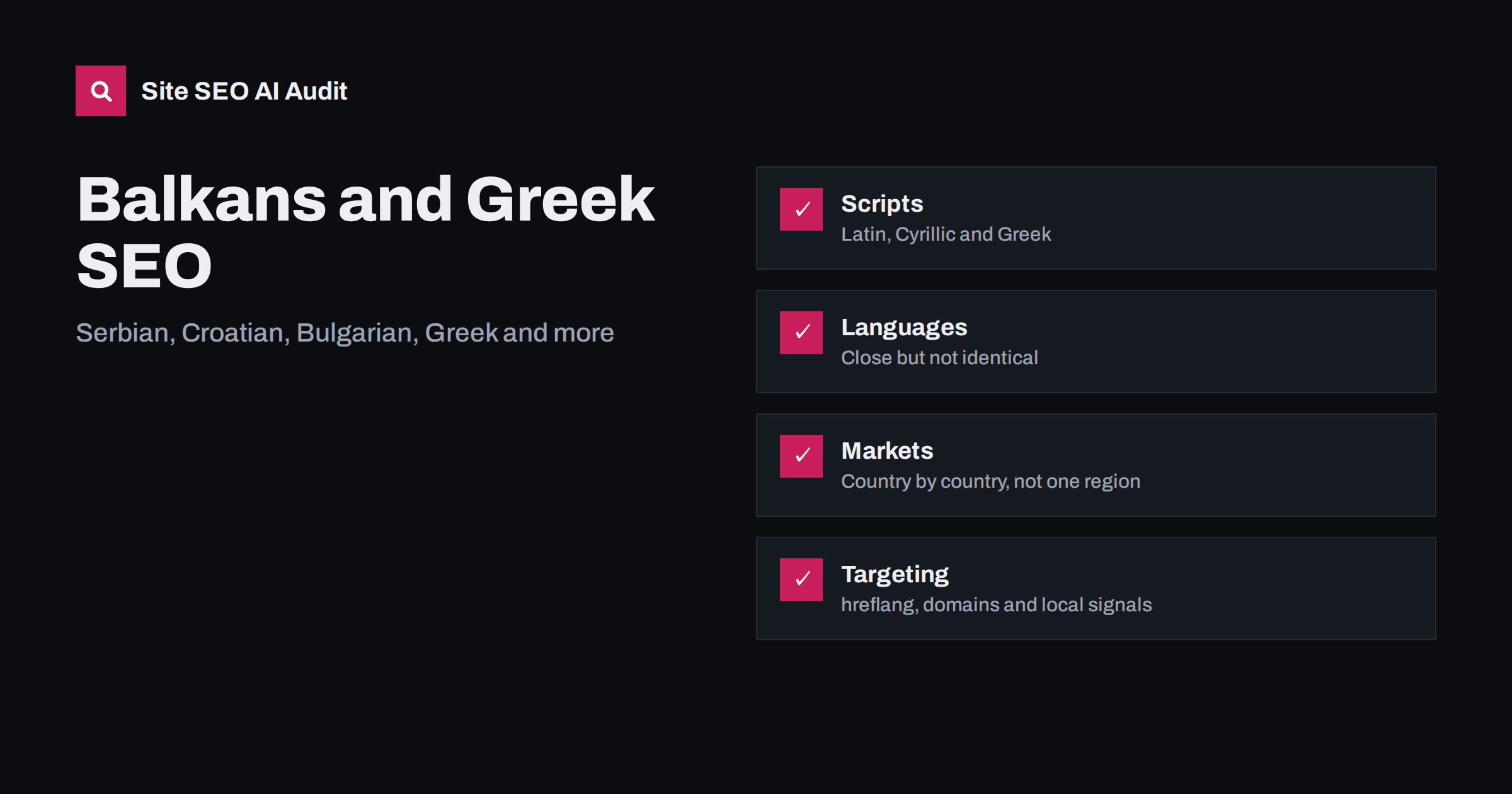
Short answer: The Balkans are not one market. Serbian, Croatian, Bosnian and Montenegrin are closely related and largely mutually understandable, yet each country has its own vocabulary preferences, currency situation, laws and search habits; Bulgarian and Macedonian use Cyrillic; Slovenian and Albanian are separate languages; and Greek has its own alphabet. Serbian is written in both Latin and Cyrillic, so one language can need two scripts. The best approach is to choose the countries you can serve, create a language version for each with local detail, use hreflang with language, script and region where needed, research keywords in the script people actually type, and avoid assuming that one translation covers the whole region. Google is dominant across these markets, so standard technical rules apply.
Companies often see south-eastern Europe as a single region and publish one translation for “the Balkans”. Visitors notice immediately: a page in a neighbouring country’s wording, a price in the wrong currency or a phone number from another country feels foreign, and conversion suffers. Search engines also treat the pages as less relevant for local queries. The opposite mistake is to create five near-identical versions of a Serbo-Croatian text with only small edits, which wastes effort and can produce duplicate content. This guide helps you decide how many versions you need, how to handle scripts and diacritics, and how to target each country properly. Related regional guidance is in the Eastern Europe SEO guide, and the market decision process in choosing target markets.
Languages and scripts
Serbian is officially written in Cyrillic and widely in Latin, and many people use Latin on the web, but a share of users type and read Cyrillic, so keyword research in both scripts is needed. Croatian uses Latin script and has vocabulary choices that differ from Serbian, and Bosnian uses Latin with its own forms; Montenegrin has its own standard. Bulgarian and Macedonian are written in Cyrillic, Slovenian and Albanian in Latin, and Greek in the Greek alphabet, with accents that many users omit when typing queries. Do not transliterate pages automatically and call the result a translation. Decide per country which script to publish as the main version, and test how people search in practice using Search Console data and keyword tools. The challenges of converting between scripts are covered in transliteration and SEO.
One text for several countries, or separate versions?
For Serbian, Croatian, Bosnian and Montenegrin, the answer depends on your business. If you sell locally with local pricing, delivery, legal terms and contact details, separate country versions are justified, even if most of the text is similar, because the details differ and the pages target different countries. If you have an informational site with no local commerce, one version in the most useful variant may suffice, though users in other countries may prefer their own wording. Where you publish similar text for several countries, make sure that each version has unique local elements such as currency, address, support hours and examples, and use hreflang so search engines understand the relationships. Translate carefully rather than swapping a few words, and have a native speaker for each country review key pages. See same language, different countries for the method.
Hreflang for scripts and countries
Use hreflang with language and region, for example sr-RS, hr-HR, bs-BA, sl-SI, bg-BG, mk-MK, sq-AL and el-GR. For Serbian pages in both scripts, the hreflang standard allows a script subtag such as sr-Latn-RS and sr-Cyrl-RS, which lets you declare which version is which. Each script version needs its own address, not a toggle that rewrites the page in the browser, and each needs return links to every other version. Add an x-default for a country chooser or default page. Validate the set with a crawler, since errors in codes and missing return links are the most common failure. Details are in hreflang language codes and hreflang return links.
Keywords, diacritics and Greek search habits
South Slavic languages use diacritics such as č, ć, š, ž and đ, and many users omit them when typing on phones or in a hurry. Search engines often treat the versions as equivalent, yet not always for every query, so write correctly with diacritics on the page, and use search data to see which spelling attracts impressions. Slugs usually look cleaner without diacritics, but choose one rule and apply it consistently. In Greek, accents and capital letters can change how words appear, and users often type without the tonos mark. Make sure the page encoding is UTF-8 throughout, including titles, structured data and URLs, as described in character encoding and SEO. Research demand per country with the method in multilingual keyword research, and write titles and descriptions natively, not as translations of English ones, following how to translate title tags and descriptions.
Domains, hosting and local signals
Country domains such as .rs, .hr, .ba, .me, .si, .bg, .mk, .al and .gr signal local focus and are trusted by local buyers, though registration rules differ and some require a local presence. A subfolder structure on one domain is easier to manage when you serve several countries and want to share authority; it works with hreflang and local content. Hosting close to your audience helps speed, so use a CDN with points of presence in the region. Local signals matter: a local address and phone number, company registration details, prices in the local currency, delivery information and payment methods people use. Check which currency each country uses and show it clearly. See country domain, subdomain or subfolder and local trust signals for country sites.
Search engines, platforms and local competition
Google is the main search engine in all of these countries. Local marketplaces, price comparison sites and classifieds are strong in many of them, and social media and messaging apps influence purchases and local discovery. Business profiles with correct categories and hours matter for local services. In many niches, local competitors have weaker technical SEO than Western European sites, which creates a chance to rank with a fast, well-structured and properly localised website. Do not assume English content is enough: in several countries, English-language searches are common among younger users but local-language searches dominate for everyday products and services.
Content that earns trust
Write for local readers with local examples, institutions and units. Explain delivery times, customs procedures where relevant, warranty terms and how to reach support. Display reviews from local customers, and mention the local legal entity or partner where there is one. Avoid machine translation without review, since errors in a language with case endings and gender agreements are visible and damage trust. Keep versions in sync: when you update prices or terms in one language, update the others, or mark the differences clearly. Publish the same quality of internal links, structured data and metadata on every version.
Plan the rollout in stages instead of launching every country at once. Start with the market that has the clearest demand and the ability to deliver, measure impressions, clicks and conversions by country in Search Console and analytics, and then add the next version using what you learned. Reuse the technical template, but rewrite titles, headings, examples and calls to action for each audience. Keep a simple spreadsheet that maps every page to its equivalents in other languages, with the publication date and the person who reviewed it, so that updates reach all versions. Check once a quarter that hreflang pairs are complete, that translated pages still match the originals and that no version has fallen out of the sitemap. Staged launches keep quality high and avoid the thin, unreviewed pages that make a whole language version look weak. If a version attracts little demand after a reasonable time, improve it or merge it into another version with redirects rather than leaving thin pages online.
Checklist and audit
- Target countries chosen, each with local prices, contacts and delivery.
- Separate addresses for each language and script, with hreflang and return links.
- Keyword research in the scripts and spellings people use.
- UTF-8 everywhere, consistent slugs and correct diacritics on the page.
- Native review for titles, descriptions and key pages.
- Local business profiles and trust signals for every country.
Site SEO AI Audit crawls every language version, checks hreflang codes and return links, lang attributes, broken language pages and duplicate titles, and ranks the fixes by the points they add. The first audit of up to 200 pages is free; for larger multilingual sites see the pricing page.
Related reading
- Eastern Europe SEO Guide
- Transliteration and SEO
- Hreflang Language Codes
- Same Language, Different Countries
The bottom line
Treat the Balkans and Greece as a set of separate markets with their own languages, scripts and habits. Choose the countries you can serve, publish genuine local versions with correct hreflang, research keywords in the right script, write with proper diacritics and add local trust signals. That is how you outrank sites that rely on one generic translation.
الأسئلة الشائعة
Do I need separate sites for Serbian, Croatian and Bosnian?
Not always. If you serve each country with local prices and details, separate versions help. For purely informational content, one well-chosen version may be enough.
Should Serbian pages be in Latin or Cyrillic?
Many users search in Latin, but some use Cyrillic. Check search data, publish the main script as separate addresses and consider offering the other with proper hreflang.
Which hreflang codes fit these markets?
Language plus country, such as sr-RS, hr-HR, bs-BA, sl-SI, bg-BG, mk-MK, sq-AL and el-GR, and script subtags like sr-Latn-RS when you publish both scripts.
Do diacritics matter in search?
Write them correctly on the page. Many users omit them when typing, and search engines often treat the forms as equivalent, but check your own query data.
Is English content enough for these countries?
For some audiences, but everyday products and services are mostly searched in the local language, so local-language pages usually perform better.