ENEnglish
 LTLietuviškai
 DEDeutsch
 FRFrançais
 RUРусский
 ESEspañol
 PLPolski
 ITItaliano
 UKУкраїнська
 CSČeština
 PTPortuguês
 JA日本語
JA日本語 LVLatviešu valoda
 ETEesti
 HUMagyar
 IDBahasa Indonesia
 TRTürkçe
 HIहिन्दी
 ELΕλληνικά
 ARالعربية
 THไทย
THไทย VITiếng Việt
 RORomână
 MSBahasa Melayu
 BNবাংলা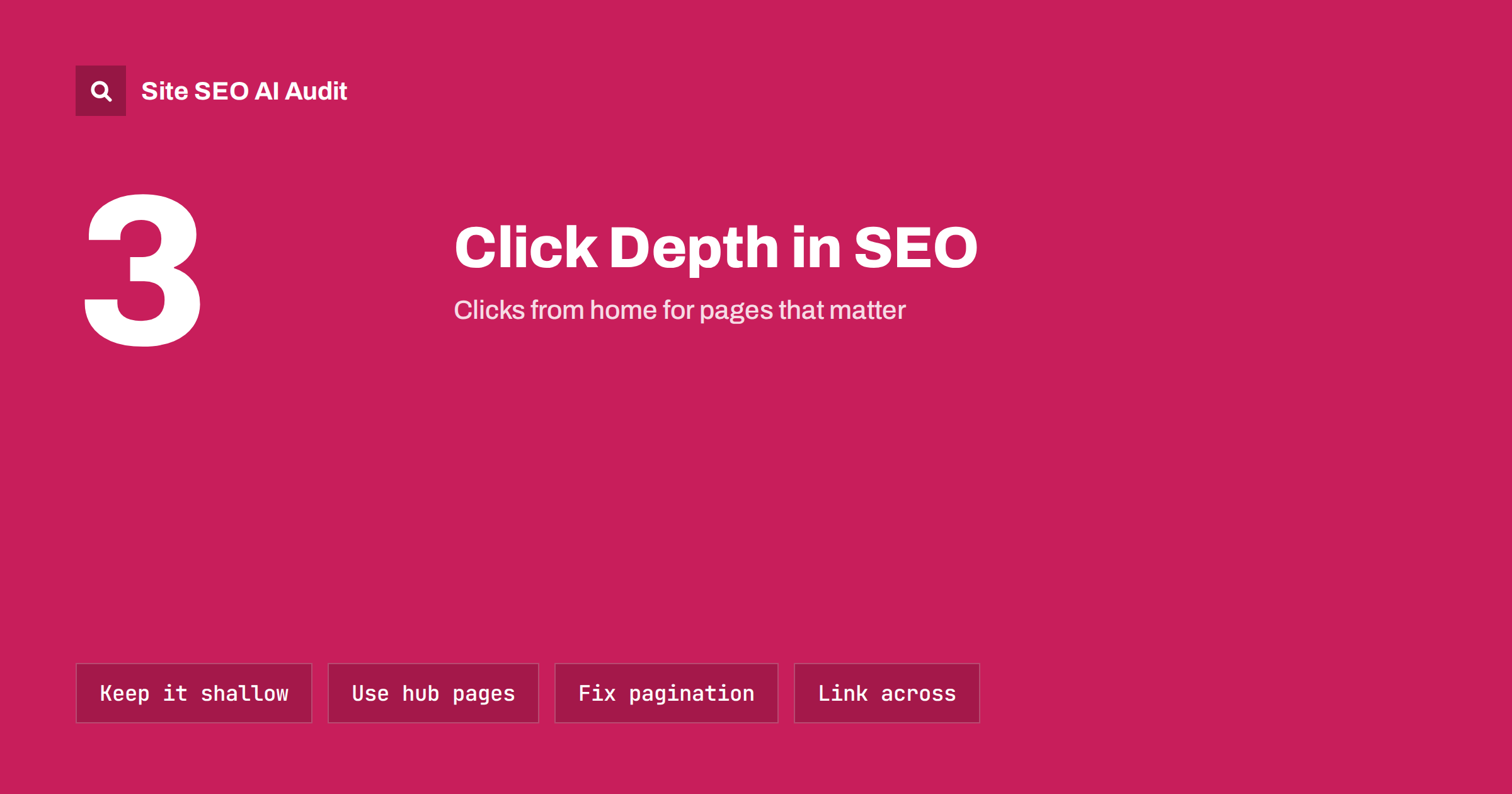
Short answer: click depth is the minimum number of clicks needed to reach a page from the home page by following internal links. Pages close to the home page are usually crawled more often and treated as more important; pages five or more clicks deep often struggle to be crawled, indexed and ranked. Keep important pages within about three clicks by using category and hub pages, related links and sensible pagination.
What click depth measures
Imagine starting on your home page and following only links. The home page has depth 0. Every page linked from it has depth 1. Pages linked from those have depth 2, and so on. A page’s click depth is the shortest path, so a product that is four clicks away through the category tree but also linked from the home page has depth 1.
Click depth is not the same as URL depth. A URL like /shop/men/shoes/running/model-x/ has many folders, but if the home page links to it, its click depth is 1. Search engines care about the link path, not the number of slashes in the address.
Why depth affects SEO
Depth matters for three connected reasons:
- Discovery and recrawling. Crawlers find pages by following links. Pages that sit many levels deep are reached later and revisited less often, so updates to them take longer to be noticed.
- Importance signals. The home page usually has the most external links and the most authority. Authority flows through internal links, and every level of depth spreads it thinner. Pages near the top of the structure get more of it.
- User behaviour. Visitors rarely click through five levels of navigation. If people cannot easily reach a page, it gets fewer visits, fewer shares and fewer links.
Google has said that pages linked from the home page are typically seen as more important than pages many clicks away. That does not mean every page must be one click away, which is impossible on larger sites, but it does mean structure is a signal you control.
What is a healthy click depth?
There is no official number, but a common and practical guideline is:
| Depth | Typical pages | Assessment |
|---|---|---|
| 0–1 | Home, main categories, key services, pillar guides | Your most important pages belong here |
| 2–3 | Subcategories, products, articles, location pages | Healthy for most content |
| 4 | Long-tail products, older articles | Acceptable, but watch important pages |
| 5+ | Deep archives, paginated lists, forgotten pages | Often under-crawled; review what lives here |
On a site with a few hundred pages, almost everything should be within three clicks. Large shops and publishers will inevitably have deeper pages, but their best-selling products and strongest articles should not be among them.
Common causes of deep pages
Pages end up buried in predictable ways:
- Chronological blog archives. With ten posts per page, a post published two years ago on an active blog may be 20 or more pages deep in the archive, which can mean depth 20+.
- Deep category trees. Home → Shop → Men → Footwear → Running → Trail → product is six clicks before the product.
- Pagination with only next and previous links. Each page in the series adds one level of depth.
- Content only reachable through internal search or filters, which crawlers do not use.
- Navigation built with JavaScript that does not output real links, so crawlers see a much thinner structure than visitors.
- Removed menu items after a redesign, which push whole sections down a level or cut them off.
How to measure click depth on your site
You need a crawler that starts at the home page and follows links like a search engine. It records the shortest path to each page and gives you a distribution: how many pages at depth 1, 2, 3 and so on. When reviewing the result:
- Look at the distribution first. A healthy site has most pages in the first three or four levels and a short tail.
- List your important pages (top landing pages from search, best-selling products, key services) and check their depth individually.
- Look at the deepest pages and ask why they are there. Often you find a pagination pattern or a single section responsible for most of them.
- Compare with the sitemap. Sitemap pages that the crawl does not reach at all are orphans, the extreme case of depth.
- Check that the crawl renders navigation the way search engines do, especially if menus are built with JavaScript.
How to reduce click depth
The goal is not a completely flat site, which would mean hundreds of links on the home page and no structure. It is a shallow, logical hierarchy with good cross-links:
- Create hub pages for main topics. A hub page on “technical SEO” or “running shoes” links to all relevant articles or subcategories. Link the hubs from the main navigation.
- Flatten category trees. Merge thin subcategories and link important subcategories directly from their parent and from the navigation.
- Add related links in content. Related posts, “you may also need” product blocks and contextual links in articles create shortcuts across the structure.
- Improve pagination. Show more items per page, link to several page numbers rather than only next and previous, and make sure category pages link to subcategories so items appear in more than one short list.
- Feature important deep pages on the home page or in the footer, for example popular guides or best-selling products.
- Use breadcrumbs. They do not reduce depth to a page directly, but they link each page back up to its parents, strengthening the whole structure and making navigation clearer.
Click depth on WordPress blogs
WordPress sites are a very common case of excessive depth, because the default archive is chronological. A few practical changes help a lot:
- Organise posts into a small number of meaningful categories and link those category pages from the menu.
- Build a pillar page for each main topic that links to the best posts on it.
- Add a related posts block based on category or tags.
- Increase the number of posts per archive page in Settings, Reading if your design allows it.
- Link older evergreen posts from newer ones whenever they are relevant.
These changes also help readers, who are more likely to find your best older content.
Click depth in online shops
Shops face the problem at a larger scale, because catalogues grow faster than navigation. Useful approaches for stores:
- Link best sellers and new arrivals from the home page and from main category pages. These blocks change often, which also gives crawlers a reason to come back.
- Keep category listings sorted sensibly by default. If the default sort pushes your most important products to page six, they are six levels deeper than they need to be.
- Link subcategories at the top of each category page, not only in a sidebar filter that may be built with JavaScript.
- Use brand pages as a second path into the catalogue, so each product is reachable through both a category and a brand.
- Add “similar products” and “frequently bought together” blocks as normal HTML links, creating many short paths between products.
After such changes, compare the depth distribution with the previous crawl. A shift of many products from depth five or six to depth two or three is common and easy to measure.
Mistakes to avoid when flattening
Enthusiastic fixes can create new problems:
- Mega menus with hundreds of links dilute the value of each link and overwhelm visitors.
- Footer link farms listing every page look spammy and help little.
- Changing URLs to “flatten” the site is unnecessary; click depth is about links, not folders. Changing URLs just adds redirects.
- Linking everything from everywhere removes the topical structure that helps search engines understand relationships between pages.
How Site SEO AI Audit reports click depth
The crawl and index area of the audit includes click depth and orphan pages. SEOAuditBot starts from your home page and sitemap, follows links like a search engine and records how many clicks each page is from the home page. Deep pages and weakly linked pages are listed with their URLs, and the score weighs them by how many of your pages are affected. After you add hub pages or related links, a re-audit shows whether the structure improved. See plans and page limits.
Related reading
- Orphan pages: how to find them and what to do with each
- Crawl budget explained: when it matters and how to save it
- Heading structure for SEO: how to use H2 to H6 properly
The bottom line
Click depth is how far a page is from your home page in clicks. Deep pages are crawled less and treated as less important. Keep your key pages within about three clicks, use hub pages, related links and better pagination to shorten paths, and measure depth with a link-following crawl rather than guessing.
الأسئلة الشائعة
Is click depth a ranking factor?
Not as a single named factor, but it strongly influences how often a page is crawled and how much internal authority it receives. Pages close to the home page are generally treated as more important.
What is a good maximum click depth?
Aim for important pages within three clicks of the home page and most other pages within four. Pages at depth five and beyond should be reviewed, especially if they are meant to rank.
Is click depth the same as URL depth?
No. URL depth counts folders in the address, while click depth counts the shortest link path from the home page. A URL with many folders can still be one click from the home page.
Do XML sitemaps solve deep pages?
They help search engines discover deep pages, but they do not give them internal link signals. A page that is only reachable through the sitemap is still treated as less important than a well-linked page.
Does pagination increase click depth?
Yes. Each page in a series adds a level if it is only reachable via next and previous links. Linking to several page numbers, showing more items per page and adding subcategories all reduce the depth of items in long lists.