ENEnglish
 LTLietuviškai
 DEDeutsch
 FRFrançais
 RUРусский
 ESEspañol
 PLPolski
 ITItaliano
 UKУкраїнська
 CSČeština
 PTPortuguês
 JA日本語
JA日本語 LVLatviešu valoda
 ETEesti
 HUMagyar
 IDBahasa Indonesia
 TRTürkçe
 HIहिन्दी
 ELΕλληνικά
 ARالعربية
 THไทย
THไทย VITiếng Việt
 RORomână
 MSBahasa Melayu
 BNবাংলা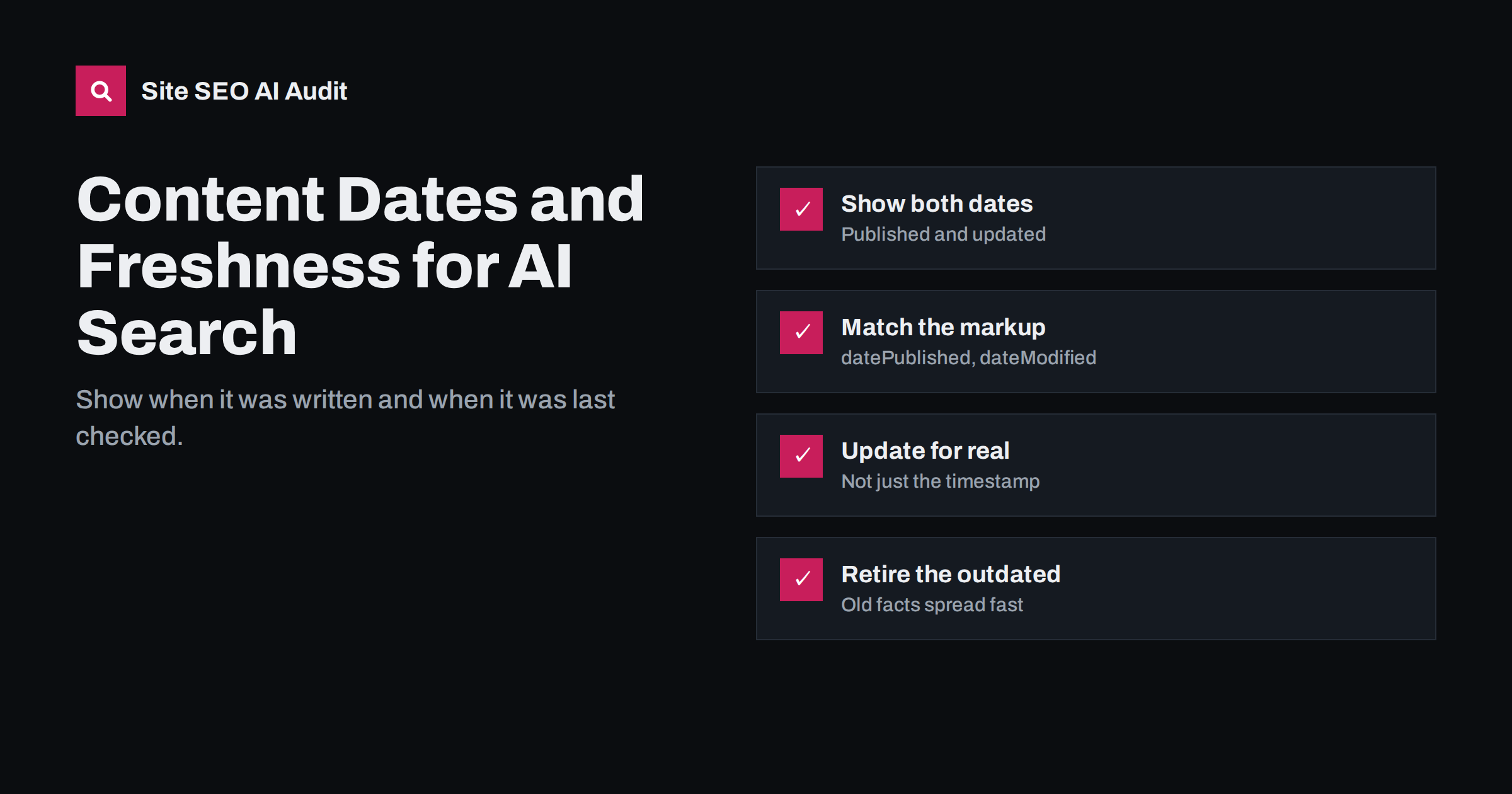
Short answer: Dates help readers, search engines and AI systems judge whether information is still current. For topics that change, such as prices, laws, software or statistics, AI answers tend to prefer sources that are clearly recent and maintained. Show a visible published date and, when you make meaningful changes, an updated date; match them in your structured data; and never change the date without changing the content, because fake freshness damages trust.
Why freshness matters more in AI answers
When a search engine shows a list of links, users see dates next to results and can judge for themselves. When an AI system writes an answer, it makes that judgement for them. If it quotes a three-year-old price or a rule that has since changed, the answer is wrong, and the system looks unreliable. AI developers therefore have strong reasons to favour sources that are demonstrably current for time-sensitive questions.
Google has long used freshness as a factor for queries that deserve it, such as news, recurring events and topics that change frequently, while older evergreen content can rank perfectly well for stable topics. Assistants that search the live web face the same trade-off. For “what is photosynthesis”, age hardly matters. For “current VAT rate for e-books in Germany” or “latest version of WordPress”, it matters a great deal.
Dates are the simplest signal of currency you can give. They do not make content better on their own, but their absence leaves every reader, human or machine, guessing.
Which dates to show
Most content benefits from two dates:
- Published date: when the page first went live. This helps readers understand context, for example that an article was written before a major change.
- Updated date: when the content was last meaningfully revised. This tells readers the information has been checked since publication.
Show both near the top of the article, close to the title or author name, in a clear format such as “Published 3 March 2025 · Updated 12 August 2026”. Avoid relative phrases like “2 days ago” as the only date, because they are ambiguous in cached copies and screenshots, and machines prefer absolute dates.
Some page types do not need visible dates, such as home pages, contact pages or evergreen product category pages. But anything that gives advice, explains rules, lists prices or reports facts should have them.
How to mark up dates correctly
Search engines look at several places to determine a page’s date. Google’s documentation recommends showing a clear date on the page and using structured data consistently with it. Use each of these:
| Where | What to include | Notes |
|---|---|---|
| Visible text | Published and updated dates near the headline | Most important; what users and non-rendering bots see |
| HTML time element | <time datetime="2026-08-12"> around the visible date |
Gives an unambiguous machine-readable value |
| Article structured data | datePublished and dateModified in ISO 8601 format |
Include time zone when you include a time |
| XML sitemap | lastmod for each URL |
Only change it when the content changes |
| Open Graph | article:published_time, article:modified_time |
Used by social platforms and some tools |
The golden rule is consistency. If the visible date says one thing, the markup another and the sitemap a third, search engines have to guess, and they may choose a date you did not intend.
What counts as a real update
An updated date is a promise that the content has been reviewed and revised. Meaningful updates include:
- Correcting facts, prices, figures or rules that have changed.
- Adding new sections that answer questions the page did not cover.
- Replacing outdated screenshots and instructions after a software change.
- Removing advice that no longer applies.
- Reviewing the entire page with an expert and confirming it is still accurate.
Changes that do not justify a new updated date include fixing a typo, changing the theme, adding a related-posts widget, or republishing the same text. Some sites update dates automatically on every edit or even on every page load, which quickly teaches search engines to ignore them.
The risk of fake freshness
Changing dates without changing content is a known tactic, and search engines are aware of it. Google has specifically warned against making superficial changes to pages to make them seem fresh. The risks are practical as well as reputational:
- Readers notice. An article dated last week that refers to “this year’s” events from two years ago loses credibility instantly.
- Machines compare. Search engines keep copies of pages. If the text is identical but the date is new, the date signal is worthless.
- AI answers can spread errors. A page that looks current but contains old facts is exactly the kind of source that produces wrong answers.
Building a content review routine
Freshness is easier to maintain with a simple routine than with occasional big clean-ups:
- Classify content by volatility. Mark each important page as fast-changing (prices, rules, tools), slow-changing (processes, best practices) or evergreen (definitions, history).
- Set review intervals. For example, every three months for fast-changing pages, every year for slow-changing ones, and every two years for evergreen ones.
- Keep a review log with the page, the reviewer, the date and what changed. This makes the updated date honest and verifiable.
- Prioritise by impact. Review pages that receive the most search impressions, AI referrals or conversions first.
- Update or retire. If a page cannot be made accurate, redirect it to a better page or mark it clearly as archived.
Freshness beyond blog posts
Dates are usually discussed for articles, but some of the facts AI answers repeat most often live on other page types. These deserve attention too:
- Pricing pages. Assistants are often asked “how much does X cost”. A line such as “Prices valid from 1 August 2026, excluding VAT” makes it clear which prices apply and when they were set.
- Policies and terms. Shipping, returns, privacy and warranty pages should show an effective date, which is also good legal practice.
- Product and service pages. Availability, specifications and compatibility change. If you cannot keep them current, remove details you cannot maintain rather than leaving them wrong.
- Opening hours and contact details. Seasonal hours and holiday closures should be stated with dates, and removed when they expire.
- Statistics and research. Always say when data was collected, not just when the page was published.
A practical test is to ask an assistant a few factual questions about your own business and compare the answers with your pages. Wherever the answer is outdated, find the source of the old fact, whether on your site or elsewhere, and correct it. Often the culprit is an old blog post or a forgotten landing page that still states last year’s terms.
WordPress date settings to check
WordPress stores both a publish date and a modified date for every post, but whether they appear depends on your theme and SEO plugin:
- Check that your theme displays the published date on posts; some minimal themes hide dates entirely.
- If you want to show updated dates, use a theme option or a small template change rather than editing the publish date manually.
- Check that your SEO plugin outputs
datePublishedanddateModifiedin Article markup, and that they match what is visible. - Be careful with plugins that change modified dates on bulk actions, such as mass category changes, which make every post look freshly updated.
- For pages you deliberately keep undated, make sure the markup does not claim dates you are not showing.
How Site SEO AI Audit helps
Site SEO AI Audit checks whether pages have the structure and dates that AI answers tend to quote, as part of its AI visibility area, and its structured data area flags invalid JSON-LD, including Article markup with problems. The crawl also checks sitemaps, so inconsistencies between pages and sitemap entries show up in one report. On WordPress sites, the fix steps point to the exact settings in wp-admin and your SEO plugin. You can run a free audit to see which pages are missing dates.
Related reading
- How to Write Content That AI Answers Actually Quote
- Does Structured Data Help in AI Search? An Honest Look
- E-E-A-T and AI Search: Showing Real Expertise on the Page
- XML Sitemap Best Practices: What to Include and Leave Out
The bottom line
Dates are a small detail with a large effect on trust. Show published and updated dates on content that gives advice or facts, mark them up consistently, and update the date only when you genuinely update the content. Pair that with a review routine for your most important pages, and your content will stay the kind of source AI answers can rely on.
الأسئلة الشائعة
Do AI answers prefer newer content?
For topics that change over time, systems tend to favour sources that are clearly current, because outdated facts produce wrong answers. For stable topics, a well-written older page can still be a strong source.
Should I show the published date, the updated date or both?
Show both when the page has been meaningfully updated. The published date gives context, and the updated date shows the content has been checked since.
Can I update the date without changing the content?
You should not. Search engines keep copies of pages and can see that nothing changed, and readers lose trust when a recently dated page contains old information.
What date format should structured data use?
Use ISO 8601, for example 2026-08-12 or 2026-08-12T09:30:00+03:00 with a time zone. The value should match the date shown on the page.
Should every page on my site have a date?
No. Home, contact and some evergreen category pages do not need visible dates. Articles, guides, news and pages with prices, rules or statistics should have them.