ENEnglish
 LTLietuviškai
 DEDeutsch
 FRFrançais
 RUРусский
 ESEspañol
 PLPolski
 ITItaliano
 UKУкраїнська
 CSČeština
 PTPortuguês
 JA日本語
 LVLatviešu valoda
 ETEesti
 HUMagyar
 IDBahasa Indonesia
 TRTürkçe
 HIहिन्दी
 ELΕλληνικά
 ARالعربية
 THไทย
 VITiếng Việt
 RORomână
 MSBahasa Melayu
 BNবাংলা
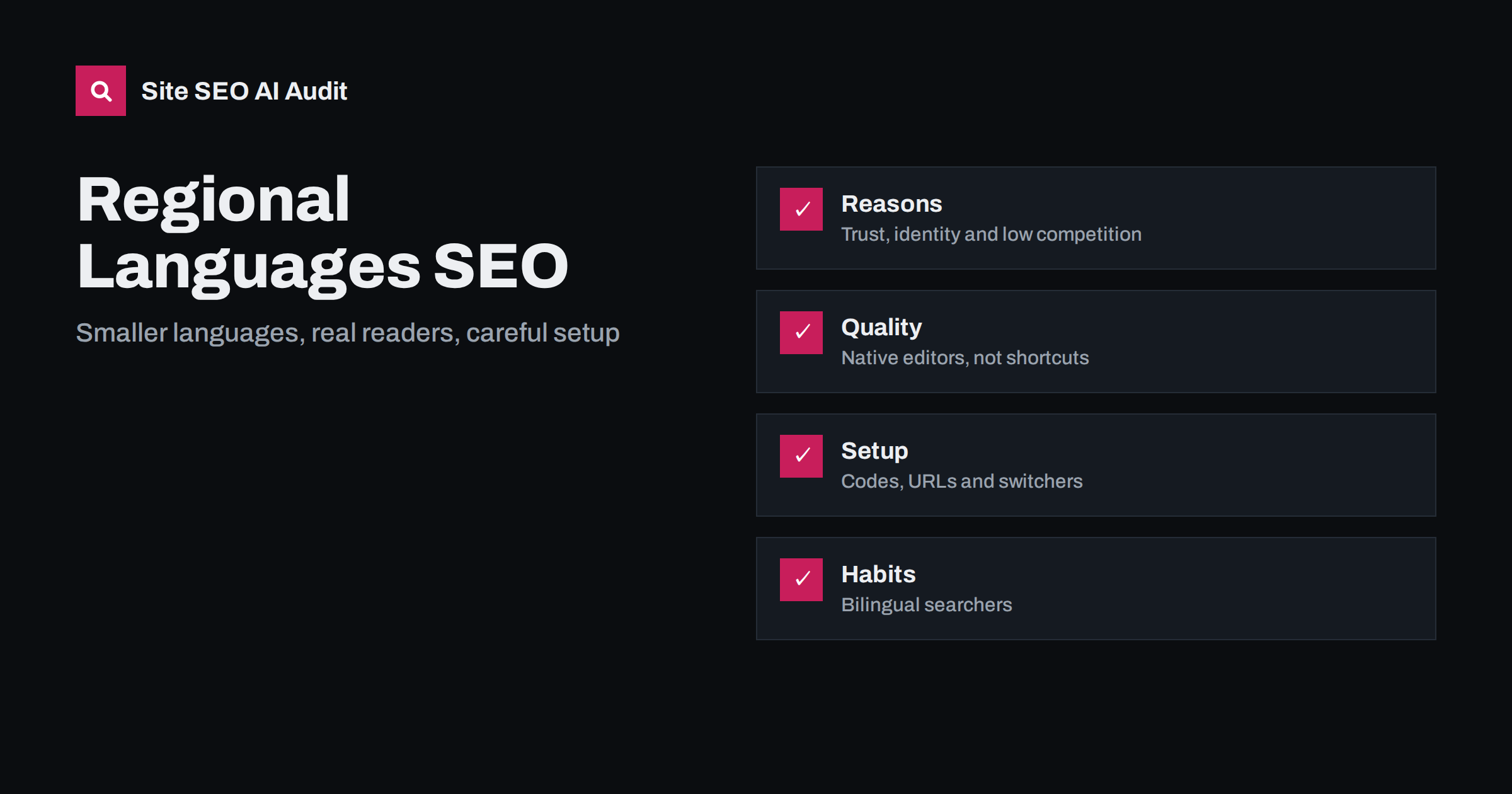
Short answer: A regional or minority language version can win loyal readers and face less competition, but only if the text is written or edited by fluent speakers. Choose the language because your audience expects it, give each version its own address, use the correct language codes in the language attribute and hreflang annotations, add a visible language switcher that shows each language in its own name, and keep the translated pages current. Do not rely on automatic translation or on redirects by browser language. Many readers are bilingual and may search in the larger language, so measure before you invest.
Catalan, Basque, Galician, Welsh, Irish, Scottish Gaelic, Breton, Frisian and many other regional languages are used daily by millions of people, and many of them use the internet in two languages. Public bodies, schools, shops, tourism businesses and local brands often publish in these languages, sometimes because the law requires it and sometimes because readers value it. For search, such versions create special questions: how many people search in the language, which codes to use, how to keep quality high with few professional translators and what to do when readers mix languages. This guide explains the practical steps. For the general foundations, see international SEO for beginners.
Decide whether the language is worth it
Start with the audience, not with the technology. Ask who would read the pages, how they search, what they currently find and whether they would prefer your content in their own language. For some businesses the answer is clear: a public service, a school, a local newspaper, a tourism board, a cultural institution or a company that sells to a community that values its language. For others, the larger language already serves most readers. Estimate the demand with your own data, such as visitors from the region and their browser language, and with search suggestions and keyword tools, remembering that tools often show low or missing volumes for smaller languages. A language version also creates a long-term cost, since every page that is added or changed must be maintained. The reasoning is similar to choosing which markets to target first.
Understand how bilingual readers search
Many speakers of regional languages are bilingual and may type queries in the larger national language, even though they prefer to read in their own. Some use both depending on the topic or device. Others search in English for technical subjects. This means a missing impression in one language does not prove that no one wants the content. Look at the queries that bring visitors, the language of their browsers and the language of the pages they read most. Test by publishing a small, important set of pages and comparing results, instead of translating the whole site at once. Interface language, spelling variants and local words also differ, as covered in transliteration and SEO and multilingual keyword research.
Protect translation quality
Quality is the largest risk. Automatic translation tools often perform worse in smaller languages, because they have less data to learn from, and errors in grammar, terms or tone are obvious to native readers. A poor page harms the brand more than a missing one. Use professional translators or fluent staff, let a native speaker review every page and keep a glossary and style guide that settle spelling, formal or informal address, regional vocabulary and how to treat names and technical terms. If you use machine translation for a first draft, make sure that a skilled editor revises it, as described in machine translation and SEO. Prefer fewer, excellent pages over many weak ones. Keep a plan for updates, as in keeping translations in sync.
Use the right language codes
The language attribute and hreflang annotations help machines understand which version is which. Use the standard two-letter codes where they exist, such as ca for Catalan, eu for Basque, gl for Galician, cy for Welsh, ga for Irish, gd for Scottish Gaelic, br for Breton and fy for Frisian. Add a region only when you really have separate versions for different regions, for example when a language is used in several countries with different content. Some regional varieties do not have a code that search engines accept in hreflang. In that case, use the code of the main language and explain the variety in the page text. Always check the current documentation of the search engine, and test the annotations, as shown in the hreflang language and region codes reference. Make sure the visible text really is in the declared language, because engines also detect it from the content, as in how Google detects the language of a page.
Give each version its own address and links
Publish each language on its own URL, usually a subfolder such as a language prefix or a subdomain, and avoid serving several languages from one address through cookies or scripts. Connect all versions with hreflang annotations that include a self-reference and return links, and add an x-default annotation for the page that should be shown when no version matches the reader. Link between versions with normal links, and keep navigation and internal links inside each language, so that a reader who starts in Basque does not suddenly land on a page in another language. If some pages are not translated, do not create empty copies. Show the original language and explain it, as recommended in what to do with untranslated pages. For the technical details, see the hreflang tags guide.
Build a clear language switcher
Let readers choose. Add a visible switcher that lists each language in its own name, such as Català, Euskara, Cymraeg or Gaeilge, not only the name in the current language and not only as flags, because flags represent countries, not languages. Place it in a consistent location and make it link to the same page in the other language when it exists, or to the home page of that language when it does not. Do not redirect visitors automatically based on location or browser language, since that blocks crawlers and frustrates travellers and bilingual readers. Remember the choice with a cookie if you like, but always allow an easy change. The details are covered in language switcher best practices and why automatic language redirects hurt.
Keep content complete and consistent
A regional-language site should not be a thin shell. Translate the elements that readers use: navigation, buttons, forms, error messages, titles, descriptions, headings, image alt text, structured data text and legal pages. Mixed pages, where the body is translated but menus and buttons are not, look unfinished and confuse search engines. Keep the structure of the versions similar so that readers find the same things in the same place. Adapt, rather than only translate, local examples, dates, units and names, as described in translation vs localization. If your legal setting requires public information in a regional language, make sure those pages are accurate and kept up to date.
Handle official status and legal context carefully
The legal position of regional languages differs by country and region. In some places, public services must offer information in more than one language, and in others the use is voluntary. Do not assume the rules; check them with a qualified adviser when you publish public notices, contracts, product labelling or consumer information. Use the officially accepted names for places and institutions in each language, and keep them consistent. Be respectful in choices that carry cultural meaning, such as spelling, dialect and place names, and ask native readers if you are unsure. Avoid taking a political position in marketing copy, and focus on being clear and accurate for the reader.
Measure and improve results
Track each language separately. In Search Console, filter by page folder and compare impressions, clicks and queries; in analytics, check the language and country of visitors, the pages they open and where they leave. Small languages produce small numbers, so look at trends over months and compare with the same pages in the main language. Ask readers for feedback on wording, and fix errors quickly. Review the results each quarter and decide which pages to extend, update or remove. Track also whether visitors switch language after landing, which suggests the wrong version appeared in search. A reporting approach is in international SEO reporting KPIs.
Site SEO AI Audit crawls a multilingual site like a search engine, checks the language attribute, hreflang annotations and return links, canonicals, titles, status codes and speed on each page, and ranks the fixes by the points they add. The first audit of up to 200 pages is free; larger sites can see the pricing page.
Related reading
- SEO for Multilingual Countries
- Canada SEO Guide
- Spanish SEO for Several Markets
- Launching a New Language Version
The bottom line
Regional languages can build trust and reach loyal readers, but only with fluent writing and a careful setup. Check demand, publish a focused set of pages, use the right codes and separate addresses, let readers switch languages freely and measure each language on its own.
الأسئلة الشائعة
Is it worth translating a site into a regional language?
It can be, when your audience expects it or when competition in that language is low. Start with the most important pages, check the results and extend gradually.
Can I use machine translation for a minority language?
Use it with great care. Quality is often lower for smaller languages, so a fluent editor must review every page before publication.
Which code do I use for a regional variety?
Use the standard code of the main language, and add a region only for real regional versions. Check the search engine documentation, because not all variety tags are accepted.
Should I redirect visitors to their browser language?
No. Automatic redirects block crawlers and frustrate bilingual readers. Show a visible switcher and let people choose.
What if search tools show no volume for my language?
Tools often underreport smaller languages. Use your own search data, test a few pages and compare results before deciding to translate more.