ENEnglish
 LTLietuviškai
 DEDeutsch
 FRFrançais
 RUРусский
 ESEspañol
 PLPolski
 ITItaliano
 UKУкраїнська
 CSČeština
 PTPortuguês
 JA日本語
 LVLatviešu valoda
 ETEesti
 HUMagyar
 IDBahasa Indonesia
 TRTürkçe
 HIहिन्दी
 ELΕλληνικά
 ARالعربية
 THไทย
 VITiếng Việt
 RORomână
 MSBahasa Melayu
 BNবাংলা
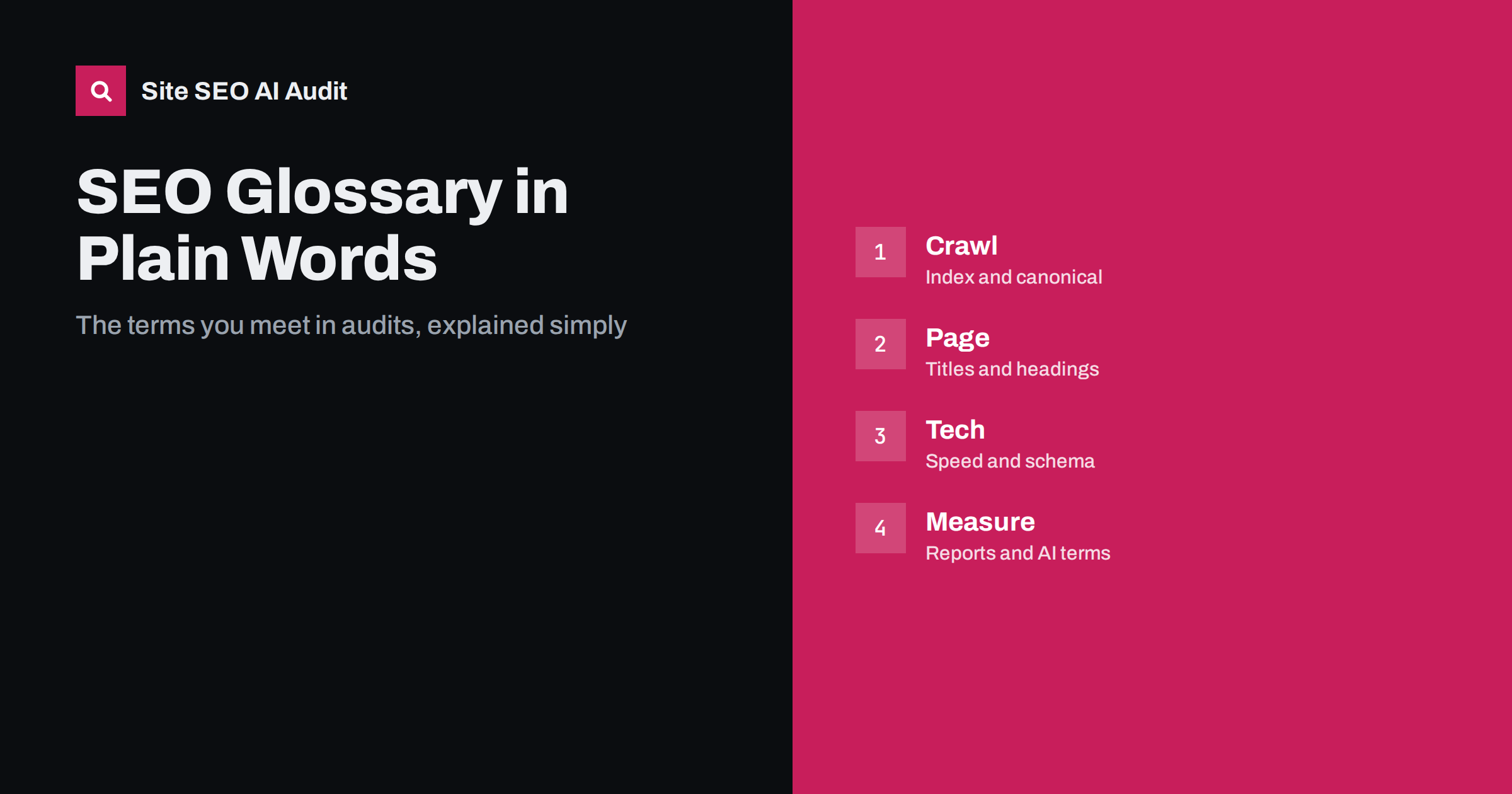
Short answer: This glossary explains the most common SEO terms in plain words, grouped by topic: crawling and indexing, on-page, links, technical and speed, structured data and languages, AI search, and measurement. Each entry says what the term means, why it matters and where to learn more. Use it when an audit report, an agency email or a developer uses a word you do not recognise, and bookmark it for new team members.
SEO is full of abbreviations and borrowed words. Some terms have exact technical meanings, others are used loosely, and a few mean different things to different people. When everyone on a project uses the same words in the same way, meetings are shorter, tickets are clearer and mistakes are rarer. The entries below are written for owners, editors and developers who are not specialists. They are grouped so that you can read a section at a time. For a smaller glossary on one subject, see the international SEO glossary.
Crawling and indexing
Crawler (bot, spider). A program that follows links and downloads pages. Search engines and audit tools both use crawlers. Crawling. The act of fetching pages. Crawl budget. The number of pages a search engine is willing and able to fetch from a site in a period; it matters mostly for very large sites.
Index. The database in which a search engine stores pages it has processed and may show in results. Indexing. Adding a page to that database. A page can be crawled and still not be indexed. Indexable. A page that returns a success status, is not blocked and is allowed to be indexed.
robots.txt. A text file at the root of a site that tells crawlers which paths they may fetch. It controls crawling, not indexing. Noindex. A directive, in a meta tag or header, asking search engines not to show a page in results. Sitemap. A file that lists the URLs you want search engines to know about. Orphan page. A page that no other page links to. Click depth. The number of clicks needed to reach a page from the home page.
Status codes and redirects
Servers speak to browsers and crawlers in short numeric messages, and knowing a few of them removes much of the mystery from audit reports.
Status code. A number that a server returns with each response. 200 means success. 301 means moved permanently and 302 means moved temporarily. 404 means not found, 410 means gone for good and 5xx codes mean a server error. Soft 404. A page that shows a not-found message but returns a success code, which confuses search engines.
Redirect. An instruction that sends a visitor from one URL to another. Redirect chain. Several redirects in a row, which slow pages and waste crawling. Redirect loop. Redirects that point back to each other so that the page never loads. The differences between types are covered in the guide to 301 and 302 redirects.
On-page terms
Title tag. The headline of a page in search results and browser tabs. Meta description. A short summary that may appear under the title; search engines sometimes rewrite it. H1. The main heading visible on the page. Heading structure. The order of H1 to H6 headings that outlines the content.
Alt text. A description of an image for people who cannot see it and for machines. Anchor text. The clickable words of a link. Keyword. A word or phrase people type into search. Search intent. What the searcher actually wants to do or learn. Thin content. Pages with little original value. Duplicate content. The same or very similar text at more than one URL. Keyword cannibalization. Several of your pages competing for the same query.
الروابط
Links connect pages to each other and sites to each other, and they are how crawlers discover most of the web.
Internal link. A link from one page of your site to another. External link. A link to another site. Backlink. A link from another site to yours. Broken link. A link that leads to an error page. Nofollow, sponsored, UGC. Attributes that tell search engines how to treat a link, for example paid links or user-submitted links.
Link equity. The idea that links pass value from one page to another. Anchor text profile. The mix of words other sites use to link to you. Disavow. A way to tell a search engine to ignore certain links, needed only in rare cases. Link building. The work of earning links, which should be honest and relevant.
Technical and speed terms
Canonical tag. A tag that names the preferred URL when several URLs show the same content. Rendering. The process of turning HTML, styles and scripts into the page a visitor sees. JavaScript SEO. Making sure content produced by scripts can be found and read. Mobile-first indexing. Search engines mainly use the mobile version of a page.
Core Web Vitals. Google’s measures of loading, responsiveness and visual stability. LCP measures how fast the main content appears, INP how quickly the page responds to input and CLS how much the layout jumps. TTFB. Time to first byte, the delay before the server starts sending a page. Lab data. Measurements in a controlled test. Field data. Measurements from real visits. Start with the explanation of Core Web Vitals if these are new.
Structured data and languages
Structured data. Code that describes the meaning of a page in a standard format. Schema.org. The shared vocabulary for that code. JSON-LD. The most common format, placed in a script block. Rich result. A search result with extra features, such as ratings, which structured data may allow. Open Graph. Tags that control how a page looks when shared on social networks.
hreflang. Annotations that tell search engines which language or country version of a page to show to which users. x-default. The fallback version for users who match no listed language. Return links. The requirement that each language version points back to the others. ccTLD. A country-code domain ending, such as .de or .fr. Localization. Adapting content to a market, beyond translation.
AI search terms
This vocabulary is newer and still changing, so check the date of any source you rely on.
AI search. Search experiences where an AI system writes an answer from retrieved sources. AI Overviews. Google’s AI-written summaries at the top of some results. GEO (generative engine optimization). Making content easy for generative systems to find and quote. Citation. A source named or linked in an AI answer. AI crawler. A bot that collects pages for AI products, which you can allow or block in robots.txt. llms.txt. A proposed file that lists key pages for language models. Entity. A distinct thing, such as a company or person, that search systems recognise. E-E-A-T. Experience, expertise, authoritativeness and trustworthiness, the qualities quality raters look for.
Measurement terms
SERP. The search engine results page. Impression. A result shown to a searcher. Click-through rate (CTR). Clicks divided by impressions. Average position. The mean place of your result for a query. Organic traffic. Visits from unpaid results. Search Console. Google’s free tool for seeing how your site performs in search. Audit. A structured review of a site’s SEO health. Audit score. A number summarising that review.
In Site SEO AI Audit, the score weighs issues by severity and by the share of pages affected, across seven areas. You can see it on a real site by running the first audit, up to 200 pages, for free, and the logic is explained in the article on how the score is calculated.
Terms that are often confused
A few pairs cause most misunderstandings. Crawling and indexing are different steps, so a page that was visited by a bot is not necessarily in the index. Robots.txt and noindex are different tools, and using both on one page can hide the noindex instruction from the crawler. A redirect and a canonical tag both point to a preferred URL, but a redirect moves the visitor while a canonical only suggests which version to index.
Lab data and field data are also mixed up. A speed test in a tool is a controlled experiment, while Core Web Vitals reports in Search Console describe what real visitors experienced. Both are useful, but they can disagree. Finally, keyword and search intent are not the same: the first is the wording, the second the need behind it. Two people typing the same words may want different pages.
When a report uses a term you do not understand, ask for the plain meaning and an example from your own site. A good consultant or tool will give you one, and the habit keeps the work grounded in what actually changes on the pages.
Related reading
The bottom line
Shared vocabulary makes SEO work faster; learn the core terms by group and return to this glossary when a report uses an unfamiliar word.
الأسئلة الشائعة
What is the difference between crawling and indexing?
Crawling is fetching a page. Indexing is storing it so it can appear in results. A page can be crawled and not indexed.
Is noindex the same as a robots.txt block?
No. Robots.txt controls fetching, while noindex asks engines not to show a page. A blocked page cannot be read, so its noindex may never be seen.
What does canonical mean?
It names the preferred URL for content available at several addresses, which helps avoid duplicates.
Which Core Web Vitals should I learn first?
Start with LCP for loading, INP for responsiveness and CLS for visual stability.
What is GEO?
Generative engine optimization is the practice of making content easy for AI answer systems to find, understand and cite.