ENEnglish
 LTLietuviškai
 DEDeutsch
 FRFrançais
 RUРусский
 ESEspañol
 PLPolski
 ITItaliano
 UKУкраїнська
 CSČeština
 PTPortuguês
 JA日本語
JA日本語 LVLatviešu valoda
 ETEesti
 HUMagyar
 IDBahasa Indonesia
 TRTürkçe
 HIहिन्दी
 ELΕλληνικά
 ARالعربية
 THไทย
THไทย VITiếng Việt
 RORomână
 MSBahasa Melayu
 BNবাংলা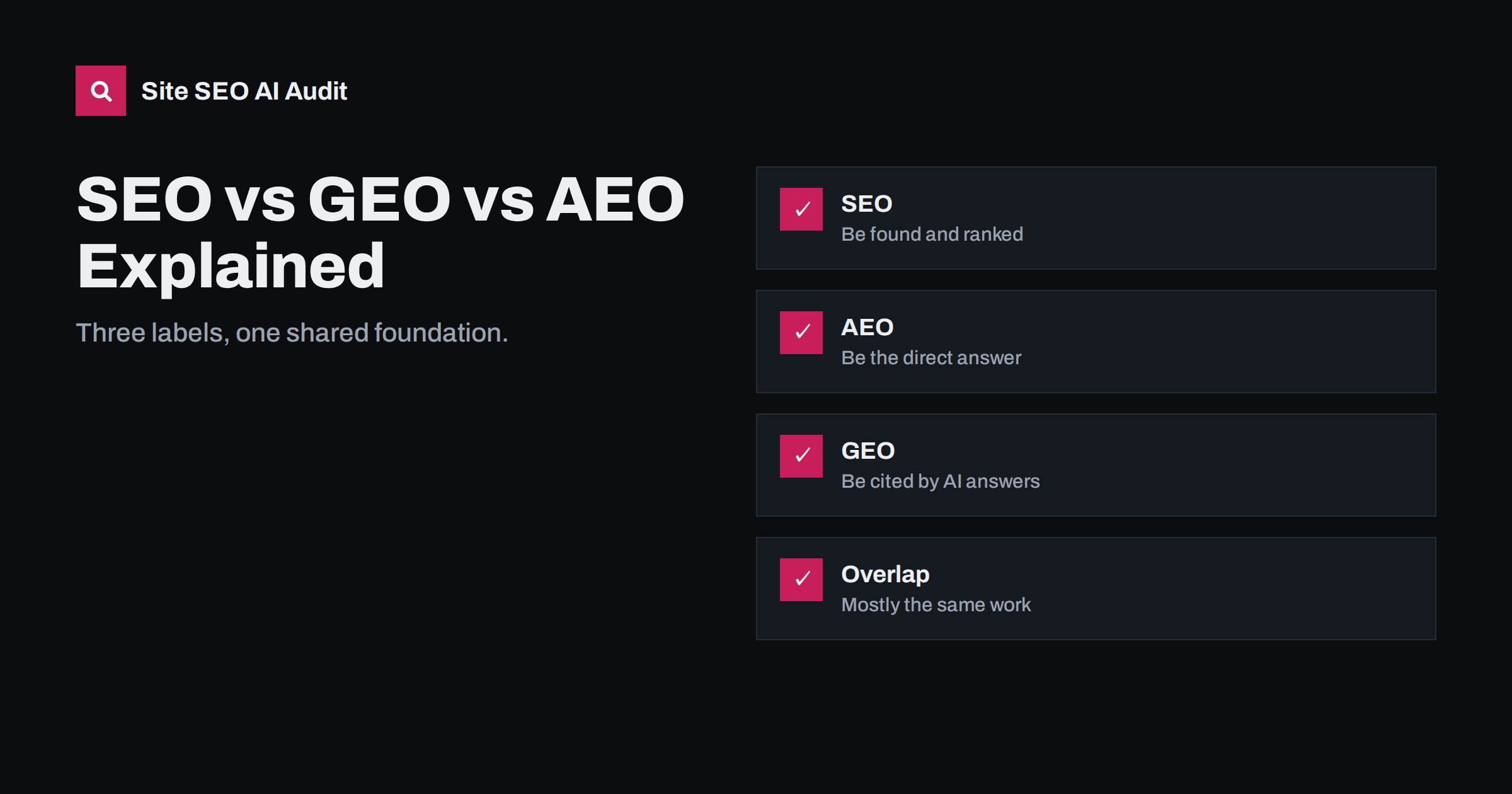
Short answer: SEO (search engine optimization) is the practice of making pages findable and competitive in search engines. AEO (answer engine optimization) focuses on being chosen as the direct answer, originally in featured snippets and voice assistants. GEO (generative engine optimization) focuses on being used and cited in AI-generated answers. All three rest on the same foundation: crawlable, indexed, clear and trustworthy pages. The differences are mostly in emphasis and in how success is measured, not in a separate set of techniques.
Where each term comes from
SEO has been in use since the 1990s, when site owners began working to improve their visibility in early search engines. Over time it came to cover technical work (crawling, indexing, site structure, speed), on-page work (content, titles, headings), and off-page work (links, brand, reputation).
AEO became popular in the late 2010s, as featured snippets, “People also ask” boxes and voice assistants started answering questions directly. The goal shifted from ranking a link to being the answer that is read out or shown at the top. Techniques emphasised question-based headings, concise answers and structured formats such as lists and tables.
GEO appeared in 2023, partly from an academic paper that studied how content changes affect citation in generative AI answers. It spread quickly as AI assistants and AI Overviews became mainstream. Related labels include LLMO (large language model optimization), AIO (AI optimization) and simply “AI SEO”.
The succession of labels says more about how search results have changed than about new disciplines. Each time results gained a new format, a new term appeared to describe optimising for it, while the underlying work stayed recognisably the same.
Side by side
| Aspect | SEO | AEO | GEO |
|---|---|---|---|
| Main goal | Rank pages and earn clicks | Be the direct answer | Be used and cited in AI answers |
| Typical surfaces | Search results pages | Featured snippets, voice answers, answer boxes | AI Overviews, AI Mode, chat assistants, answer engines |
| Unit of competition | Page | Short answer passage | Passage, plus brand and facts |
| Key technical needs | Crawling, indexing, speed, structure | Same, plus snippet eligibility | Same, plus AI crawler access and raw HTML content |
| Main success metrics | Rankings, clicks, conversions | Snippet ownership, answer presence | Mentions, citations, AI referrals |
The table shows differences in emphasis, not in kind. Every column starts with the same requirement: a page that search systems can reach, read and trust.
How much they overlap
In practice, the overlap is large. Consider what each discipline recommends:
- Make pages crawlable and indexable. Required for all three. An answer engine or AI assistant cannot use a page it cannot reach.
- Match content to intent. Central to all three.
- Answer questions clearly and early. The core of AEO, strongly recommended in GEO, and good SEO practice.
- Use descriptive headings and structured formats. Common to all three.
- Build trust and authority. Links, reviews, expertise and consistent brand facts matter in all three.
- Keep content accurate and current. Essential everywhere, and more visible when answers quote you.
Google’s own guidance for its AI features says that the same SEO best practices apply and that no special optimisation is required. That is a strong signal that, at least for Google, GEO is SEO applied to a new presentation of results.
What is genuinely different
There are real differences, and they are worth knowing:
- More crawlers to consider. AI companies run their own crawlers, and robots.txt, CDN and firewall settings must be checked for each one.
- Rendering matters more. Many AI crawlers do not execute JavaScript, so content that Google renders eventually may be invisible to them.
- Passages compete, not pages. AI retrieval often selects chunks, so self-contained paragraphs and clear sections matter more than overall page length.
- Brand mentions carry value without clicks. Being named in an answer is visibility even when nobody visits.
- Measurement is harder. There are no stable rankings in AI answers, so visibility is measured through mention and citation rates, referrals and branded demand.
- Other indexes matter. Several assistants rely on Bing or their own crawls, so being indexed only in Google is not enough.
One page through three lenses
A concrete example makes the relationship clearer. Imagine a plumbing company’s page about fixing a leaking kitchen tap.
- Through the SEO lens, the page needs to be indexed, load quickly on mobile, have a clear title and heading, cover the topic well and be linked from the site’s service pages. Success means ranking for “leaking kitchen tap repair” and similar searches, and turning visits into bookings.
- Through the AEO lens, the page needs a short, direct answer near the top: the usual causes, whether it is a DIY job and when to call a plumber. Success means that answer appearing as a featured snippet or being read out by a voice assistant.
- Through the GEO lens, the page must also be readable by AI crawlers without JavaScript, contain self-contained passages with specific facts such as typical repair times and price ranges, and name the business in those passages. Success means being cited or mentioned when someone asks an assistant what to do about a dripping tap in their city.
The improvements overlap almost completely. One well-made page serves all three goals, and the extra GEO steps are small additions rather than a different project.
Which label should you care about?
For most businesses, the label matters much less than the work. A practical view:
- If you already do solid SEO, add the AI-specific checks: crawler access, raw HTML content, Bing indexing, passage-friendly writing, brand consistency and AI referral tracking.
- If your SEO foundations are weak, fix those first. GEO tactics on top of blocked, slow or thin pages will not help.
- If you publish content for a living, think carefully about the trade-off between being quoted and being visited, and about which crawlers to allow.
- If you sell products or services, being named accurately in answers is valuable, so focus on clear facts, comparisons and reputation.
Whichever situation you are in, measure before and after. Without a baseline, it is impossible to tell whether new work under any label made a difference.
Evaluating services sold under these labels
New labels are often used to sell old services at new prices, or to sell tactics that do not work. When evaluating a GEO or AEO offer, ask:
- What exactly will be checked and changed on our site?
- How will you measure results, and how do you handle the variability of AI answers?
- Which of your recommendations differ from standard SEO, and why?
- Do you guarantee placement? (A guarantee is a warning sign.)
- Do you use hidden text, prompt injection or other manipulative tactics? (The answer should be no.)
Good providers answer these questions plainly and treat AI visibility as part of a broader search strategy rather than a separate magic trick.
It is also reasonable to ask for examples of past work and to speak to a previous client. Providers with real experience can usually show what they changed and what happened afterwards, including the cases where results were modest.
A combined checklist
If you want one list that covers all three labels, it looks like this: crawler access for search and AI bots; server-rendered content and real links; clean indexing in Google and Bing; content that answers questions directly with specific facts; descriptive headings and self-contained passages; structured data that matches the page; visible authors and dates; consistent brand facts across the web; genuine reviews and mentions; and measurement that includes clicks, impressions, AI referrals and answer checks. Nothing on the list is exclusive to one label, which is the clearest sign of how much they share.
How Site SEO AI Audit helps
Site SEO AI Audit does not treat these as separate disciplines. One crawl scores your site across seven areas: crawl and index, on-page, links, speed, structured data, languages and AI visibility. The AI visibility area checks AI crawlers in robots.txt, llms.txt, content that needs JavaScript, and the structure and dates AI answers quote, while the other areas cover the SEO foundations every label depends on. You can run a free audit to see all of it in one report.
Related reading
- What Is Generative Engine Optimization? A Plain Guide
- AI Search Myths: What Does Not Help Your Visibility
- Featured Snippets: How to Structure Content to Win Them
- What Is Technical SEO? A Plain Guide for Site Owners
The bottom line
SEO, AEO and GEO describe the same goal from different angles: being found, being the answer and being cited. They share almost all of their foundations. Keep doing SEO well, add the AI-specific checks for crawlers, rendering, passages, brand facts and measurement, and judge any service by what it actually does rather than by the label it uses.
الأسئلة الشائعة
Is GEO replacing SEO?
No. AI answers depend on crawlable, indexed and trustworthy pages, which is what SEO builds. GEO adds attention to AI crawlers, passages and citations on top of that foundation.
What is the difference between AEO and GEO?
AEO focuses on being the direct answer in snippets and voice results, while GEO focuses on being used and cited in AI-generated answers. The techniques overlap heavily, especially clear, question-based content.
Do I need separate strategies for SEO, AEO and GEO?
Usually not. One search strategy that includes AI crawler access, answer-first content, brand consistency and broader measurement covers all three.
Are LLMO and AIO different from GEO?
They are alternative names for similar ideas: optimising content and sites for use by language models and AI answers. The practical work is essentially the same.
How do I measure GEO success?
Track AI referral traffic, mention and citation rates across a fixed set of questions, crawler activity in logs and branded search trends. Classic SEO metrics remain important alongside them.