ENEnglish
 LTLietuviškai
 DEDeutsch
 FRFrançais
 RUРусский
 ESEspañol
 PLPolski
 ITItaliano
 UKУкраїнська
 CSČeština
 PTPortuguês
 JA日本語
JA日本語 LVLatviešu valoda
 ETEesti
 HUMagyar
 IDBahasa Indonesia
 TRTürkçe
 HIहिन्दी
 ELΕλληνικά
 ARالعربية
 THไทย
THไทย VITiếng Việt
 RORomână
 MSBahasa Melayu
 BNবাংলা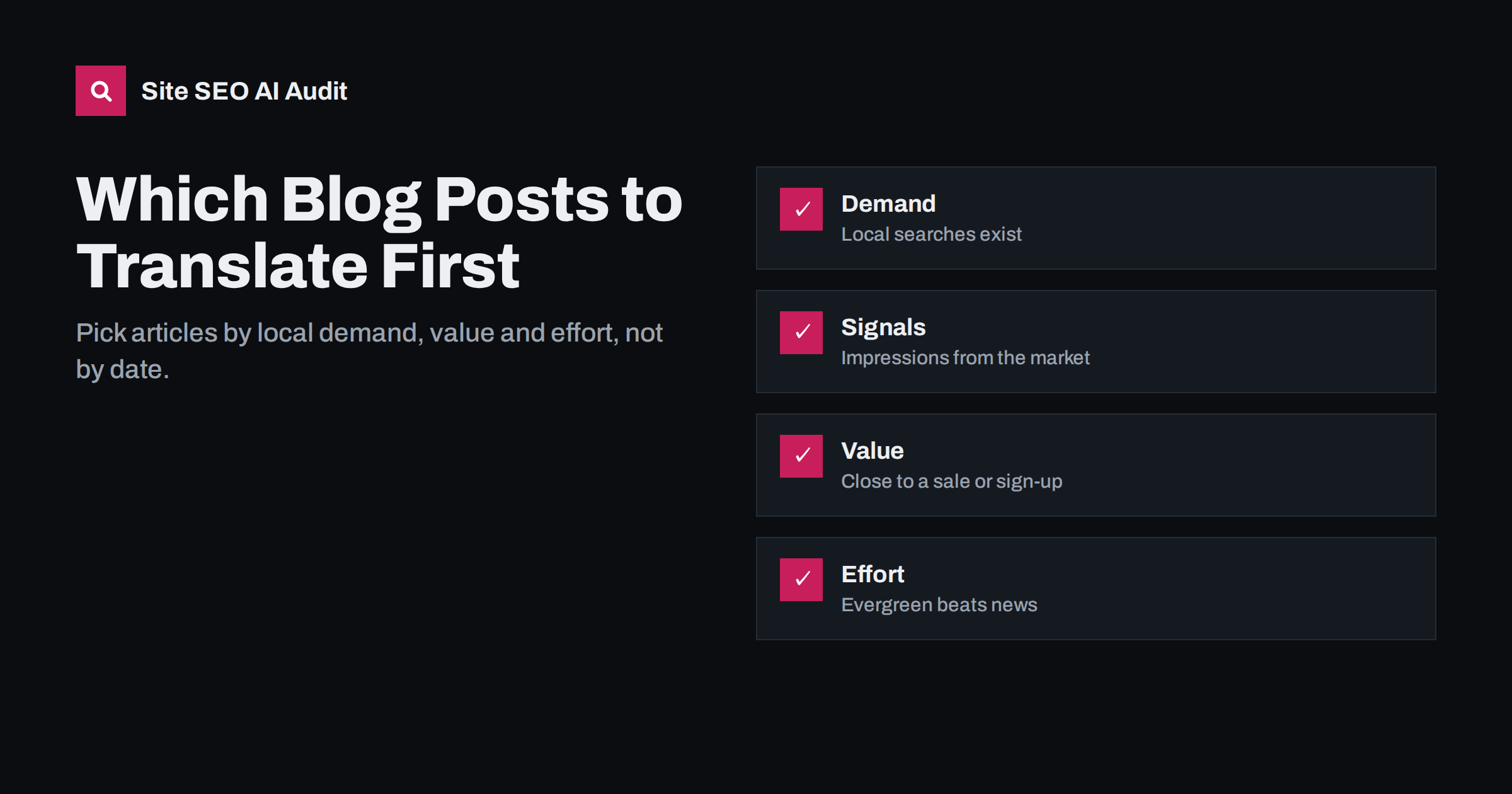
Short answer: Translate the blog posts that local searchers actually look for, that already attract visitors or impressions from the target market, that support a sale or sign-up, and that will stay valid for a long time. Skip news, event posts and articles tied to home-market rules. Score candidates on demand, existing signals, business value and effort, translate the top group as a connected cluster with internal links, and measure before translating more.
Why not translate the whole blog?
A blog built up over years can contain hundreds of articles. Translating all of them into every new language is expensive, and much of the effort is wasted: many older posts are out of date, tied to one market or never attracted much traffic even in the original language. Large volumes of translated content that nobody reads can also dilute a new language section with low-value pages.
A selective approach gives better results for less money. A smaller set of well-chosen, well-localized articles builds visibility in the new language faster, links together into a coherent section and is easier to keep up to date.
Selection also protects quality. Translation and review budgets are finite, so the more articles you translate, the less attention each one gets. Concentrating on fewer articles lets you afford native review, proper keyword localization and localized screenshots, which is what makes translated content perform. It also keeps maintenance manageable: every translated article must be updated when the original changes, and a smaller set is far easier to keep in sync.
Criterion 1: local search demand
The first question is whether people in the target market search for the topic at all, and with which words. For each candidate article:
- Research the main topic in the target language and country, using local keyword tools, autocomplete and local search results.
- Check whether the search intent matches the article: people looking for a how-to guide, a comparison, a definition?
- Look at what currently ranks locally. If strong local articles already cover the topic thoroughly, your translation needs to be at least as useful.
Topics with clear local demand and a weak or thin set of local results are the best opportunities.
Remember that demand in smaller markets is often modest in absolute numbers, and keyword tools may show very low or no volume for niche topics in smaller languages. Low reported volume does not always mean no demand. Combine tool data with local search results, autocomplete suggestions and what customers in that market actually ask, rather than rejecting a topic because a tool shows a small number.
Criterion 2: existing signals from the market
Your own data often shows which articles already interest the target market, even in the original language:
- Search Console: filter performance by the target country and look at which original-language articles get impressions and clicks there.
- Analytics: find articles with visitors from the target country or with browser languages matching the new language.
- Internal search and support: questions from customers in that market often map to existing articles.
An article that already receives impressions from Germany in English is a strong candidate for a German version, because demand is proven and the topic fits.
Criterion 3: business value
Not all traffic is equal. Prioritise articles that help visitors move towards a purchase, enquiry or sign-up:
- Guides that explain problems your product or service solves.
- Comparisons and “how to choose” articles.
- Tutorials for using your product, which help conversion and reduce support load.
- Articles that naturally link to your main commercial pages in the new language.
Purely general-interest articles can bring traffic, but they are lower priority when budgets are limited.
Ask sales and support teams which articles they send to prospects and customers most often. Articles that already work as sales or support tools in the original language usually become just as useful in the new one, and the teams can start using them immediately.
Criterion 4: effort and shelf life
Some articles are cheap to localize and stay useful for years; others need heavy adaptation or will be outdated soon. Consider:
- Evergreen versus time-bound. News, announcements, event recaps and posts tied to a specific date usually do not justify translation.
- Market dependence. Articles about home-market laws, taxes, holidays or local providers need rewriting, not translation, and may be irrelevant elsewhere.
- Length and complexity. Very long or highly technical articles cost more to translate and review.
- Freshness. Update an outdated original before translating it, or you will multiply outdated content.
A simple scoring model
Score each candidate from 1 to 3 on four criteria and add up the points:
| Criterion | 1 point | 2 points | 3 points |
|---|---|---|---|
| Local demand | Little evidence | Some searches | Clear, relevant demand |
| Existing signals | None from the market | Some visits or impressions | Regular traffic from the market |
| Business value | General interest | Supports the offer indirectly | Close to a sale or sign-up |
| Effort and shelf life | Time-bound or needs rewriting | Moderate adaptation | Evergreen, easy to localize |
Start with articles scoring 10 to 12, then work down. The model is deliberately simple; its purpose is to make choices explicit and consistent, not to be precise.
A worked example
Imagine a company that sells project management software, with an English blog of about two hundred articles, preparing a German version. Applying the model might look like this:
- A guide to choosing project management software scores high on every criterion: clear German search demand, some impressions from Germany already, close to a purchase decision and evergreen. It goes into the first batch.
- A tutorial on setting up recurring tasks in the product scores high on business value and shelf life, and support tickets from German customers mention the topic. It also goes into the first batch, alongside screenshots of the German interface.
- A post about a US conference the team attended scores low on everything and is skipped.
- An article on US employment rules for contractors is tied to the home market. If German readers need something similar, it should be written from scratch for German rules, not translated.
- A general article about productivity habits has some German search demand but little connection to the product. It is a candidate for a later batch.
The first batch would then group the choosing guide, the tutorial and several related articles on planning and task management into one German cluster, linked to the German product and pricing pages. After a few months, Search Console data for Germany would show which of these articles attract impressions and clicks, guiding the second batch.
The example also shows why the model should stay simple. Its job is to turn a long list of articles into a short, defensible first batch, not to predict traffic precisely.
Translate in clusters, not singles
Choose articles that relate to each other, so the new language section forms topic clusters with internal links, rather than scattered single posts. A cluster might be one main guide plus four or five supporting articles on the same topic, all linking to each other and to the relevant service or product page in the new language.
Clusters help readers continue to related content in their language, and they give search engines a clear structure. Translated articles that stand alone, linked only from the language switcher of the original, tend to be weakly linked and slow to gain visibility.
Localize, then measure
For each selected article, localize rather than just translate: local keywords in the title and headings, local examples, translated metadata and alt texts, and internal links to pages in the same language. Connect each translation with hreflang to its original.
Then measure for a few months before the next batch: indexed pages in the new section, impressions and clicks from the target country, and conversions or enquiries attributed to translated articles. Use the results to refine the scoring model; some criteria will prove more predictive than others for your site.
Technical problems can hide the effect of good content. Site SEO AI Audit crawls a site like a search engine and checks the Languages area on every page, including hreflang return links, broken language versions and lang attributes, along with titles, descriptions and internal links. Checking the new section after each batch makes sure your translations can be found. The first audit is free.
Related reading
- Multilingual keyword research: finding real local search terms
- What to do with untranslated pages on a multilingual site
- Internal linking on multilingual sites: rules that work
The bottom line
Translate the articles that local searchers want, that already show signals from the market, that support your business and that will stay valid. Skip news and home-market posts, update outdated originals first, translate in linked clusters, localize properly and measure before the next batch. A focused set of strong translations beats a large archive of neglected ones.
الأسئلة الشائعة
Should I translate old blog posts?
Only those that are still accurate, evergreen and relevant to the new market. Update outdated posts before translating them, and skip news or event posts.
How many posts should I translate at first?
Enough to form one or two connected topic clusters, often somewhere between a handful and a few dozen articles depending on your resources. Measure results before translating more.
Can I use Search Console to choose posts?
Yes. Filter by the target country to find original-language articles that already get impressions there. Those are strong candidates for translation.
Should translated posts be identical to the originals?
No. They should cover the same topic but use local keywords, examples and references. Some sections may need adapting or removing for the new market.
What about writing new articles only for one market?
That is often worthwhile when local searchers ask questions your original content does not answer. Such articles simply have no hreflang alternates.