ENEnglish
 LTLietuviškai
 DEDeutsch
 FRFrançais
 RUРусский
 ESEspañol
 PLPolski
 ITItaliano
 UKУкраїнська
 CSČeština
 PTPortuguês
 JA日本語
 LVLatviešu valoda
 ETEesti
 HUMagyar
 IDBahasa Indonesia
 TRTürkçe
 HIहिन्दी
 ELΕλληνικά
 ARالعربية
 THไทย
 VITiếng Việt
 RORomână
 MSBahasa Melayu
 BNবাংলা
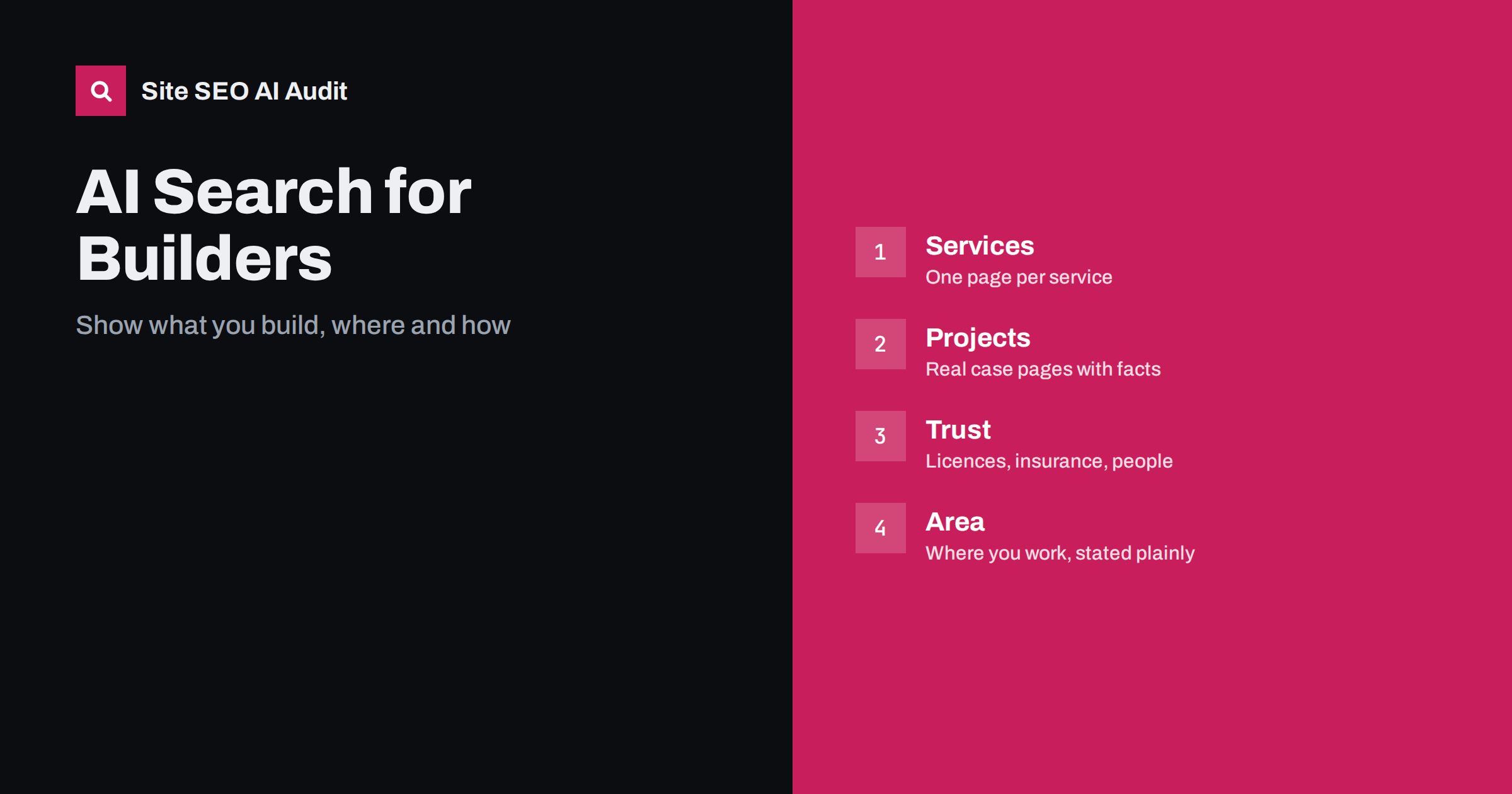
Short answer: Builders, architects, renovation firms and contractors get recommended by AI assistants when their websites state clearly what they build, where they work, how a project runs and who stands behind it. Publish a page for each service and area, document finished projects with real details, show licences and insurance where they apply, keep your business profile consistent everywhere and answer the practical questions clients ask before they call.
Choosing a contractor or an architect is a large, slow and risky decision. Before they phone anyone, people now ask a search engine or an AI assistant questions such as which firm builds timber houses in my region, how long a loft conversion takes, what an architect does before a building permit or how to compare quotes. The answer is assembled from pages the system can read and trust. Construction websites often disappoint here: a few photos, a slogan and a contact form. This guide shows what to publish so that a clear, accurate answer about your company exists to be found.
What clients ask before they pick a firm
Questions in this sector are specific and tied to a place, a budget and a risk. They fall into recognisable groups, and each group should have a home on your site.
- Scope: do you build new houses, renovate, extend, fit out interiors, or design only? Which materials and methods do you use?
- Place: which towns and regions do you serve, and do you travel for larger projects?
- Process: what are the steps from first call to handover, who manages the site and how are changes handled?
- Cost and time: what drives price, what is included in a quote and how long do typical projects take?
- Trust: are you licensed or registered where that is required, insured, and able to show finished work?
- After the project: what warranty applies and who do clients call about problems?
An assistant that cannot find these answers on your site may quote a directory or a competitor. Understanding how AI search engines work makes the priority clear: they retrieve and quote pages that state facts in plain text.
One page for each service and each project type
A page called Services with a long list of bullet points helps nobody. Give each main service its own page: house construction, extensions, bathroom renovations, roofing, architectural design, interior fit-out, whatever you really do. Start each page with a short summary of two or three sentences: what the service is, who it suits, what the process looks like and how to start. Then use headings for scope, materials, stages, timeline, permits, price factors and questions.
Be careful with numbers. Do not publish a fixed price per square metre unless you honour it. Describe what changes the price instead: size, design complexity, ground conditions, finishes, access to the site and permit requirements. If you give a time range, say what it depends on. Honest explanations are quoted safely and they prepare clients for a real quote. The structure follows the logic in service page SEO and works equally well for people and for machines.
Document finished projects like case studies
Photos alone say little. A project page becomes valuable when it explains the brief, the constraints, the solution and the result in text. Include the type of building, the location at a level the client agrees to, the scope of work, the main materials, how long it took and what was difficult. Add a short quote from the client if you have permission. Each image should have descriptive alt text and a caption that states what it shows, using the habits from writing image alt text.
Real specifics make a page citeable. “A two-storey extension with a flat green roof in a dense neighbourhood, built over eight months with the family living in the house” gives an assistant something to quote. “Quality and reliability since day one” does not. The same principles are described in case study pages for SEO. Keep client privacy in mind: avoid showing house numbers, security details or anything the owner has not agreed to publish.
Licences, insurance and the people behind the firm
Construction involves safety, money and legal duties, so trust signals matter more than in many other sectors. Where your country or region requires a licence, registration or professional membership, state the number or body and link to the official register if one exists. Mention the kind of insurance you carry and the warranty terms you actually offer, in the same plain wording your contract uses. If you hold safety or quality certifications, name them accurately.
Show who runs the firm: the owner, the site managers, the lead architect or engineer, with roles and relevant experience. A page with real names and photographs, published with consent, supports the signals described in E-E-A-T and AI search. Do not claim awards, rankings or memberships you cannot document. An unverifiable claim creates risk if an assistant repeats it.
Say where you work, and keep your profile consistent
Local relevance decides much of this market. List the cities and regions you serve, and for the most important ones create a useful page with real project examples from that area, not copies of the same text with the town name swapped. The warnings in location pages for SEO apply: duplicated city pages are thin and may be ignored.
Make sure your name, address, phone number, opening hours and service area are identical on your website, your map profile, trade directories and social pages. Keep a master sheet and update every listing from it. For architects and engineers with several offices, use a separate page for each office. Our guide to AI search for local businesses goes through the checks.
Answer questions with a plain FAQ and process page
Construction clients worry about the same things: delays, hidden costs, permits and who is responsible when something goes wrong. A process page that explains each stage in order, with who does what, is one of the most useful pages you can add. Typical stages include a first meeting, a site visit, a quote, a contract, permits, a work schedule, regular progress updates, a final inspection and handover. Add short FAQs on pages where the question really arises, written the way clients phrase it. The format is covered in FAQ sections that AI answers can use.
Add a pricing explanation page if you can. You may not publish a price list, but you can explain what a quote includes, what is charged separately, how variations are handled and how payment is staged. That page often becomes the passage an assistant quotes when someone asks how construction quotes work.
Structured data, reviews and images
Structured data helps a system recognise your organisation, but it must match the visible content. Mark up the company with name, logo, address, contact details and official profiles, and follow the principles in organization schema for AI systems. If you work from a physical office, a local business type can add opening hours and an area served; the options and common mistakes are in the LocalBusiness schema guide.
Reviews matter, but only real ones. Invite satisfied clients to review you on the platforms where clients look, respond to criticism calmly and never write or buy reviews. Do not mark up reviews you copied from elsewhere onto your own site as if they were first-party content. Also check that plans, brochures and price documents are not locked in PDF files only; repeat the key facts in text on the page.
Check the technical basics
A site full of large photographs often has slow pages. Compress images, use modern formats and make sure the layout does not jump while loading. Confirm that pages are indexable, that service and project pages are linked from the menu or from category pages and that each one has a clear title and heading. A crawl shows which pages are orphaned, which lack descriptions and which return errors. Site SEO AI Audit scores a site across seven areas, including AI search visibility, and ranks the fixes by impact. The first audit of up to 200 pages is free, and the pricing page shows how to repeat it after redesigns or new project launches.
Related reading
- Service Page SEO: How to Build Pages That Rank and Convert
- Case Study Pages: On-Page SEO for Proof and Results
- AI Search for Local Businesses: What to Fix First
- AI Search for Plumbers, Electricians and Home Services
The bottom line
An assistant can only recommend a construction firm it understands. State your services, areas, process and credentials in plain text, document real projects, keep your listings consistent and explain how quotes work. Clients who ask for a builder or an architect will then receive an accurate answer that names you for the right reasons.
FAQ
What should a builder publish first for AI search?
Start with one clear page for each main service, with scope, process, areas served and how to request a quote. Add three or four documented projects next, since real examples build trust quickly.
Should I publish prices?
Only figures you honour. If you cannot give fixed prices, explain what influences the cost and what a quote includes. That helps clients and gives assistants accurate material to quote.
Do licences and insurance details help visibility?
They help trust. State the registration or licence where required, name the body, and link to an official register if one exists. Do not claim anything you cannot document.
Can an architect use the same approach?
Yes. Explain your design stages, what you deliver at each stage, which permits you handle, and show projects with a written brief and result. Add team profiles with real qualifications.
How many project pages do I need?
Quality matters more than quantity. A few pages with real details, clear photos and honest descriptions work better than dozens of thin galleries. Add new projects as you finish them.