ENEnglish
 LTLietuviškai
 DEDeutsch
 FRFrançais
 RUРусский
 ESEspañol
 PLPolski
 ITItaliano
 UKУкраїнська
 CSČeština
 PTPortuguês
 JA日本語
 LVLatviešu valoda
 ETEesti
 HUMagyar
 IDBahasa Indonesia
 TRTürkçe
 HIहिन्दी
 ELΕλληνικά
 ARالعربية
 THไทย
 VITiếng Việt
 RORomână
 MSBahasa Melayu
 BNবাংলা
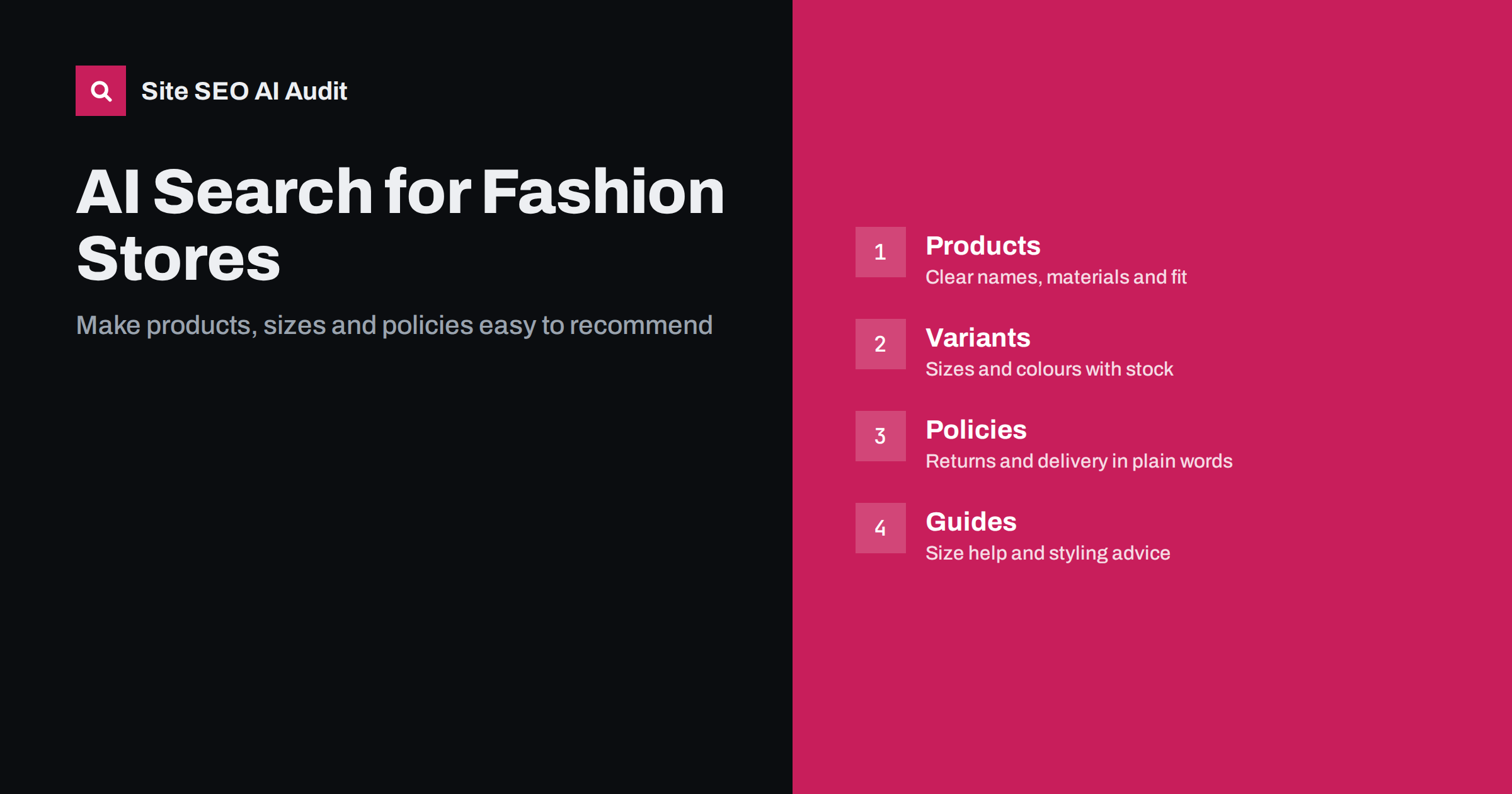
Short answer: Fashion shoppers increasingly ask AI assistants questions such as which jacket suits a rainy commute, what to wear to a summer wedding or which shop sells wide-fit boots. To be recommended, an apparel store needs product pages that state exactly what the item is, with material, fit, sizes, colours, price and availability in text and in structured data; clear returns, delivery and size information that can be quoted; and guides that answer the questions customers ask before buying. Style is subjective, so assistants lean on specific, verifiable facts and on reviews. Stores that describe products vaguely, hide details inside images or load them only with scripts are hard to quote and are skipped in favour of competitors that state the facts.
Fashion has features that make AI visibility different from other retail. Catalogues are large and change with seasons, one product exists in many sizes and colours, images carry most of the message, and returns are a major concern for buyers. Each of these can help or hurt. A store that keeps one clear page per product with accurate variants and honest sizing gives assistants confident answers, while a store with thousands of thin, similar pages gives them nothing to choose. This guide explains how to prepare product pages, variants, category pages, policies and content for AI search. Product-level basics are in product pages for AI shopping, and this article adds what is specific to apparel.
Write product pages with facts, not slogans
A product title should say what the item is: type, key feature, fit or style, and where useful the brand. “Relaxed-fit organic cotton T-shirt” tells an assistant more than a collection name. The description should list material and composition, cut and fit, length, care instructions, country of origin if you state it, and any features such as waterproofing or stretch. Use short paragraphs or a list of attributes, because both people and machines scan for them. Avoid claims you cannot support, such as “premium quality” with no detail, and never state a feature the product does not have. Put the information in the page text, not only in an image of a size chart or a styled graphic, since text inside images is often not read. See the product page SEO guide for the general structure.
Write for the question behind the search. Someone asking for a dress for an outdoor summer wedding wants to know about fabric weight, length, whether it needs special underwear and how it travels, so mention such practical points where they are true. Descriptions that answer them are more likely to be quoted than lists of adjectives, and they also reduce returns and support questions.
Handle sizes, colours and variants cleanly
Variants are the central technical challenge for apparel. If every size and colour has its own indexable address with identical text, you create near-duplicates that compete with each other; if all variants share one page, the page must still show which sizes and colours exist and which are in stock. In most cases one main page per product with selectable variants works best, with a canonical address and variant data in structured data. Show the sizes available as text, not only as buttons that appear after a script runs. A colour that is a distinct style, with its own photos and search demand, may justify its own page. The trade-offs are explained in product variants and SEO, and stock handling in out-of-stock product pages.
Add Product structured data and keep it accurate
Structured data tells machines the name, image, brand, price, currency, availability, colour, size and review summary of each product in a consistent format. Use JSON-LD, match it to what the page shows and update it when price or stock changes. Prices and availability in markup that differ from the visible page create mistrust and can lead to rich results being withheld. If you publish a returns policy or shipping details, structured data for them can also be provided, and the same information should appear in plain text on the page or on a linked policy page. Product identifiers such as GTIN or SKU help systems match your item with others. Detailed guidance is in the product schema guide, and errors are covered in fixing structured data errors.
Keep product data consistent everywhere you publish it. The same item should carry the same name, price, sizes and availability on your site, in your feed to shopping platforms and on marketplaces; mismatches make systems doubt which source is right. Remove discontinued products from feeds quickly and update stock at least daily during sales, when information changes fastest.
Make size and fit information quotable
Fit is the question shoppers ask most and the reason for most returns. Provide a size guide with measurements in centimetres and inches, and add a plain note on fit on each product: runs small, true to size, relaxed, cropped. State the model’s height and the size worn. Reviews that mention fit are valuable because they are specific, so make it easy for customers to say whether the item fit. If you offer wide-fit, tall, petite or plus ranges, give them clear category pages and describe them in words so that an assistant asked for such items can find you. Honest, consistent size data reduces returns and makes your answers more reliable than those of stores that give only a generic chart.
Optimise category pages and collections
Category pages such as women’s rain jackets or men’s leather boots match how people and assistants think about shopping. Give each important category a short introduction that explains what the range covers, how to choose, and which materials or fits are available, followed by product listings with real text links. Avoid creating thousands of filter combinations that can be crawled, since colour, size and price filters produce duplicates. Keep a limited set of indexable, useful collections, and handle the rest with canonical tags or noindex. The structure is described in the category page SEO guide.
Reviews, images and trust
Real reviews with details about fit, comfort, quality after washing and delivery are among the strongest signals for recommendation. Display them in the page text with dates, collect them from verified purchases, respond to problems and keep the star rating consistent with the review count. Images matter in fashion: use several angles, a detail shot and a photo that shows scale, and write descriptive alt text that names the item and colour rather than repeating keywords. Descriptive file names and captions help as well. Practical advice is in the image SEO guide and the reputation and reviews guide.
Policies, delivery and international shoppers
Assistants answer questions like “which shop has free returns” or “does it ship to Ireland” by quoting policy pages. Write returns, exchanges, delivery times, costs, supported countries and payment methods in simple text on dedicated pages, and link them from product pages and the footer. If you sell abroad, show prices in local currency, give size conversions between regional systems and use separate language and country versions with correct hreflang, as described in international e-commerce SEO. Keep dates on policy pages so that readers know they are current.
Seasonal collections and content
Fashion demand moves with seasons and events, so create seasonal pages that you keep at the same address year after year and refresh, rather than new pages that start from zero. Add guides that answer questions customers ask: how to measure yourself, how to care for wool, what to wear to a particular event, how to build a capsule wardrobe. Each guide should link to relevant categories and products, give concrete advice and show who wrote it. The method for recurring pages is in seasonal pages SEO.
Checklist and audit
- Product titles and descriptions with material, fit, sizes and colours in text.
- One canonical page per product, with variant and stock data in text and markup.
- Valid Product structured data that matches visible price and availability.
- Size guide, fit notes and model details on every product.
- Returns, delivery and payment policies on crawlable pages.
- Crawlable robots rules that allow the AI crawlers you want.
Site SEO AI Audit crawls your store, flags duplicate titles, missing structured data, heavy pages and blocked AI crawlers, and ranks the fixes by how many points each adds. The first audit of up to 200 pages is free; for larger catalogues see the pricing page.
Related reading
The bottom line
For fashion stores, AI visibility comes from clear facts: precise product names, material and fit in text, clean variants, accurate structured data, honest size help and readable policies. Keep the catalogue tidy, avoid thin duplicate pages and give assistants specific information they can quote with confidence.
FAQ
Should every size and colour have its own page?
Usually no. One main page per product with selectable variants avoids duplicates. Give a colour its own page only when it is a distinct style with its own photos and demand.
Why does text in images matter for fashion?
Size charts and details placed only in images are often not read by crawlers or assistants. Put sizes, materials and fit in page text as well.
Do reviews help AI assistants recommend a product?
Yes, especially reviews that mention fit, quality and delivery. Show them in the page text, keep them from verified buyers and respond to problems.
What structured data should an apparel store use?
Product markup with name, image, brand, price, currency, availability, colour and size, plus review data where you have real reviews. Keep it identical to the visible page.
How do I handle out-of-season products?
Keep the address, mark stock honestly and link to current alternatives. Seasonal category pages should stay at a stable address and be refreshed each year.