ENEnglish
 LTLietuviškai
 DEDeutsch
 FRFrançais
 RUРусский
 ESEspañol
 PLPolski
 ITItaliano
 UKУкраїнська
 CSČeština
 PTPortuguês
 JA日本語
 LVLatviešu valoda
 ETEesti
 HUMagyar
 IDBahasa Indonesia
 TRTürkçe
 HIहिन्दी
 ELΕλληνικά
 ARالعربية
 THไทย
 VITiếng Việt
 RORomână
 MSBahasa Melayu
 BNবাংলা
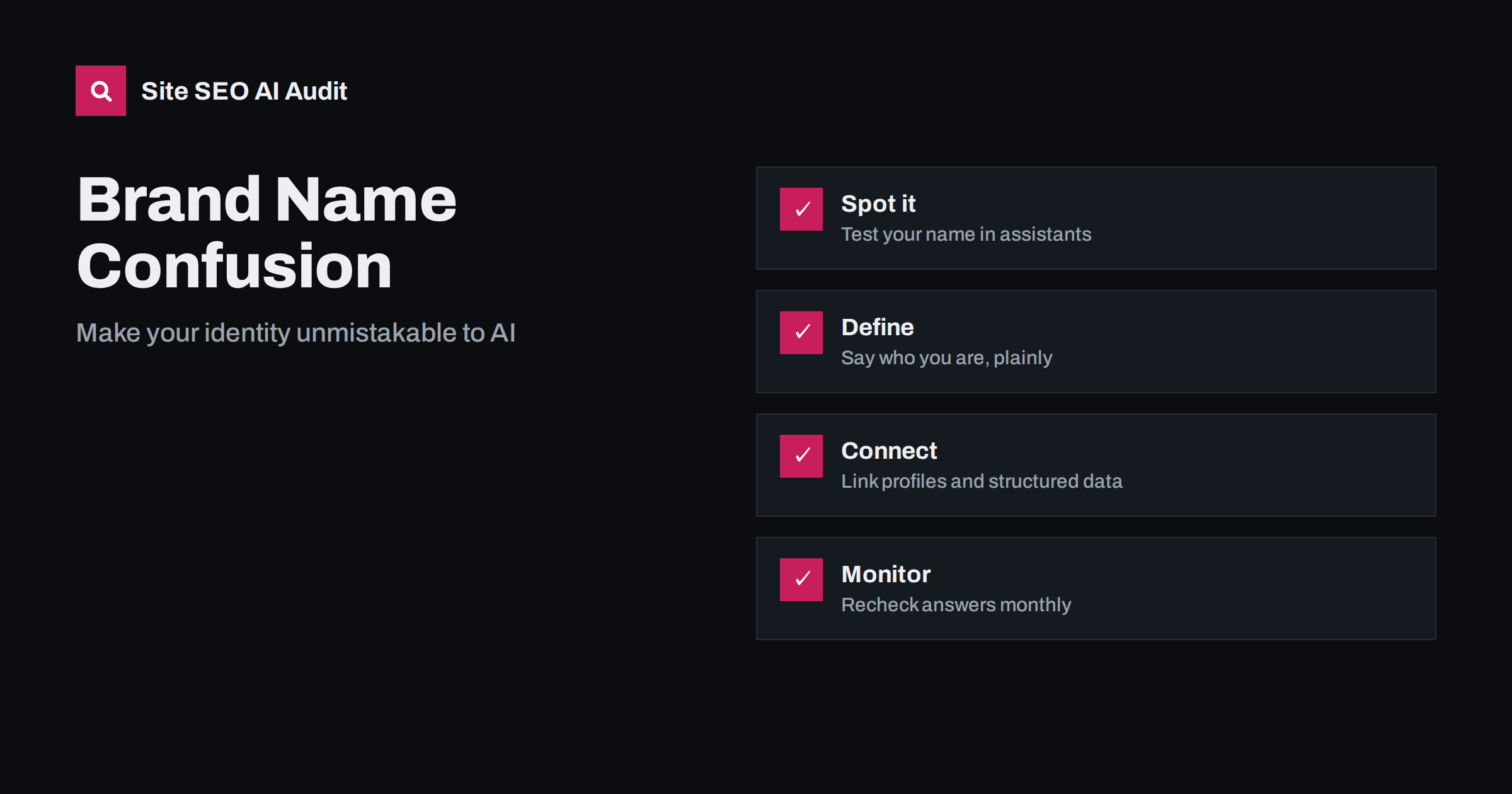
Short answer: Brand name confusion happens when your name is shared with another company, a person, a place or an everyday word, and AI systems merge or mix up the facts. To reduce it, state clearly who you are and what you do on your own pages, use consistent naming everywhere, add Organization structured data with official profile links, earn mentions that pair your name with your category, and check what assistants say about you on a regular schedule.
Choosing a short, memorable brand name was good advice for decades. In the age of AI answers it comes with a risk. A system that builds a response from many sources has to decide which entity a name refers to. If the name is also a fruit, a river, a software library or a well-known company in another industry, the system can pick the wrong one, or blend facts from several. A customer then reads a summary that gives your opening hours to a different business, or credits your product with a rival’s features. You cannot fully control what a model says, but you can make your identity easier to recognise and harder to confuse. This guide shows how to check the situation and what to do about it.
How the confusion arises
Search engines and AI systems work with entities: things such as companies, people and places, each with attributes and relationships. When a name could refer to more than one entity, the system uses context to choose. Context includes the words around the name in a question, the location, the language and what the sources say. Confusion appears when:
- The name is generic, such as a common noun or a place name, so searches are ambiguous.
- Another organisation with the same or a similar name is larger or older and dominates the sources.
- Your own pages describe you vaguely, so there is little to tie the name to your category.
- Different sites spell or format the name differently, which splits the evidence about you.
- You rebranded or merged, and old and new names circulate together.
The concept of entities is covered more broadly in entity SEO and AI search. Here the practical question is how to separate your entity from the others.
Test how assistants see your name
Start by asking. Use several assistants and search engines and run a fixed set of prompts, such as: what is [brand], who owns [brand], what does [brand] do, where is [brand] located and is [brand] a good choice for [your category]. Run each in more than one phrasing and add a location or category word in some of them. Record the answers in a simple sheet with the date and the system used.
Look for three patterns: the system names the wrong organisation, it mixes attributes from two entities, or it says it has no information. The first two are confusion; the third means your identity is too weakly established. The method matches what is described in measuring brand visibility in AI answers, and wrong statements can be handled with the steps in when AI says something wrong about your business.
Say who you are in plain words
The most effective fix is clear self-description. Write a one- or two-sentence statement that names your brand together with its category, location and purpose, for example “Brand is a family-run bakery in a named town”. Use the same form on your home page, your about page, your contact page and your profiles. The wording does not need to be clever. It needs to be consistent, specific and easy to quote. The guide to about page SEO explains what that page should contain.
Repeat the pairing of name and category in a natural way, in titles, headings and opening paragraphs, but avoid stuffing it into every sentence. A sentence such as “the Example CRM for dental clinics” does more than the bare name, because it adds the context that separates you from other entities that share the word.
Use one name format everywhere
Pick an official form of your name, including capitalisation, spacing, punctuation and legal suffix, and apply it consistently: on the site, in structured data, on social profiles, in directories, in press mentions and in app stores. If you must use a short and a long form, define both once, for example “Example Ltd, known as Example”. Inconsistent forms fragment the evidence that a system gathers about you. If you have rebranded, keep a clear page that explains the change and mention the former name for a period, so that systems connect the two.
The site name that search engines display is a related matter; see site name and favicon in Google for how to signal it.
Add structured data and official profile links
Machines are better at connecting an entity when your site states it in a structured form. Add Organization markup on the home page with your official name, alternate names if you use them, logo, address or contact details and a sameAs list that links to your official profiles on other platforms. Make sure every value matches the visible page. The article on organization schema for AI systems describes the fields and common mistakes.
The reverse links matter too. Your social profiles and listings should link back to your website, so that the connection runs in both directions. Where a public knowledge base such as Wikidata applies to your organisation and you meet its rules, a correct entry can help distinguish you; the guide to Wikipedia, Wikidata and your brand in AI explains when this is appropriate and when it is not. Do not create entries that do not meet notability or sourcing rules, because they are removed and can cause harm.
Earn mentions that carry context
External evidence helps a system decide who you are. Aim for mentions in trade publications, local organisations, partner pages, directories and reviews that name you together with your category or location. Even unlinked mentions help when they include context; see unlinked brand mentions and AI. Ask partners and customers to use your full descriptive name where appropriate. Avoid spammy or purchased mentions, which add noise rather than clarity.
Search behaviour is part of this signal. If people search for your name together with a category or place, the pairing becomes common evidence. Watch the queries in Search Console and compare brand and non-brand demand, as described in branded vs non-branded search.
If the confusion is with a bigger entity
When a larger organisation shares your name, you will not outrank it for the bare name, and you should not try. Focus on the combinations that matter to your audience: name plus category, name plus city, name plus product. Create pages that answer those queries directly. Use geographic and sector terms in titles and headings in a natural way, and make sure your listings carry the same descriptors. For local businesses, consistent address and category information across listings is especially important, as explained in AI search for local businesses.
If you are still choosing a name, test it before you commit: search it in several languages, look at what the results show today, and check whether the domain, social handles and trademark registers are clear. A slightly longer name with a descriptive word can save years of confusion.
Monitor and correct
Repeat your prompt set every month or after major changes, and compare the answers with your records. When a system gives a wrong answer, first check whether your own site or a major listing contains the wrong information. Correct your own sources before anything else. Then correct third-party listings, and use feedback channels that platforms provide for factual errors. Corrections can take time to appear, since models and indexes update on different schedules. Keep your approach honest: there is no way to guarantee how an assistant will phrase an answer, and no trick that replaces clear, consistent public information.
Technical hygiene supports all of this. Make sure that your key pages are crawlable, load without scripts and contain the facts as text. Site SEO AI Audit checks crawl access, structured data and AI search readiness among its seven areas, and ranks fixes by impact. The first audit of up to 200 pages is free, and the pricing page shows how to re-check regularly.
Related reading
- Entity SEO for AI Search: Be a Thing Machines Recognise
- Organization Schema: Telling AI Systems Who You Are
- When AI Gets Your Business Wrong: What to Do
- Unlinked Brand Mentions and AI Answers
The bottom line
If your name is shared, you cannot rely on the name alone. Describe yourself in plain, consistent words, use one name format, mark up your organisation, earn mentions with context and test the answers regularly. Over time these signals make it easier for people and machines to tell you apart from everything else with the same name.
FAQ
How do I know if AI confuses my brand with another?
Ask several assistants a fixed set of questions about your name, with and without location or category words, and look for wrong or blended answers.
Should I rebrand because of a name clash?
Not automatically. Clear self-description, consistent naming and pairing the name with your category often help enough. Consider a change only if the clash does lasting damage.
Does Organization schema fix confusion?
It helps by stating your identity and official profiles in a structured way, but it works best together with consistent text and external mentions.
Can I edit what an AI assistant says about me?
Not directly. You can correct your own pages and third-party sources, and use platform feedback tools, but changes appear on each system’s schedule.
How often should I check my brand in assistants?
Monthly is a reasonable rhythm for most businesses, plus a check after a rebrand, a move or a major launch.