ENEnglish
 LTLietuviškai
 DEDeutsch
 FRFrançais
 RUРусский
 ESEspañol
 PLPolski
 ITItaliano
 UKУкраїнська
 CSČeština
 PTPortuguês
 JA日本語
JA日本語 LVLatviešu valoda
 ETEesti
 HUMagyar
 IDBahasa Indonesia
 TRTürkçe
 HIहिन्दी
 ELΕλληνικά
 ARالعربية
 THไทย
THไทย VITiếng Việt
 RORomână
 MSBahasa Melayu
 BNবাংলা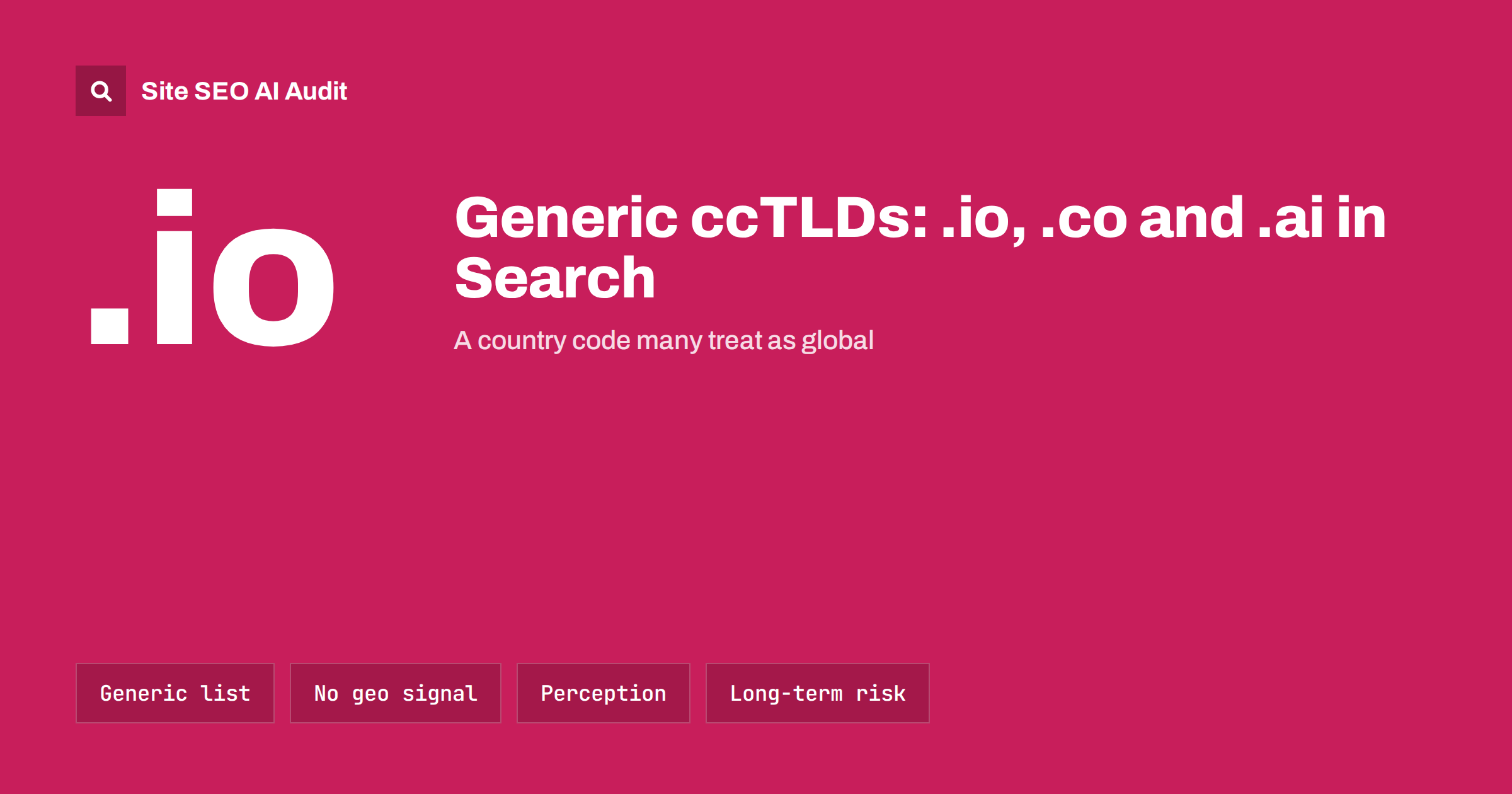
Short answer: A few country code domains are so widely used for global websites that Google treats them as generic, like .com. This group, often called generic ccTLDs or gccTLDs, includes domains such as .io, .co, .me and .tv, and Google has said it treats .ai the same way. For SEO, that means such a domain does not tie your site to the country it originally belonged to, so you can use it for an international audience. It also means the domain gives no country signal, so if you target specific countries you need to do it with content and hreflang. Other search engines and your customers may see the domain differently.
ccTLDs, gTLDs and the group in between
Domain endings come in two main families:
- Generic top-level domains (gTLDs) such as .com, .org, .net and newer ones such as .shop or .app. They say nothing about a country.
- Country code top-level domains (ccTLDs) such as .de, .fr, .lt or .co.uk. Each belongs to a country or territory, and search engines normally use them as a strong signal that the site targets that country.
Some ccTLDs escaped their origin. .io belongs to the British Indian Ocean Territory, .co to Colombia, .tv to Tuvalu, .me to Montenegro, .ai to Anguilla. Because startups, media and technology companies worldwide use them as short, brandable alternatives to .com, Google has for many years published a list of ccTLDs it treats as generic in its documentation on multi-regional and multilingual sites. The list changes from time to time, so check the current version rather than relying on older blog posts.
The main trade-offs between ccTLDs, subdomains and subfolders are covered in ccTLD vs subdomain vs subfolder. This article focuses on the special case of country domains used as global ones.
What “treated as generic” means in practice
When Google treats a ccTLD as generic, it stops using the domain ending as a signal for a particular country. A site on .io is not assumed to be aimed at the British Indian Ocean Territory, and a site on .co is not assumed to target Colombia. The site can rank anywhere its content is relevant, just like a .com.
That has two sides:
- The upside: you can use a short, available gccTLD for a global product without being pushed towards one country.
- The downside: the domain does nothing to help you rank in a specific country. If your business is really about one market, a real ccTLD such as .de or .fr still sends that signal, and a gccTLD does not.
Regional domains such as .eu and .asia, and city or regional gTLDs such as .london or .berlin, are also treated as generic by Google according to its documentation. They may help with branding and user perception, but not as a geotargeting signal.
How to target countries on a generic domain
Since 2022, Google Search Console no longer offers the old international targeting setting that let owners assign a country to a generic domain. Targeting now happens through signals on the site itself, as described in how to target a specific country in Google.
- Use a clear structure for languages or countries, for example subfolders like
/de/or/en-gb/. - Add hreflang annotations that connect the versions and state language and, where needed, region. Our hreflang guide explains the basics.
- Localise the content: language, currency, prices, delivery information, phone numbers and addresses.
- Earn local links and mentions from sites in the target country.
- Set the lang attribute correctly on each language version.
A gccTLD with a clean subfolder structure and hreflang can target many countries at once, exactly like a .com.
Other search engines may see it differently
Google’s list applies to Google. Other search engines publish less detail about how they treat each domain ending, and some may still use a ccTLD as a country hint. If a large share of your audience uses Bing or a strong local search engine, check how your domain performs there. The article on search engines beyond Google gives an overview of where those engines matter.
In practice, the same on-page signals help everywhere: hreflang, clear language versions, local content and local links. Relying on the domain alone is fragile with any search engine.
What customers think of the domain
Search engines are only one audience. People also react to domain endings, and their reaction depends on the market and the industry.
| Domain | Common perception | Typical fit |
|---|---|---|
| .io | Technology, developer tools, startups | Software, APIs, SaaS |
| .co | Short alternative to .com; sometimes mistaken for a typo | Startups, brands |
| .ai | Artificial intelligence products | AI tools and services |
| .me | Personal sites and apps | Portfolios, personal brands |
| .tv, .fm | Video and audio | Media, podcasts, streaming |
| Local ccTLD (.de, .fr) | Local business, local trust | Companies focused on one country |
For a local plumber, accountant or shop, a gccTLD can look unusual to customers, while the local ccTLD or .com feels familiar. Our guide to local trust signals for country sites covers other elements that shape that perception.
Long-term risks to consider
A ccTLD always belongs to a country or territory, whatever search engines think of it. That brings risks that .com does not have:
- Policy changes. The registry or the responsible government can change registration rules, prices or eligibility.
- Political changes. Questions have been raised about the long-term future of .io following the 2024 agreement on the sovereignty of the Chagos Islands. Such situations are rare, but they show that the domain depends on the status of a territory.
- Renewal costs. Some popular gccTLDs cost considerably more than .com, and prices can change.
- Search engine lists. A domain could, in principle, be removed from or added to a search engine’s generic list, changing how it is treated.
None of these is a reason to panic if you already use a gccTLD. They are reasons to own your brand on .com or relevant local ccTLDs as well, where possible, and to keep your redirect plan ready.
Choosing a domain for a new project
If you are starting a new site and weighing a gccTLD against .com or a local ccTLD, a few questions usually settle it:
- Who are the customers? If they are mostly in one country and buy locally, the local ccTLD or .com is usually the safer choice. If they are global and used to technology brands, a gccTLD is rarely a problem.
- Is the .com available at a reasonable price? Many companies start on a gccTLD because the .com is taken. That is a valid reason, but try to secure the .com later if the brand grows.
- Will you need country versions? A generic domain with subfolders keeps all markets on one domain and one link profile, which is often easier to manage than several ccTLDs.
- How will people hear the name? Endings like .co are easily confused with .com when spoken aloud or typed from memory. Consider registering the common typo variant and redirecting it.
- What does it cost over ten years? Compare renewal prices, not only the first-year offer.
From a pure search point of view, the domain ending matters less than most people expect. Content, structure, links and a clean technical setup decide far more of the outcome.
Moving to or from a generic ccTLD
If you decide to change domains, treat it as a full domain migration: map every URL, use 301 redirects from the old domain to the new one, update internal links, canonicals, hreflang and sitemaps, and use the change of address tool in Search Console where it applies. The steps are the same as in any international site migration. Expect some fluctuation while search engines process the move.
How Site SEO AI Audit helps
Whatever domain you use, targeting depends on what is on the pages. Site SEO AI Audit’s Languages area checks hreflang return links, broken language versions, x-default and lang attributes, and its crawl and index checks catch redirect chains and canonical problems that often follow a domain change. That helps you confirm that a generic domain is backed by clear signals for every market you target. You can begin with a free audit of your website.
Related reading
- International SEO for Beginners: How to Take a Site Global
- Same Language, Different Countries: How to Target en-US and en-GB
- International SEO Myths That Waste Time and Budget
The bottom line
Generic ccTLDs such as .io, .co and .ai work like .com in Google: they carry no country signal, so they are fine for global sites but do not help you rank in one specific country. Target markets with structure, hreflang and localised content instead, check how other search engines treat your domain, consider how customers perceive it, and keep in mind that a country domain always carries some policy risk.
FAQ
Is a .io domain bad for SEO?
No. Google treats .io as a generic domain, so it can rank globally like a .com. It simply does not give a country signal, and some customers outside technology sectors may find it unfamiliar.
Does Google treat .ai as a country domain?
Google has said it treats .ai as generic, so it is not tied to Anguilla in search. Check Google’s current documentation, because the list of generic ccTLDs can change.
Can I target a specific country with a .co domain?
Yes, but not through the domain. Use country or language folders, hreflang, local content, local contact details and local links to show which market each page serves.
Are .eu and .asia treated as country domains?
No. Google treats regional domains such as .eu and .asia as generic, so they do not target a specific country. Use hreflang and localised content for each market.
Should I switch from a gccTLD to .com?
Only if there is a clear business reason, such as trust, brand protection or registry risk. A domain change is a migration that needs careful redirects and usually causes temporary ranking fluctuations.