ENEnglish
 LTLietuviškai
 DEDeutsch
 FRFrançais
 RUРусский
 ESEspañol
 PLPolski
 ITItaliano
 UKУкраїнська
 CSČeština
 PTPortuguês
 JA日本語
JA日本語 LVLatviešu valoda
 ETEesti
 HUMagyar
 IDBahasa Indonesia
 TRTürkçe
 HIहिन्दी
 ELΕλληνικά
 ARالعربية
 THไทย
THไทย VITiếng Việt
 RORomână
 MSBahasa Melayu
 BNবাংলা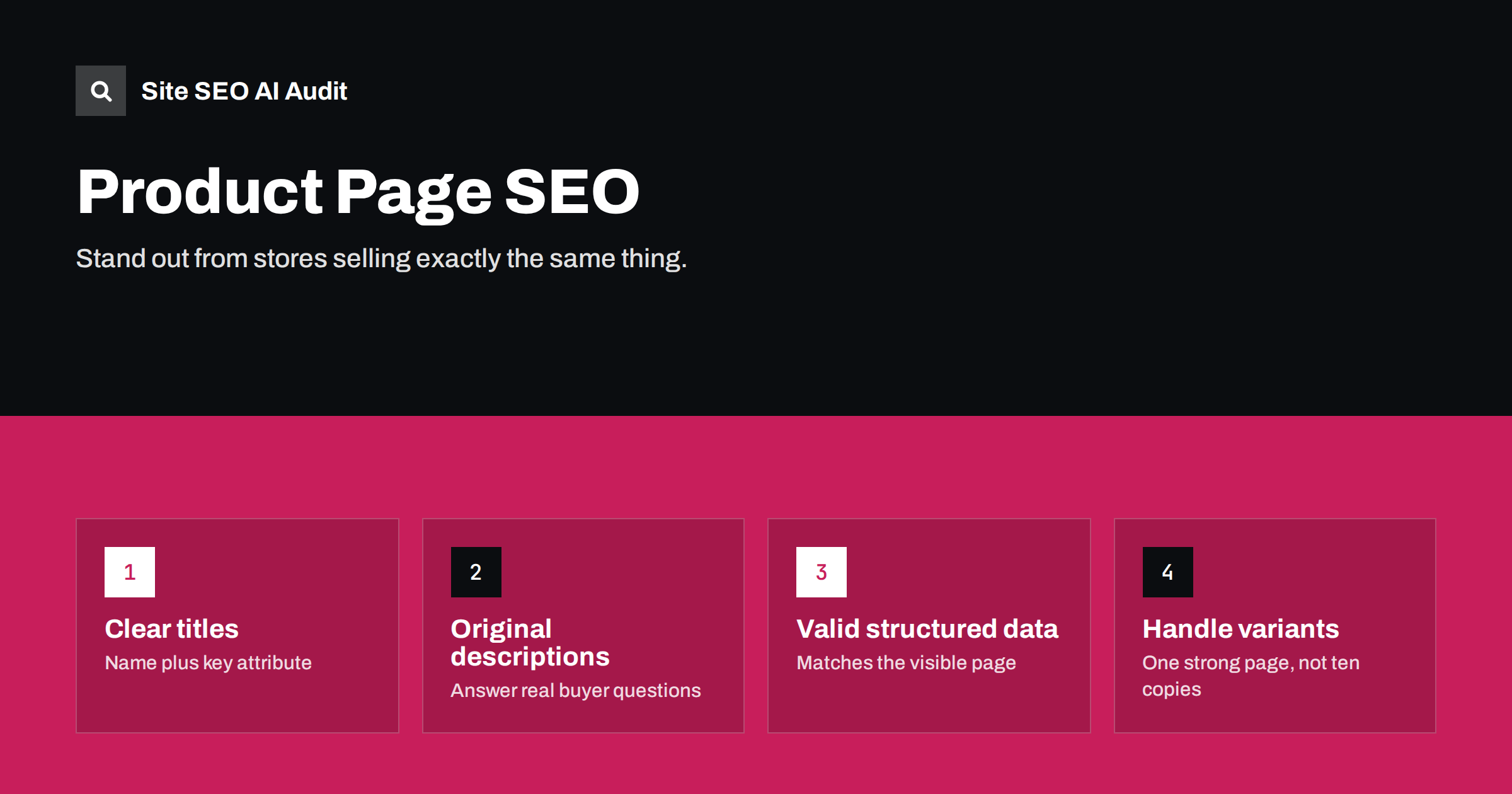
Short answer: A well-optimized product page has a unique title built from the product name and its key attribute, an original description that answers buyers’ real questions, descriptive images with alt text, clear price and availability, reviews where you have them, and product structured data that matches the visible content. On a store with many products, the biggest wins come from fixing templates and duplicate descriptions, then improving your best sellers by hand.
Why product pages are hard to rank
Product pages face a problem that most other pages do not: many other sites sell exactly the same thing. The same trainers, the same coffee machine, the same phone case are listed by dozens of stores, often with the same manufacturer photos and the same manufacturer text. From a search engine’s point of view, those pages are nearly interchangeable, so it tends to prefer the ones with more authority, better experience or genuinely extra information.
On top of that, stores generate large numbers of pages automatically. Variants, filters, sorting options and out-of-stock items multiply URLs, and templates spread any mistake across the whole catalog. A single missing field in a product template can affect thousands of pages at once.
The good news is that the same scale works in your favour when you fix things. One template correction improves every product. And a handful of genuinely useful details on your top products can set them apart from competitors who never go beyond the manufacturer feed.
Title tags and H1 for products
The product title tag should tell the searcher exactly what the product is. A reliable pattern is:
- Product name (including brand and model where people search for it)
- Key attribute that distinguishes it: type, size range, material, capacity, compatibility
- Store name at the end if there is room
For example: “Trail Runner 3 Waterproof Running Shoes | Storename” or “Espresso Pro 2 Coffee Machine, 15 Bar | Storename”. Avoid titles that only contain a SKU or an internal code, and avoid appending the same long phrase such as “Buy Online at the Best Price with Free Delivery” to every product. It pushes the useful part out of view and adds nothing distinctive.
The H1 is normally the product name as shown on the page. It should match the product exactly, since shoppers use it to confirm they have the right item.
Writing product descriptions that help
The description is where most product pages are weakest. Manufacturer text is written to describe the product in general, not to help your customer choose it from your store, and it appears word for word on every other retailer’s page.
A useful product description answers the questions a knowledgeable shop assistant would answer:
- Who is it for? Beginners or professionals, small kitchens or offices, narrow or wide feet.
- What problem does it solve? In plain language, not just a list of features.
- How does it compare? With the previous model, a cheaper alternative, or the most similar product you sell.
- What are the exact specifications? Dimensions, weight, materials, compatibility, power, capacity. Put them in a list or table so they are easy to scan.
- What should I know before buying? Sizing advice, what is included in the box, what is not, care instructions, warranty.
- What do customers often ask? Your support inbox and returns reasons are the best source.
You do not need to write long essays for every product. For a large catalog, a sensible approach is to write unique descriptions for the products that bring the most revenue or search impressions, and improve the rest over time or through better templates that combine structured attributes into readable sentences.
Images and media
Shoppers cannot touch the product, so images do much of the selling. For search, they also matter in image results and in shopping features. Good practice:
- Show the product from several angles, in use, and at scale, not only the manufacturer’s packshot.
- Write alt text that describes each image specifically: “Trail Runner 3 shoe, grey with orange sole, side view” rather than repeating the product name on every image.
- Use descriptive file names before uploading.
- Compress images and serve them at sensible sizes. Product galleries are one of the most common reasons store pages load slowly.
- If you have videos, place them on the page with a short description of what they show.
Price, availability and reviews
Buyers want to know the price, whether the item is in stock and when it will arrive, and search engines often show that information directly in results. Make it visible on the page as text, not only inside an image or a script that loads late.
Reviews help shoppers decide and add unique, regularly updated text to the page. Show them on the product page itself where possible, and never invent or copy reviews from elsewhere. If a product has no reviews yet, that is fine; an honest empty state is better than fabricated praise.
Structured data for products
Product structured data, written in JSON-LD using schema.org’s Product and Offer types, tells search engines the name, image, price, currency, availability and, where applicable, review ratings in a machine-readable form. It can make a page eligible for richer results that show price and availability.
Two rules matter more than any others. First, the structured data must match what the page visibly shows: the same price, the same stock status, the same rating. Second, it must be valid. Broken JSON-LD is ignored. Google documents the required and recommended fields in its product structured data guide, and most store platforms or plugins output the basics automatically, so check what yours produces before adding more.
Variants, duplicates and out-of-stock products
| Situation | Common problem | Typical solution |
|---|---|---|
| Colours and sizes | Each variant on its own URL with the same text | One product URL with variant options, or canonical tags to the main version |
| Same product in several categories | Product reachable at several category paths | One canonical product URL, used in all internal links |
| Manufacturer descriptions | Identical text across many stores | Unique text for key products; improved templates for the rest |
| Temporarily out of stock | Page removed or redirected, losing its history | Keep the page, show availability and alternatives |
| Permanently discontinued | Dead page with no path forward | Redirect to the successor or closest category, or keep as an information page if still searched |
Variants deserve their own indexable pages only when people search for them separately and the pages can be genuinely different, for example a product that comes in materials with different specifications. Otherwise, one strong product page is better than ten near-copies.
Internal links to and from product pages
Product pages usually receive links from category pages and little else. You can strengthen them by:
- Linking to key products from buying guides and blog posts where they are genuinely relevant.
- Showing related products and accessories with descriptive product names as anchors.
- Using breadcrumbs that link back to the category and subcategory.
- Making sure important products are not buried many clicks deep behind pagination.
Auditing product pages at scale
On a store with hundreds or thousands of products, the most common issues repeat across the catalog: duplicate titles from templates, missing descriptions, thin pages with only a name and price, duplicate content from manufacturer text and variants, images without alt text, and invalid structured data. Finding them product by product is impossible; a crawl that groups issues by how many pages they affect is the only practical approach.
Site SEO AI Audit crawls a store like a search engine and checks every page for on-page issues such as titles, descriptions, H1s, thin and duplicate content and image alt texts, as well as schema.org structured data and invalid JSON-LD. Fixes are ranked by how many points they add, and on WordPress and WooCommerce sites each issue comes with the steps in wp-admin. Larger catalogs need a paid plan to crawl every page; see the pricing page.
Related reading
- Duplicate Title Tags and Meta Descriptions: How to Fix Them
- Thin Content: How to Find and Fix Low-Value Pages
- Image Alt Text: How to Write It for SEO and Accessibility
- URL Parameters and Duplicate Content: A Practical Fix Guide
The bottom line
Product pages compete with many near-identical listings, so what sets them apart is useful, original detail. Build clear titles from the product name and key attribute, write descriptions that answer real buyer questions, describe images, show price and availability as text, add valid structured data that matches the page, and handle variants and stock changes without creating duplicates or dead ends. Fix templates first, then invest in your best sellers.
FAQ
Can I use the manufacturer’s product description?
You can, and many stores do, but it gives search engines no reason to prefer your page over every other store using the same text. Write unique descriptions for your most important products first, and add your own details, such as sizing advice and answers to common questions, to the rest over time.
What should a product title tag include?
The product name, including brand and model where people search for them, plus one key attribute such as type, size or material. Add the store name at the end if there is room. Avoid long generic phrases repeated on every product.
Should out-of-stock products be removed?
Not if they will return. Keep the page live, show that the item is unavailable and suggest alternatives. For permanently discontinued products, redirect to the successor or closest category, or keep an information page if people still search for it.
Do product pages need structured data?
It is not required, but valid Product structured data makes pages eligible for richer results showing price and availability. It must match what the page visibly shows. Most store platforms add basic markup automatically.
Should every product variant have its own page?
Usually not. One product page with variant options is simpler and avoids duplicate content. Separate pages make sense only when people search for the variants separately and the pages can be meaningfully different.