ENEnglish
 LTLietuviškai
 DEDeutsch
 FRFrançais
 RUРусский
 ESEspañol
 PLPolski
 ITItaliano
 UKУкраїнська
 CSČeština
 PTPortuguês
 JA日本語
JA日本語 LVLatviešu valoda
 ETEesti
 HUMagyar
 IDBahasa Indonesia
 TRTürkçe
 HIहिन्दी
 ELΕλληνικά
 ARالعربية
 THไทย
THไทย VITiếng Việt
 RORomână
 MSBahasa Melayu
 BNবাংলা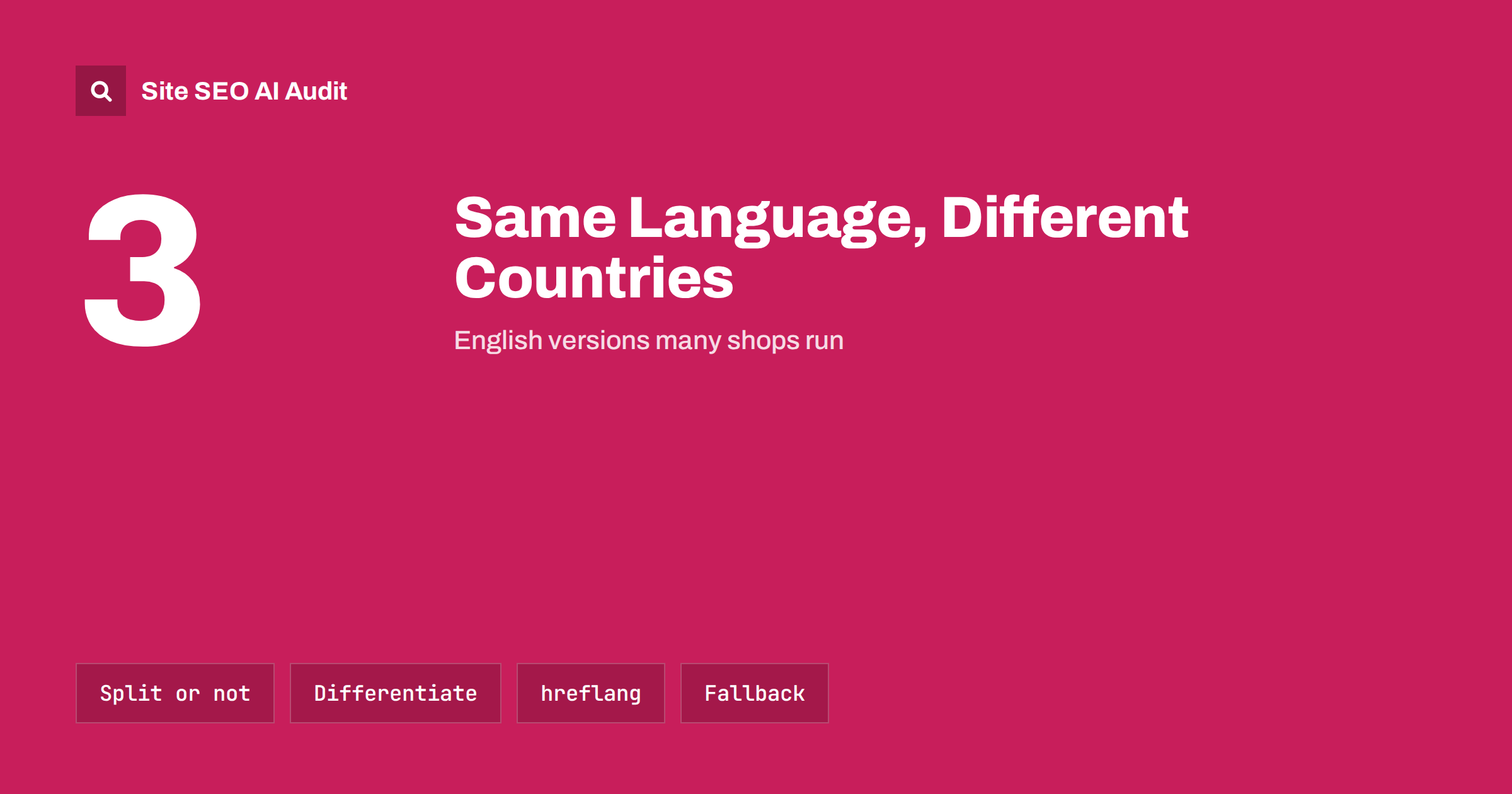
Short answer: Create separate pages for countries that share a language only when the content genuinely differs, for example in prices, currency, shipping, legal terms, product range or vocabulary. Give each version a self-referencing canonical, connect them with hreflang codes such as en-us, en-gb and en-au, and add a plain language version or x-default as the fallback. If the pages would be identical, one version for the whole language is simpler and usually works better.
The problem with near-identical country pages
Many businesses expand into several English-speaking, Spanish-speaking or German-speaking countries at once. The quickest way to do this is to copy the existing site into several country folders: /us/, /uk/, /au/. The pages are then almost identical, with perhaps a different currency symbol and phone number.
Search engines see several URLs with nearly the same content. They may group them together, choose one as the canonical version on their own and show that one everywhere, regardless of what you intended. Translated content in different languages does not have this problem, because the text differs. Same-language country versions do, because the text barely changes.
hreflang helps here: it tells search engines that the pages are deliberate country alternates, and Google says it uses hreflang to show the right URL to the right users even when the pages are similar. But hreflang works best when there is also a real reason for the pages to exist separately. That reason is what you create when you localize properly.
When separate country versions make sense
Ask whether a visitor from each country would genuinely be better served by a different page. Good reasons include:
- Prices and currency. US dollars, pounds sterling and Australian dollars, with local tax display.
- Shipping, returns and delivery times that differ per country.
- Product range. Some products are sold only in certain countries, or come in different variants, such as plug types or sizes.
- Legal and regulatory content. Consumer rights, warranties, certifications and required disclosures vary.
- Vocabulary and spelling. Color and colour, sneakers and trainers, apartment and flat; in Spanish and Portuguese, the differences can be larger.
- Local contact and support: phone numbers, addresses, opening hours in local time.
If none of these apply, and you simply want to “have a UK site”, a single English version is usually the better choice. Maintaining several copies of the same content multiplies work without helping visitors.
Setting up hreflang for country variants
For a product page available for the US, the UK and Australia, each version carries the same cluster:
hreflang="en-us"pointing at the US pagehreflang="en-gb"pointing at the UK pagehreflang="en-au"pointing at the Australian pagehreflang="x-default"pointing at the version you want for everyone else
Note the United Kingdom code: gb, not uk. Each page must list all versions including itself, each link must be returned, and each URL must be the canonical, indexable, 200-status version of that page.
Consider the searchers you have not listed: English speakers in Ireland, Canada, New Zealand, India, Singapore or South Africa. Without a fallback, search engines will pick one of your versions for them. You can guide this in two ways:
- Add a plain
hreflang="en"to one version, often the US or an international version, so any English speaker without a better match gets it. - Point x-default at a country selector or an international version.
Both approaches are valid and can be combined.
Canonicals for country versions
Each country version needs a self-referencing canonical tag. Do not canonicalise the UK and Australian pages to the US page to “avoid duplicate content”. That tells search engines to index only the US page, and the other versions drop out of results, taking their hreflang with them.
It is worth knowing that search engines may still decide on their own to treat very similar pages as duplicates and choose one canonical. In Search Console, the URL inspection tool shows which canonical Google selected. If Google keeps choosing the US page for your UK URLs, it is a sign the pages are too similar, and the fix is more differentiation, not more tags.
How to differentiate country pages
You do not need to rewrite every page from scratch. Focus on the elements that matter to visitors and that search engines can see:
| Element | What to change | Effort |
|---|---|---|
| Prices and currency | Local currency, tax display, local offers | Low once set up in the shop |
| Spelling and vocabulary | Local spelling and terms in titles, headings and body | Medium; a local editor helps |
| Shipping and returns | Country-specific delivery times, costs and policies | Low |
| Contact details | Local phone, address, support hours | Low |
| Examples and references | Local holidays, standards, brands, regulations | Medium |
| Strukturovaná data | Price, currency and availability per country | Low if generated from shop data |
| Reviews and testimonials | Show reviews from local customers where you have them | Depends on data |
Titles and meta descriptions are a good place to start. They are short, visible in search results and easy to adapt with local spelling and terms.
Spanish, Portuguese, French and German
English is the most common case, but the same logic applies elsewhere:
- Spanish: Spain and Latin American countries differ in vocabulary and forms of address. A common set-up is
es-esfor Spain, one or more Latin American country versions such ases-mx, and a plainesversion as the fallback for other Spanish speakers. There is no hreflang code for Latin America as a region. - Portuguese: Portugal and Brazil differ noticeably in spelling and vocabulary.
pt-ptandpt-brare standard; Brazilian searchers often prefer Brazilian Portuguese content. - French: France, Belgium, Switzerland and Canada differ in some vocabulary and in commercial details such as currency.
- German: Germany, Austria and Switzerland share the language with some vocabulary and spelling differences, and Switzerland uses francs.
In each case, the rule is the same: split only when content really differs, and provide a language-level fallback.
When one version per language is the better choice
It is easy to assume that more country versions mean more visibility. Often the opposite is true. Every extra version divides your internal links, your editorial attention and, in practice, your update discipline. Three nearly identical English sites can end up weaker than one strong one.
One version per language is usually the better choice when:
- You sell digital products or services with the same price and terms worldwide.
- Your content is educational and not tied to local rules, prices or availability.
- You do not have people who can maintain local differences over time.
- Your analytics show that most traffic from the extra countries already arrives and converts on the main version.
In that case, keep one English version with a plain en hreflang (if you have other languages at all), show prices in the visitor’s currency with a converter if needed, and list country-specific information, such as shipping to the UK or Australia, on dedicated help pages. You can always split a market out later when the business case appears, and that later split will be based on real data rather than assumptions.
Common mistakes
- Cloned folders with no differences, leading search engines to fold them together.
- Canonicals from country versions to the “main” version, removing the others from search.
- en-uk instead of en-gb, which makes the UK annotations invalid.
- No fallback, leaving English speakers in unlisted countries with a random version.
- Forced redirects by IP, which can prevent crawlers from seeing non-US versions at all.
- Divergent updates. Prices or product information updated in one country version and not the others, which confuses visitors who compare.
Checking that the set-up works
After launch, check both the technical signals and the results:
- Crawl the site to confirm each country version has a self-referencing canonical and a complete, returned hreflang cluster.
- Use URL inspection in Search Console on a few UK or Australian URLs to see which canonical Google chose.
- In the performance report, filter by country and check which folder gets impressions there. If US URLs dominate UK results, hreflang or differentiation needs work.
Site SEO AI Audit checks hreflang return links, codes, x-default and broken language versions in its Languages area, and flags duplicate titles and descriptions in its on-page area, which is a common symptom of undifferentiated country pages. Issues are weighted by how many pages they affect. You can run a free audit on your site.
Related reading
- hreflang language and region codes: a practical reference
- Canonical tags and hreflang: how to use them together
- hreflang x-default: when to use it and how to set it up
The bottom line
Countries that share a language should get separate pages only when those pages can be genuinely different. When they are, connect them with hreflang codes such as en-us, en-gb and en-au, give each a self-referencing canonical, add a plain-language or x-default fallback, and differentiate prices, terms, spelling and contact details. When they are not, one version per language is simpler and more effective.
FAQ
Are en-US and en-GB pages duplicate content?
They can be treated as duplicates if they are nearly identical, and search engines may then pick one to show. hreflang helps show the right version, and real differences such as prices and spelling make the distinction clearer.
Do I need a separate UK version if I sell in the UK?
Not necessarily. If prices, shipping and terms are the same as your main English version, one English version is enough. Create a UK version when UK visitors genuinely need different information.
What hreflang code should I use for the United Kingdom?
Use en-gb. The code en-uk is invalid because the ISO country code for the United Kingdom is GB.
How do I target all Spanish speakers in Latin America?
There is no regional code for Latin America. Use a plain es version as the general Spanish page and add country versions such as es-mx only where you have different content.
Why does Google show my US page in the UK?
Common causes are missing or broken hreflang, a canonical pointing at the US page, or pages that are so similar that Google treats them as duplicates. Check the canonical Google selected with URL inspection.