ENEnglish
 LTLietuviškai
 DEDeutsch
 FRFrançais
 RUРусский
 ESEspañol
 PLPolski
 ITItaliano
 UKУкраїнська
 CSČeština
 PTPortuguês
 JA日本語
 LVLatviešu valoda
 ETEesti
 HUMagyar
 IDBahasa Indonesia
 TRTürkçe
 HIहिन्दी
 ELΕλληνικά
 ARالعربية
 THไทย
 VITiếng Việt
 RORomână
 MSBahasa Melayu
 BNবাংলা
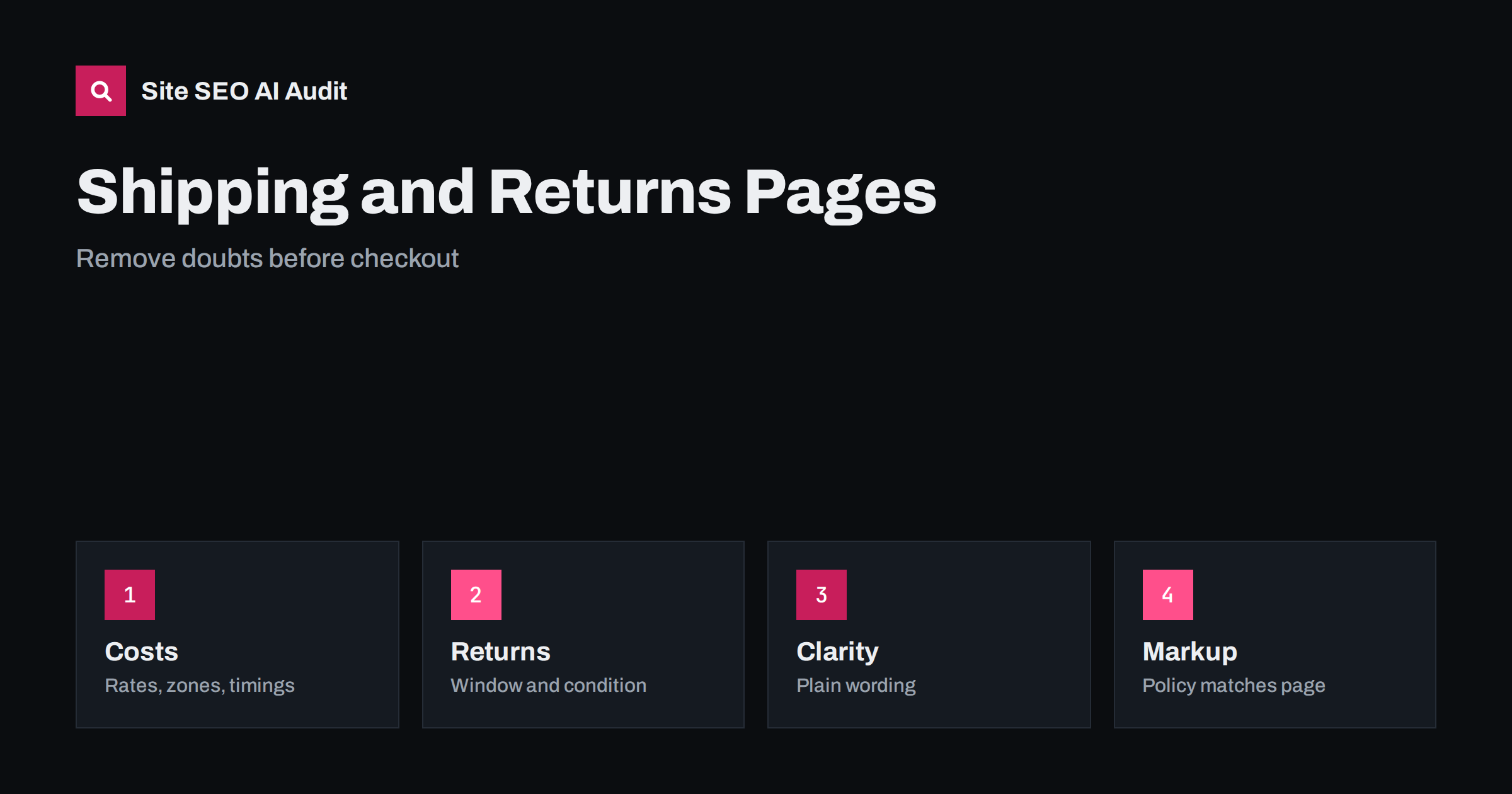
Short answer: A shipping and returns page should state delivery areas, costs, delivery times, the returns window, who pays for a return, how refunds work and how to contact you, in plain language on a page with its own address. Link to it from product pages, the cart and the footer, keep it consistent with what checkout really does, and add policy markup only where it matches the visible text. Such a page builds trust, reduces support requests and gives search systems clear facts to quote.
Shoppers look for delivery and returns information before they buy, often before they read the product description in full. If they cannot find it, they leave or ask the support team. These pages rarely get attention from SEO teams, because they are not seen as content that ranks. Yet they are quoted in AI answers, they appear as links under search results for brand queries and they affect conversion, which makes every other visit more valuable. This guide describes a practical structure and the technical details. For the broader product page work, see product page SEO.
Why these pages matter for search and users
Questions about delivery and returns are among the most common ones that shoppers type: how long does delivery take, is shipping free, can I return an item I opened. When a store has a clear page, search systems can show the answer, and an assistant can summarise it. When the page is vague or missing, they may quote a third-party review or an old forum thread instead. A good page also reduces the number of emails to support, because customers find the answer first. It is a content asset that does commercial work every day.
Cover delivery in full
List the countries or regions you ship to and any you do not. For each, state the available delivery methods, the cost or the rule for free delivery, the usual delivery time from the moment the order is dispatched and the cut-off time for same-day dispatch. Explain how orders are tracked and who handles problems, such as lost parcels or damaged goods. Mention extra costs a customer may face, such as import duties or taxes on international orders, in a clear and neutral way. Use a table for rates and times if there are many options, with real text and not an image, so that the information can be read by everyone and by crawlers.
Explain returns without jargon
Write the returns policy so that a customer can follow it in a minute. State the length of the returns period and when it starts, the condition in which items must be returned, which items cannot be returned, how to start a return, who pays for return shipping and how and when refunds are made. If you offer exchanges or store credit, describe them separately. Avoid legal language where plain words work, and do not promise more than your processes can deliver. Where the law gives customers rights in your market, make sure the page does not contradict them; if you are unsure, ask a qualified adviser.
Keep the page consistent with checkout
The most damaging mistake is a page that says one thing while the cart does another. If the page promises free delivery above a threshold and checkout charges for it, customers lose trust and the store gains complaints. Review the page whenever you change carriers, prices, packaging or processing times. Build one source of truth, such as a shared settings table, and display the same values on the page, in the cart and in confirmation emails. A tidy process also keeps your structured data honest, and it avoids mismatches that merchant listings checks may flag.
Place the page where shoppers look
Link to the page from the places where doubts arise: the product page near the price and the add-to-cart button, the cart and checkout, and the footer. Use a short summary on the product page, such as the delivery estimate and the returns period, with a link to the full page for details. Give the page a stable, readable address and one clear title that includes the words people use, such as shipping and returns. If you split the content into two pages, link them to each other. Do not hide the page behind a login or a pop-up that crawlers cannot open. The navigation principles are in navigation menus and footer links.
Write a useful title, heading and summary
Treat the page like any other: a unique title tag, a description that sums up the main promise, one main heading and short sections with clear subheadings. Open with the key facts in the first paragraph, for example the free delivery threshold, the usual delivery time and the length of the returns period, so that a reader or a machine finds the answer immediately. Follow with details. If you have many markets, create a page for each with the right language, currency and carriers, and connect them correctly, as described in international ecommerce SEO.
Use markup that matches the visible text
Merchants can describe shipping details and return policies in structured data, either at the product offer level or for the organization as a whole. Use these only when the values exist on the page and are true: the countries, the costs, the handling and transit times, the return window and the return method. Do not add values that are not shown to visitors, and keep markup updated when the policy changes. Errors in this markup may cause warnings in Search Console. Add a short FAQ section on the page if you answer common questions, and mark it up only if the questions are visible. The product-level fields are covered in the product schema guide.
Handle special situations
Some products need extra rules: perishable goods, made-to-order items, hazardous goods, oversized parcels or digital products. State the rules clearly and, where they differ strongly, give them their own sections. For seasonal peaks, such as holidays, add a dated notice at the top of the page with the last order dates, and remove it when the season ends. When an item is out of stock or discontinued, explain what the customer can expect, using the guidance in out-of-stock and discontinued products. Honest notes about delays are better than silence, and they build the reputation that assistants and reviewers pick up.
Review the page with a customer’s eyes. Open it on a phone and see whether the key facts are visible without scrolling far, whether tables fit the screen and whether the text is large enough. Ask a colleague who does not work in operations to find the returns period and the refund time, and time how long it takes. If they struggle, so will your customers. Gather the questions that support receives each month and add the missing answers to the page, so it improves with use.
Keep the language neutral and factual. Avoid superlatives that you cannot prove, such as the fastest delivery in the country, and avoid copying a competitor’s wording, since duplicated policy text offers no value and may not fit your processes. Finally, record the date of the last review on the page. Customers and machines both read dates as a sign that the information is current, which supports the trust that this page exists to create.
Consider an example of a small store that sells homeware across several countries. Its original page was a single paragraph saying that delivery takes a few days and returns are accepted within a reasonable time. Support received dozens of questions each week. The store replaced it with a page that opens with three facts: free delivery over a stated amount, a stated number of working days for the home country and a longer range for others, and a stated number of days for returns from the delivery date. Below came a rate table by country, step-by-step return instructions and a short list of items that cannot be returned. Within weeks, the number of delivery questions dropped, and the page began to appear in search results for brand queries that include the words shipping and returns.
Site SEO AI Audit crawls your store and checks that policy pages return normal status codes, are reachable by links, have titles, descriptions and headings, load quickly and carry valid structured data, and it lists broken links across the site. It does not write your policy or confirm that it matches what checkout does. The first audit of up to 200 pages is free; larger sites can see the pricing page.
Related reading
The bottom line
Publish one clear page with delivery areas, costs, times, the returns window and refund steps, keep it consistent with checkout, link it where doubts arise and add markup only for facts that visitors can see.
FAQ
Should shipping and returns be one page or two?
One page works for most stores. Split them if each section is long, and link the pages to each other.
Should the page be indexed?
Yes. It answers common questions and supports trust. Do not block it or put it behind a login.
Do I need structured data for policies?
It is optional. Use it only when every value matches the visible text and keep it updated with the policy.
How often should I update the page?
Whenever carriers, prices or terms change, and review it at least quarterly, with a visible review date.
Can I copy a competitor’s policy wording?
No. Write your own, based on what your operations really do. Copied text may not fit your processes and adds no value.