ENEnglish
 LTLietuviškai
 DEDeutsch
 FRFrançais
 RUРусский
 ESEspañol
 PLPolski
 ITItaliano
 UKУкраїнська
 CSČeština
 PTPortuguês
 JA日本語
 LVLatviešu valoda
 ETEesti
 HUMagyar
 IDBahasa Indonesia
 TRTürkçe
 HIहिन्दी
 ELΕλληνικά
 ARالعربية
 THไทย
 VITiếng Việt
 RORomână
 MSBahasa Melayu
 BNবাংলা
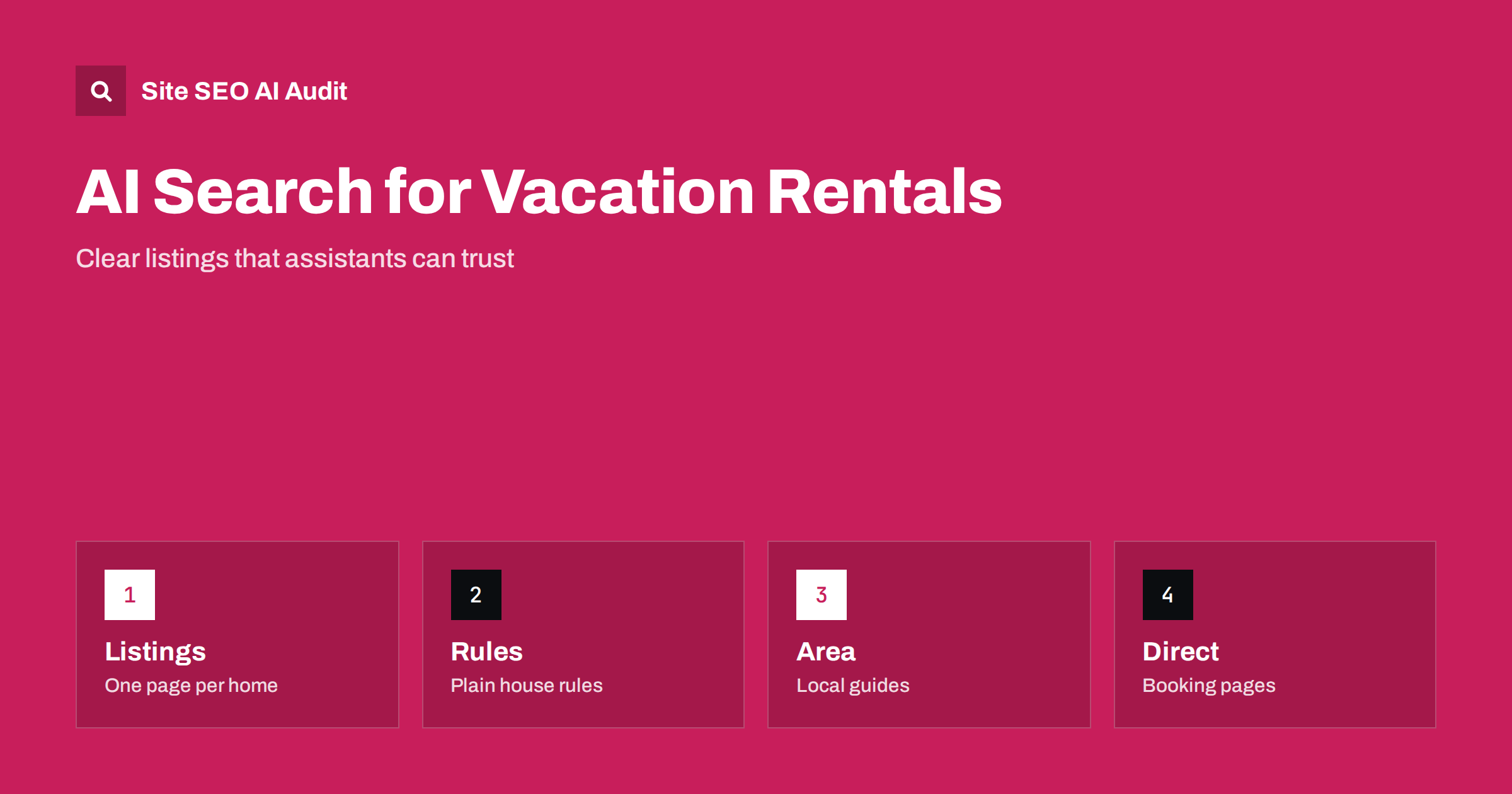
Short answer: Travellers now ask AI assistants where to stay, which area suits a family, whether pets are allowed and what is nearby. A vacation rental or property management business is more likely to be named when each home has its own detailed page, the facts match everywhere, house rules and fees are stated plainly, the surrounding area is explained with real local knowledge, and a direct booking page is easy to find and crawl. Marketplaces will remain strong, so your own site must offer clear facts that they cannot.
Holiday rentals are a crowded field. Large booking platforms dominate the first results, and AI assistants often draw on them. That does not leave owners without a role. People still ask questions that a platform listing answers poorly: is this house quiet at night, how far is the beach on foot, can we arrive late, is there a cot, what happens if the heating fails. A manager who answers such questions honestly on a well-built website gives assistants something specific to quote. This guide covers the pages, facts and technical points that matter. For the general principles of local visibility, read the guide to local business and AI search.
Give every property its own page
Do not hide your homes behind a search form or one long listing page. Each property needs a stable page with a clear name, the town or area in the title, and the facts that guests compare: number of bedrooms and beds, who it suits, size, floor, parking, accessibility, outdoor space, heating and cooling, internet, kitchen equipment and what is not included. Describe what a stay is actually like. Mention the noise from the road, the steps to the door or the shared courtyard if they exist. Honest detail reduces cancellations and gives assistants text that fits specific questions.
Use original photos with descriptive file names and alt text, as explained in the guide to image alt text. Avoid copying the same description across many similar units, which creates duplicate pages. If you manage ten flats in one building, write what is different about each: the view, the floor, the layout and the sleeping arrangements. The risk of near copies is described in the guide to thin content.
State rules, fees and policies in plain language
Many questions concern conditions rather than features. Can we bring a dog, is smoking allowed, what are the check-in and check-out times, is there a deposit, what are the cleaning and tourist taxes, how does cancellation work and can a group of young people book. Put these answers on a visible page and repeat the key ones on each property page. If a rule depends on the season, say so. Assistants cannot guess, and a missing rule often leads to a wrong answer or no answer.
Keep prices honest. If you show a starting price, state what it includes. If tax or cleaning fees are added at checkout, say so on the page. Rates change often, so avoid copying a price into long articles where it will go out of date, and mark the date of any table you publish. Pages that show up as stale are less trusted, a point covered in the guide to content dates and freshness.
Write area guides from real local knowledge
Guests rarely ask only about the house. They ask what to do in the town in October, where to eat without a booking, which beach has shallow water, how to reach the property without a car and which villages are worth a visit. A manager who lives in the area has knowledge that general sites do not. Publish guides with specific names, distances, travel times and seasonal notes, and keep them updated. A page on the best quiet beaches within twenty minutes, written by someone who goes there, is far more useful than a list of generic attractions.
Connect these guides to the homes they relate to with natural internal links, as described in the guide to internal linking. Link from each property to the guide for its area, and from each guide to the homes that suit that visit. Do not write guides for places you do not know. Weak content of that kind adds nothing and can lower the quality of the whole site.
Keep listings and facts consistent
A property usually appears in several places: your own site, booking platforms, maps, social pages and local directories. If the number of bedrooms, the address, the rules or the contact details differ, assistants may repeat the wrong version. Decide on one master record for each home and update every channel when something changes. Check the name, the address format and the phone number on your business profile against your site, using the approach in the guide to business profile and website alignment.
Use structured data to describe the business and, where suitable, the accommodation, following the guide to LocalBusiness schema. The markup must match what visitors can see. Do not add review ratings you cannot display or support, and do not mark up content that is hidden. If you are unsure, use less markup rather than more.
Make direct booking easy to find and crawl
If your booking engine is a separate widget loaded by script, test what a crawler can see. Many engines show availability and prices only after JavaScript runs, so a plain request returns an empty block. Make sure the property page itself contains the key facts as normal text, and that the link to book is a real link. The basics of rendering are covered in the guide to JavaScript content and AI crawlers.
Avoid creating thousands of calendar or search URLs for every date combination. Such pages waste crawl time and produce duplicates; if your system generates them, block or canonicalise them, using the ideas in the guide to crawl traps. Offer a clear reason to book direct, such as flexible arrival, local help or a better price, but only if it is true and stated on the page.
Answer the questions guests ask before they book
List the questions your team receives by message and phone, and turn the common ones into short answers on the relevant pages. Typical examples are how to get from the airport, whether there is a lift, where to park, whether bed linen and towels are included, how strong the wifi is for remote work, and what is open nearby in winter. A short question-and-answer block on each property page works well, and it can use the markup described in the guide to FAQ sections only where the questions are visible on the page. Write the answers as you would speak them to a guest, with exact numbers when you have them.
Check the messages you receive after launch as well. New questions are a free source of ideas, and a page that never changes after publishing slowly falls behind the real stay.
Handle reviews, guest messages and trust
Reviews influence what assistants say about a place. Encourage guests to leave honest reviews on the channels you use, answer them politely and fix repeated problems rather than only replying to them. Show a selection of real guest comments on your own site with names or initials where permitted, and keep the date. Avoid invented testimonials. Explain who manages the homes, how guests are met, who answers calls at night and how problems are solved. A short about page with real names and a contact route supports trust, as discussed in the guide to about pages.
Plan for seasons, restrictions and local rules
Short-term rentals are regulated differently from town to town. Some places require a registration number to be shown in each advertisement, some limit the number of nights and some require specific safety information. If a licence number or similar identifier is required in your area, display it on each page where the rule applies. Update pages when regulations or seasons change, and remove homes that are no longer available rather than leaving them live. Seasonal pages that return each year should keep the same address and be refreshed, as explained in the guide to seasonal pages.
As an example, a small manager with twelve homes had one page with a gallery and a booking widget. The property pages were rewritten to include sleeping arrangements, walking distances, rules and an honest note about noise. Two area guides were added, one for the old town and one for the coast. The team reported that guests wrote fewer messages asking for basic details before booking, and the pages began to appear for questions about the specific neighbourhoods.
Site SEO AI Audit crawls your website and checks status codes, titles, descriptions, duplicate and thin content, broken links, structured data, page speed and AI visibility settings, which helps you find weak or duplicated property and area pages. It does not manage bookings or listings. The first audit of up to 200 pages is free, and larger sites can see the pricing page.
Related reading
The bottom line
Describe every home honestly, keep every channel consistent and share the local knowledge a platform cannot.
FAQ
Should I stop using booking platforms?
Not necessarily. Platforms bring guests, but your own site can add facts, local guides and a direct booking route that assistants may quote.
Do I need a separate page for each home?
Yes. A separate, detailed page lets you answer specific questions about that property and avoids a thin list page.
How much detail should rules and fees have?
Enough that a guest knows the total conditions before booking. State check-in times, deposits, taxes, pets and cancellation clearly.
Is structured data required?
No, but it helps assistants read business details. The visible page must be correct first, and the markup must match it.
How often should I update the pages?
Whenever a fact changes, and at least once each season. Remove homes that you no longer offer.