ENEnglish
 LTLietuviškai
 DEDeutsch
 FRFrançais
 RUРусский
 ESEspañol
 PLPolski
 ITItaliano
 UKУкраїнська
 CSČeština
 PTPortuguês
 JA日本語
JA日本語 LVLatviešu valoda
 ETEesti
 HUMagyar
 IDBahasa Indonesia
 TRTürkçe
 HIहिन्दी
 ELΕλληνικά
 ARالعربية
 THไทย
THไทย VITiếng Việt
 RORomână
 MSBahasa Melayu
 BNবাংলা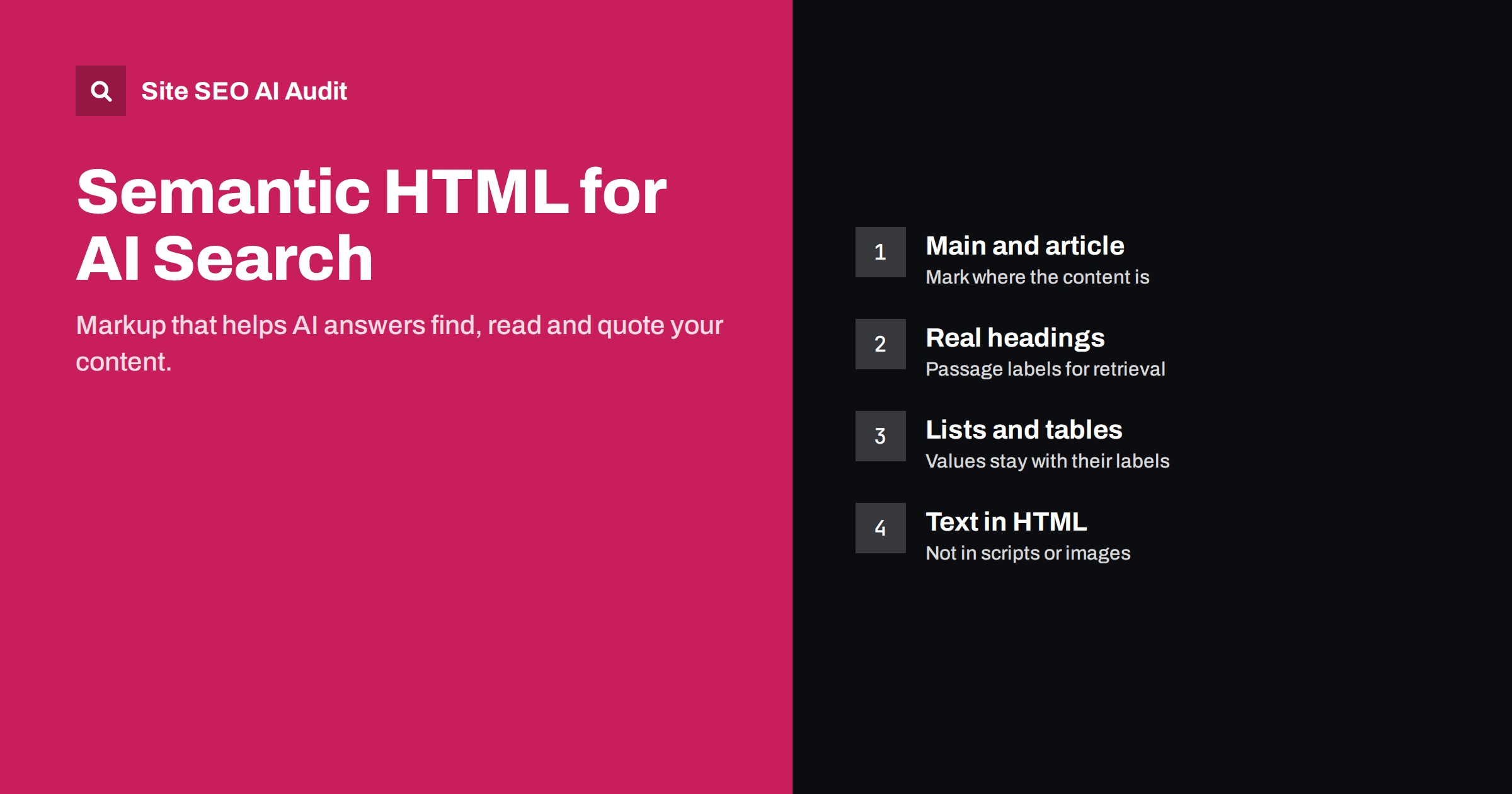
Short answer: AI search systems fetch your HTML, strip away navigation and clutter, split the main content into passages and decide which passages answer a question. Semantic HTML makes each of those steps easier: a <main> or <article> element marks the content, real headings mark topics, <ul>, <ol> and <table> keep lists and data intact, and text in the HTML rather than in scripts or images can be read at all. It is not a ranking trick; it removes reasons for machines to misread or skip your content.
How AI systems read a web page
Whether a page is used by an AI search tool, an AI overview in a search engine or an assistant browsing on a user’s behalf, the processing usually follows similar steps:
- Fetch. A crawler or fetcher requests the URL and receives HTML. Many AI crawlers do not run JavaScript.
- Extract. Boilerplate such as menus, footers, cookie banners and sidebars is removed, leaving the main content.
- Segment. The content is split into smaller passages, often along headings and paragraphs.
- Retrieve and rank. Passages that best match the question are selected.
- Generate and cite. The answer is written from those passages, sometimes with a link to the source.
Every step depends on how clearly the HTML expresses the structure of the page. When the structure is only visual, created with styled <div> elements, the machine has to guess. The overall process is described in more detail in how AI search engines work.
What “semantic HTML” means
Semantic HTML means using elements for their meaning rather than their appearance. A heading is marked as <h2>, not as a bold <div> with a large font. A list is a <ul> with <li> items, not lines separated by <br>. A table of values is a <table>, not a grid of styled boxes.
Browsers display both versions the same way after CSS, so humans often do not notice the difference. Machines do. Screen readers, search engine crawlers and AI extraction tools all rely on the element names to understand what they are looking at. The same markup that improves accessibility tends to improve machine readability. The reference for every element is on MDN’s HTML elements reference.
Mark the main content clearly
Extraction tools need to separate what the page is about from everything around it. Help them with landmark elements:
<main>wraps the primary content of the page. Use it once per page.<article>wraps a self-contained piece, such as a blog post or product description. On a single post page, the post sits in one article element.<header>,<nav>,<aside>and<footer>mark the parts that are not the main content.
Common problems are pages where the article text is split across many unrelated containers, related-post widgets placed inside the article element, and several <article> elements on a single post page because the theme wraps comments or teasers the same way. Each makes it harder to tell where the real content starts and ends.
On WordPress and similar systems these elements come from the theme, not from the editor. Check the single post, page, product and archive templates once, because every page built from a template inherits its landmarks. Page builders deserve particular attention: some wrap every block in several layers of generic containers and never output a main element at all. If you switch themes, repeat the check, since landmarks are one of the first things that change silently.
Headings as a map of passages
Headings do more than organise the page visually. For AI retrieval, they often define the boundaries of passages and give each passage its topic.
- One H1 that states what the page is about.
- H2 for each main question or subtopic, written as a clear, specific phrase. “How long does shipping to Canada take?” is a better passage label than “Details”.
- H3 for subsections inside an H2 section, without skipping levels for styling reasons.
- No fake headings. Bold paragraphs styled to look like headings are invisible as structure; real headings styled to look small are fine.
Our guide to heading structure for SEO explains the rules in detail. The practical test: read only your headings. If they outline the page and each one predicts the content below it, machines can use them too.
Lists, tables and definitions
Many AI answers are lists, steps or comparisons. Content that is already structured this way in HTML is easy to extract without distortion.
- Steps belong in
<ol>, so the order is explicit. - Options, features and requirements belong in
<ul>. - Comparisons and specifications belong in a
<table>with<th>header cells, so each value is tied to its row and column. - Terms and definitions can use
<dl>,<dt>and<dd>.
Tables built from styled <div> grids are a frequent problem, especially in pricing sections and product specifications. After extraction, they become a jumble of values with no labels. A real table keeps “Weight: 1.2 kg” together. The writing side of quotable content is covered in how to write content that AI answers quote.
Keep important text in the HTML
Semantic markup only helps if the text is there. Several common patterns hide content from machines:
- Content rendered only by JavaScript. Many AI crawlers read the initial HTML only. If your product descriptions, prices or articles are inserted by scripts, they may be missing entirely. See why AI crawlers miss JavaScript content.
- Text in images. Infographics, banners and screenshots of tables carry no machine-readable text unless you repeat it on the page.
- Content inside tabs and accordions loaded on click. Content that exists in the HTML but is visually collapsed is usually fine; content fetched only when a tab is clicked is not.
- Text in iframes and embedded widgets. These are separate documents and are usually not attributed to your page.
Small elements that add clarity
Several less-known elements give machines precise information:
<time datetime="2026-10-01">for publication and update dates, which helps systems judge freshness. Dates matter for AI answers, as explained in content dates and freshness.<address>for contact information of the page or organisation.<figure>and<figcaption>to connect images and charts with their descriptions.<blockquote>and<cite>to mark quotations and their sources, so they are not mistaken for your own claims.<code>and<pre>for commands and code, which keeps them intact.- Descriptive link text instead of “click here”, so links carry meaning out of context.
- A correct
langattribute on the<html>element, so the language is not guessed.
Semantic HTML vs structured data
Semantic HTML and structured data solve different problems and work best together.
| Semantic HTML | Structured data (JSON-LD) | |
|---|---|---|
| What it describes | The structure of the visible content: sections, headings, lists, tables | Facts about entities: organisation, product, price, author, dates |
| Who benefits | Every reader, including screen readers, crawlers and AI extractors | Systems that parse schema.org vocabulary |
| Risk if missing | Content misread, merged or skipped during extraction | Fewer explicit facts; no rich results where eligible |
| Effort | Mostly in theme templates and editor habits | Usually generated by the CMS or an SEO plugin |
For an honest look at what markup does and does not do for AI answers, read does structured data help in AI search.
A quick semantic HTML audit
You can check the basics on a few key templates in under an hour:
- View the page source (not the rendered DOM) and confirm the main text is present.
- Look for one
<main>and, on posts, one<article>around the content. - List the headings with a browser extension or accessibility tool and check the outline.
- Find lists and tables that are built from
<div>elements and convert them in the template. - Check that dates, prices and key facts appear as text, not only in images.
Site SEO AI Audit checks the related signals across every page of a site: H1 problems, content that needs JavaScript to appear, structured data validity, and the AI visibility area, which covers AI crawler access in robots.txt, llms.txt and whether content is structured and dated in ways AI answers can quote. The first audit is free.
Related reading
- AI agents browsing websites: how to be agent-friendly
- Table of contents and jump links: when they help long pages
- AI search visibility checklist: 25 things to audit
The bottom line
AI systems extract and quote passages, and semantic HTML tells them where the content is, how it is organised and which values belong together. Mark the main content, use real headings, lists and tables, keep important text in the HTML and use elements like <time> for precise facts. Most of the work is a one-time fix in your templates, and it improves accessibility at the same time.
FAQ
Does semantic HTML improve rankings in AI search?
It is not a direct ranking factor. It makes your content easier to extract and interpret correctly, which removes obstacles to being used and cited.
Do AI crawlers read CSS to understand layout?
Generally not in a meaningful way. Extraction relies mostly on the HTML elements and text, which is why visual-only structure is easily lost.
Is a div-based layout bad for SEO?
Divs are fine for layout. The problem is using divs where a heading, list or table is meant, because the meaning of the content is then lost to machines.
Should every page use the article element?
Use it for self-contained content such as blog posts, news items and product descriptions. Pages like contact forms or dashboards do not need it, but every page benefits from one main element.
Does semantic HTML also help accessibility?
Yes. Screen readers use the same headings, landmarks, lists and tables to let users navigate. Improving one usually improves the other.