ENEnglish
 LTLietuviškai
 DEDeutsch
 FRFrançais
 RUРусский
 ESEspañol
 PLPolski
 ITItaliano
 UKУкраїнська
 CSČeština
 PTPortuguês
 JA日本語
JA日本語 LVLatviešu valoda
 ETEesti
 HUMagyar
 IDBahasa Indonesia
 TRTürkçe
 HIहिन्दी
 ELΕλληνικά
 ARالعربية
 THไทย
THไทย VITiếng Việt
 RORomână
 MSBahasa Melayu
 BNবাংলা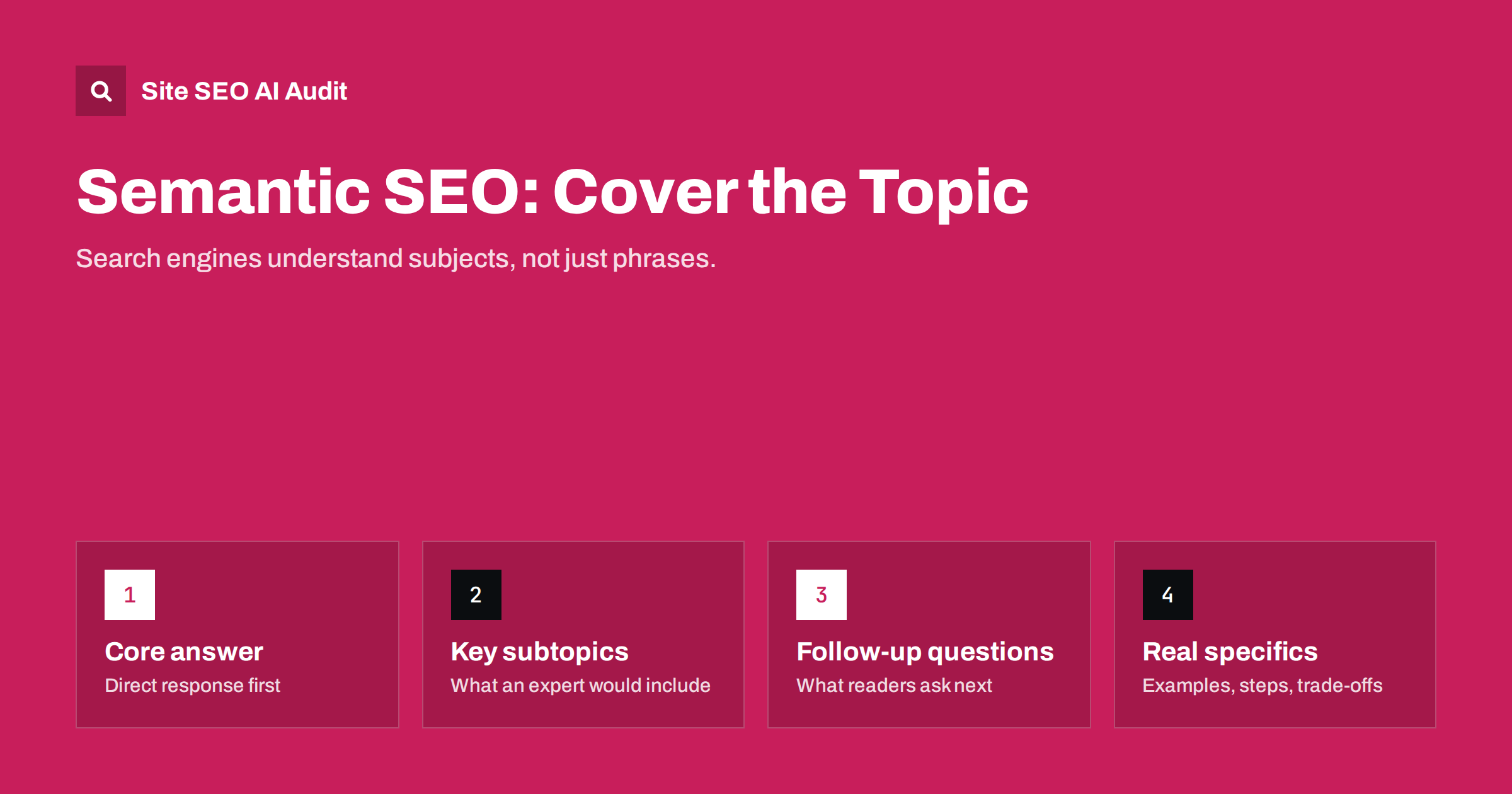
Short answer: Semantic SEO means writing for the topic behind a search, not just the keyword: covering the questions, subtopics, terms and examples that anyone who really understands the subject would include. Search engines understand language and relationships between concepts, so a page that thoroughly and clearly covers a topic tends to be matched with many related searches. Build coverage from real questions and expert knowledge, not from lists of keyword variants.
From keywords to topics
Early search engines matched pages to queries largely by the words on the page. If you wanted to rank for “cheap running shoes”, you repeated “cheap running shoes”. That era is long gone. Modern search engines understand synonyms, recognize that “trainers” and “running shoes” can mean the same thing, know that a page about marathon training is related to one about running shoes, and can tell whether a page genuinely explains a subject or just repeats a phrase.
The practical consequence is a shift in how to think about content. Instead of asking “how many times should this phrase appear?”, ask “what does someone searching this need to understand, and does my page cover it?” A page that answers the main question and the obvious follow-up questions, uses the natural vocabulary of the subject and connects to related topics is what search engines are designed to find.
This is often called semantic SEO. The name sounds technical, but the idea is what good writers and teachers have always done: explain a subject completely and clearly.
What “covering a topic” actually means
Topic coverage has several layers. A page that covers a subject well usually includes:
- The core answer: the direct response to the main question.
- The key subtopics: the parts of the subject that anyone explaining it would mention.
- The follow-up questions: what readers typically want to know next.
- The natural vocabulary: the terms, names and concepts associated with the topic.
- Context and relationships: how the topic connects to related topics, with links where useful.
- Specifics: examples, steps, numbers and trade-offs that show real understanding.
For example, a page about “how to choose running shoes” that never mentions cushioning, heel-to-toe drop, fit, pronation, running surface or when to replace shoes is not a thorough answer, no matter how often it says “running shoes”. A page that covers those naturally will contain the words people search for without trying.
How to find what a topic should cover
Look at the questions people ask
Search engines show “People also ask” boxes, related searches and autocomplete suggestions for most topics. Together they are a free map of what searchers want to know. Customer emails, support tickets, sales calls and forum threads add questions that tools do not show.
Study the pages that already rank
Read the top results for the main query. List the subtopics that most of them cover; those are probably expected. Then list what they miss or explain poorly; those are your opportunities to be better.
Use your own expertise
The most valuable parts of a page are often ones that no tool suggests: the mistakes you see customers make, what surprised you when you did the work, the trade-offs experts argue about. These details are also the hardest for competitors to copy.
Check your Search Console queries
If the page already exists, the queries it receives impressions for show how search engines understand it. Queries you rank poorly for may point to subtopics the page only touches on.
Turning coverage into structure
Once you know what the topic includes, organize it so readers and search engines can see the coverage at a glance:
- Open with the direct answer to the main question.
- Give each key subtopic its own H2 section with a descriptive heading.
- Answer follow-up questions in H3 subsections or an FAQ.
- Use lists for steps and options and a table for comparisons.
- Link to your deeper pages on subtopics that need more space than this page can give.
A clear structure makes thorough coverage usable. Without it, a long page becomes a wall of text that readers skim past.
An example: planning coverage for one page
Suppose you are writing a page for “how to descale a coffee machine”. A keyword-first approach would list variants: “descale coffee machine”, “descaling coffee maker”, “coffee machine descaler”. A topic-first approach asks what someone descaling a machine needs to know:
- Why descaling matters: limescale, taste, machine life, and signs that it is overdue, such as slower brewing.
- How often: depends on water hardness and use; how to find your water hardness.
- What to use: commercial descalers, citric acid, and the vinegar debate, with the honest trade-offs and the manufacturer’s warranty conditions.
- Step by step: for drip machines, for espresso machines, for pod machines, since the steps differ.
- Rinsing: how many cycles and how to get rid of any aftertaste.
- Troubleshooting: what to do if the descale light stays on, or the machine still runs slowly.
- Prevention: filtered water, regular cleaning.
Written this way, the page naturally includes every variant a keyword tool would suggest, plus words like “limescale”, “water hardness”, “citric acid” and “descale light” that searchers use in their follow-up questions. It also answers those follow-ups, which is exactly what makes a reader stop searching.
Coverage is not the same as length
Thorough coverage often makes pages longer, which leads some people to conclude that longer is better. It is not. Length that comes from covering what readers need is useful; length that comes from padding, repetition and tangents is not.
| Useful depth | Padding |
|---|---|
| Answering the follow-up questions readers actually have | Restating the same point in different words |
| Specific examples and steps | Generic statements that apply to anything |
| Explaining trade-offs and exceptions | Long introductions about why the topic matters |
| Defining terms readers may not know | Definitions of things every reader already knows |
| Linking to deeper pages for side topics | Covering every side topic in full on one page |
A simple question deserves a short page. A complex subject deserves a thorough one. Match depth to the topic, not to a word count target.
One page or several?
Semantic SEO also shapes how you divide content between pages. If a subtopic has its own clear search intent and needs a detailed answer, it usually deserves its own page, linked from the broader one. If it is a small part of the main question, it belongs as a section on the main page.
This is where topic clusters help. A broad overview page covers the whole subject at a useful level and links to detailed pages on each subtopic, which link back. Search engines can see how the pages relate, readers can move between overview and detail, and no two pages compete for the same question.
Common mistakes
- Keyword lists disguised as content: sections that exist only to include variants, such as “running shoes for men”, “running shoes men”, “men’s running shoes”.
- Chasing tool scores: adding terms because a content tool suggests them, whether or not they help the reader.
- Covering everything on one page: turning a focused answer into an encyclopedia that serves nobody well.
- Ignoring the obvious next question: explaining how to do something but not what to do when it fails.
- Generic content: text that could appear on any site, with no specifics or experience.
Checking coverage and quality on your site
Coverage is a judgment call, best checked by someone who knows the subject reading the page against the questions people ask. But weak coverage leaves traces an audit can find: thin pages with little content, near-duplicate pages that split a topic, pages with vague or duplicate titles, and important pages that receive few internal links from related content. Site SEO AI Audit checks these across every page, and its AI visibility checks look at whether content is structured in a way AI answers can quote. See the plans or run a free first audit.
Related reading
- Topic Clusters and Pillar Pages: How to Structure Content
- Keyword Placement: Where to Use Keywords on a Page
- Entity SEO: Helping AI Systems Understand Your Brand
- Search Intent: How to Match Your Page to What Searchers Want
The bottom line
Search engines understand topics, not just words. Write pages that answer the main question directly, cover the subtopics and follow-up questions an expert would include, use the subject’s natural vocabulary, and add specifics from real experience. Organize the coverage with clear headings, split distinct subtopics into their own linked pages, and let depth follow the topic rather than a word count.
FAQ
What is semantic SEO?
It is the practice of optimizing for the meaning and topic behind searches rather than exact keywords. In practice it means covering a subject thoroughly, answering related questions and using natural language, so search engines can match the page to many related queries.
Do I still need to use keywords?
Yes, but naturally. Use the main phrase in the title, H1 and opening, and let the rest of the vocabulary come from covering the topic well. Repeating variants does not add coverage.
How do I know if my page covers a topic well enough?
Compare it with the questions people ask and the subtopics the best results cover. If a knowledgeable reader would find obvious gaps, the page is incomplete. If they would find padding, it is too long.
Should I use content optimization tools?
They can remind you of subtopics and terms, which is useful. Treat their suggestions as prompts to check your coverage, not as a checklist of words to insert.
Is longer content better for semantic SEO?
Not in itself. Thorough coverage of a complex topic often produces a long page, but padding does not add coverage. Simple questions deserve short, direct answers.