ENEnglish
 LTLietuviškai
 DEDeutsch
 FRFrançais
 RUРусский
 ESEspañol
 PLPolski
 ITItaliano
 UKУкраїнська
 CSČeština
 PTPortuguês
 JA日本語
JA日本語 LVLatviešu valoda
 ETEesti
 HUMagyar
 IDBahasa Indonesia
 TRTürkçe
 HIहिन्दी
 ELΕλληνικά
 ARالعربية
 THไทย
THไทย VITiếng Việt
 RORomână
 MSBahasa Melayu
 BNবাংলা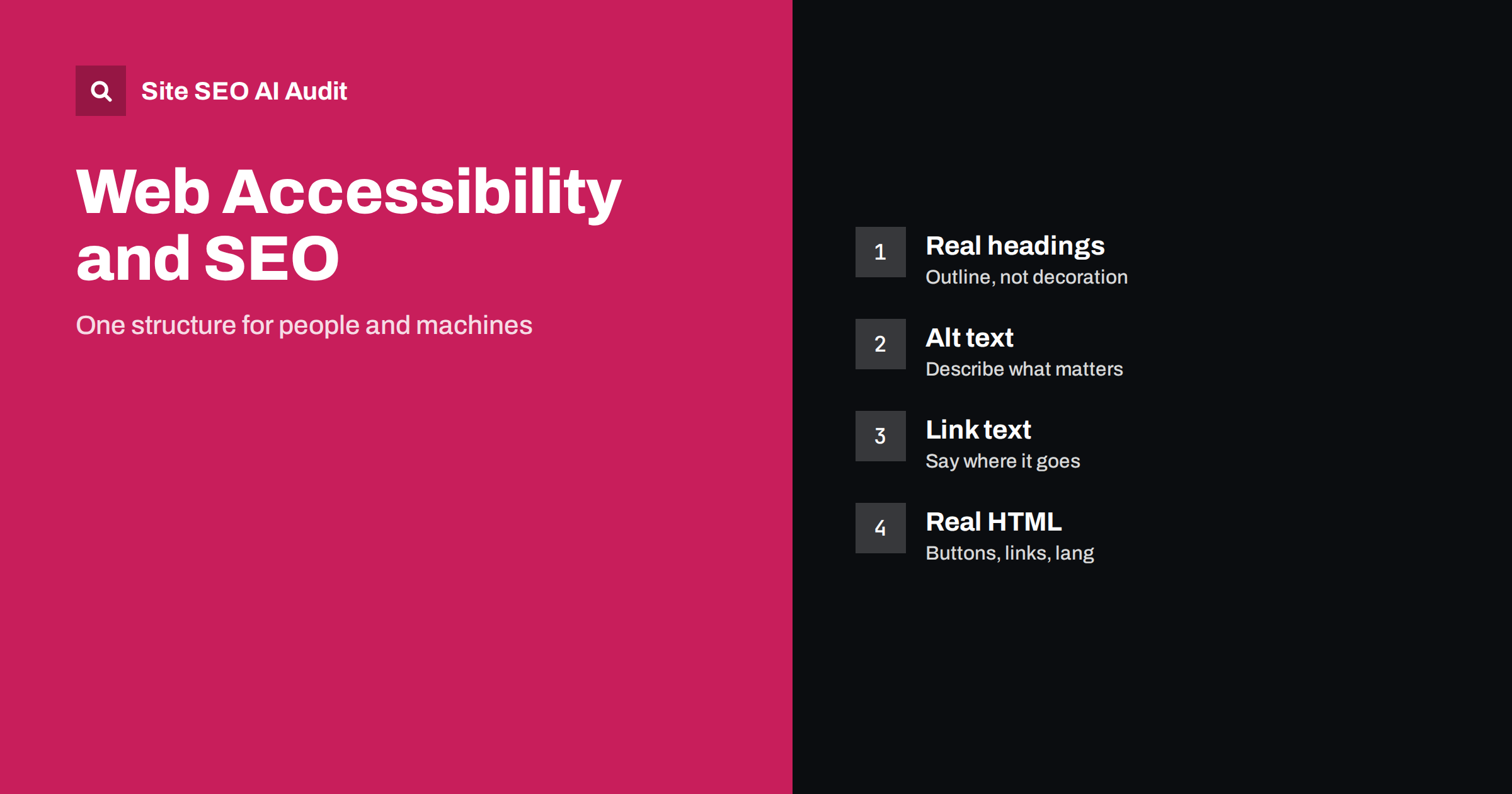
Short answer: Accessibility and SEO overlap because screen readers, search engine crawlers and AI systems all depend on the same thing: clear, real HTML structure. Descriptive headings, meaningful alt text, link text that says where the link goes, a correct lang attribute, real links and buttons, captions and transcripts, and text that is not locked inside images help disabled users and machines at the same time. Accessibility is not a ranking factor in itself, and it has needs that SEO does not cover, such as contrast and keyboard use, but most fixes help both.
Accessibility is often treated as a legal checkbox and SEO as a marketing task, handled by different people with different tools. In practice they touch the same templates and the same content. A site that works well with a screen reader is usually easy for crawlers to understand, and many common SEO problems are also accessibility barriers. Knowing where they overlap helps you fix things once.
Why the two overlap
A screen reader does not see your design. It reads the document: the title, the headings, the text, the links, the image descriptions, the form labels. A search engine crawler and an AI system do much the same. They parse HTML, build a picture of the page’s structure and decide what each part means. When the structure is clear, both can work with it. When meaning exists only in visual design, such as big bold text that is not a heading, an icon without a label, or text baked into an image, both lose information.
The Web Content Accessibility Guidelines, published by the W3C, are the standard reference; the WCAG overview explains their principles. Several of its requirements map directly onto SEO practices, as the next sections show.
Headings: one outline for everyone
Screen reader users often navigate by headings, jumping from one to the next to find the part they need. Search engines and AI systems use headings to understand the topics of a page and to extract sections as answers. Both need the same thing:
- one
h1that states the main topic of the page; h2andh3headings that describe the sections that follow, in a logical order;- no heading tags used only to make text big, and no visually styled “headings” that are really paragraphs;
- descriptive wording, such as “Delivery times to the EU”, not “Good to know”.
Our guides to H1 best practices and heading structure cover the details. Skipped heading levels are a minor issue for search but can confuse screen reader users, so keep the outline tidy.
Alt text: describe what matters
Alt text is the clearest overlap. For a blind user, the alt attribute replaces the image. For a search engine, it is a main source of information about what the image shows and how it relates to the page. Good alt text serves both:
- describe what the image shows that matters in context, briefly;
- for images that contain text, such as a chart or an infographic, give the key information in the alt text or in nearby text;
- for purely decorative images, use an empty alt attribute (
alt="") so screen readers skip them; - do not stuff keywords into alt text; it makes pages harder to use and adds nothing for search.
Our image alt text guide has examples for product photos, charts, logos and icons.
Link text that says where it goes
Screen reader users can list all links on a page and choose one. A list of ten “click here” and “read more” links is useless to them. Search engines use anchor text to understand what the linked page is about, so the same vague links waste a ranking signal. Write link text that makes sense on its own: “compare our delivery options” instead of “click here”, “read the full returns policy” instead of “more”. Our guide to anchor text best practices explains how to vary it without stuffing keywords.
Also watch for empty links: icon links with no text and no accessible name, such as a social media icon or a cart icon. They are announced as “link” with no destination and give crawlers no anchor text at all. Add visible text, a visually hidden label or an aria-label.
Real links, buttons and forms
Elements that look like links but are built from div or span elements with JavaScript click handlers cause problems for both audiences. Keyboard users cannot reach them, screen readers do not announce them as links, and crawlers do not follow them because there is no href. Use:
<a href="...">for navigation to another page or section;<button>for actions on the same page, such as opening a menu;<label>elements connected to form fields, so the purpose of each field is clear.
Our guide to JavaScript SEO basics covers why crawlers need real links to discover pages.
Language, titles and page structure
A few document-level details help both audiences:
- The lang attribute. Screen readers use it to choose the right pronunciation; search engines use it among other signals for language. Our article on the HTML lang attribute explains how to set it per page and for passages in another language.
- Descriptive page titles. The title is the first thing a screen reader announces and the main text of a search result. Each page needs a unique one.
- Landmarks. Using
header,nav,mainandfooterelements lets screen reader users jump to the main content and helps machines separate content from boilerplate. - Tables used for data, not layout, with header cells marked as such.
Video, audio and text in images
Captions and transcripts make video and audio usable for deaf and hard-of-hearing users. They also give search engines and AI systems text they can read, because the spoken content of a video is otherwise largely invisible to them. A transcript on the page, or a detailed summary, can make a video page rank for the questions it actually answers. Our guide to video SEO covers the rest of the setup.
Text inside images, such as banners with offers or infographics, is a barrier for screen reader users and weak for search. Use real HTML text for important messages and keep images for what images do well.
Where accessibility goes beyond SEO
The overlap is large but not complete. Some accessibility requirements have little or no direct SEO effect, and they still matter for real people and often for legal compliance:
| Area | Accessibility need | Direct SEO effect |
|---|---|---|
| Colour contrast | Readable text for people with low vision | Little; helps engagement |
| Keyboard navigation | Every function usable without a mouse | Little, except real links help crawling |
| Focus indicators | Visible focus when tabbing | None |
| Motion and animation | Option to reduce motion | None directly |
| Form errors | Clear, announced error messages | None directly; helps conversions |
| Zoom and reflow | Content usable at 200–400% zoom | Related to mobile-friendly layouts |
Do not stop at the fixes that help rankings. An SEO audit is not an accessibility audit; for the full picture, test with keyboard and screen reader and use a dedicated accessibility checker.
What to fix first
If you want fixes that pay off twice, start where the overlap is biggest and the effort is usually lowest:
- missing or vague alt text on meaningful images, and empty alt on decorative ones;
- missing, duplicate or decorative headings, starting with the H1;
- empty links and vague “click here” anchors, especially in templates;
- a missing or wrong lang attribute;
- navigation built without real links;
- videos without captions or transcripts.
Fix templates before individual pages, because one header, footer or product template can affect every page on the site.
Find the overlapping issues on every page
Several of the problems above are measurable across a whole site. Site SEO AI Audit checks every crawled page for missing image alt texts, H1 and heading problems, empty anchors, lang attributes and titles, and ranks each issue by how many pages it affects, so template-level fixes show up first. It does not replace a full accessibility test with keyboard and screen reader. Try a free audit of up to 200 pages to see which overlapping issues your site has.
Related reading
The bottom line
Screen readers, crawlers and AI systems read the same HTML, so clear structure helps all of them. Start with the shared fixes: real headings, useful alt text, descriptive link text, real links and buttons, a correct lang attribute and captions for media. Then go beyond SEO with contrast, keyboard and focus checks, because accessibility is about people, not rankings.
FAQ
Is accessibility a Google ranking factor?
Not directly. Google does not rank pages by an accessibility score. But many accessibility practices, such as clear headings, alt text, descriptive links and real HTML links, also help search engines understand and crawl pages, so they support SEO indirectly.
Does alt text help both SEO and accessibility?
Yes. Alt text replaces the image for screen reader users and tells search engines what the image shows. Write a short, accurate description of what matters in context, and use an empty alt attribute for decorative images.
Can an SEO audit replace an accessibility audit?
No. An SEO audit finds the overlapping issues, such as missing alt text, headings and empty links, but not contrast, keyboard access, focus order or screen reader behaviour. Use a dedicated accessibility check and manual testing as well.
Do accessibility overlays fix SEO or accessibility problems?
Overlay widgets that change pages with JavaScript do not fix the underlying HTML, which is what crawlers and many assistive technologies read. Fix the templates and content directly instead.
Which accessibility fix helps SEO the most?
Usually a clean heading structure and descriptive link text in templates, because they affect every page. Missing alt text on product and article images is often the next biggest shared win.