ENEnglish
 LTLietuviškai
 DEDeutsch
 FRFrançais
 RUРусский
 ESEspañol
 PLPolski
 ITItaliano
 UKУкраїнська
 CSČeština
 PTPortuguês
 JA日本語
 LVLatviešu valoda
 ETEesti
 HUMagyar
 IDBahasa Indonesia
 TRTürkçe
 HIहिन्दी
 ELΕλληνικά
 ARالعربية
 THไทย
 VITiếng Việt
 RORomână
 MSBahasa Melayu
 BNবাংলা
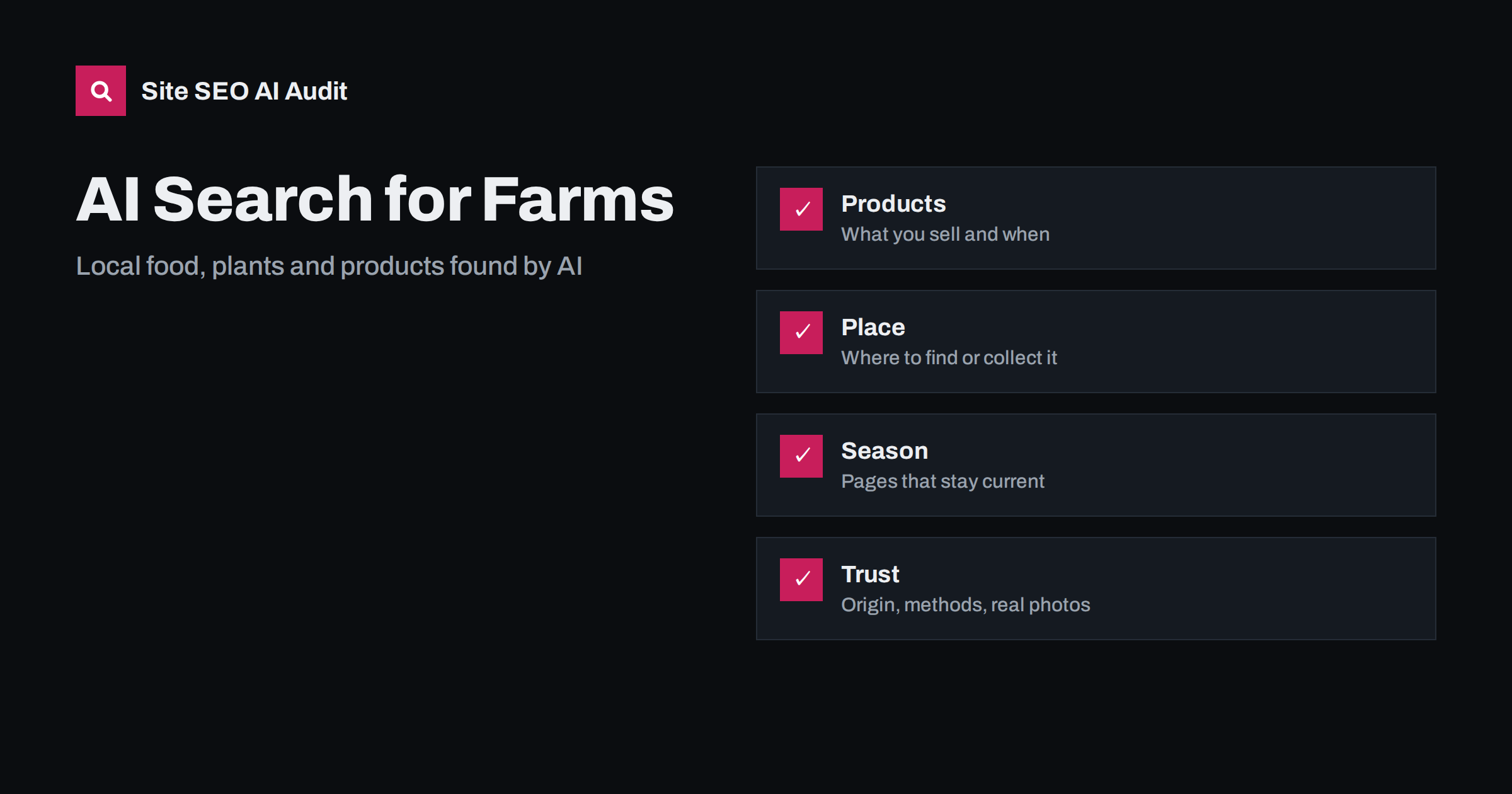
Short answer: Farms, garden centres, bakeries and small food producers get recommended by AI assistants when their websites state clearly what they sell, where and when, how it is produced and how to buy or collect it. Publish a page for each product group, keep seasonal availability and opening hours current, show real origin and methods, make your name and address match across listings, and answer the questions customers ask before they visit or order.
People increasingly ask assistants things like where to buy fresh vegetables near me, which farm sells raw honey, when strawberry picking starts, where to find a garden centre with fruit trees or which bakery has gluten-free bread on Saturdays. These are local, seasonal and practical questions. Small producers often have the best answers but the weakest websites: a social media page, a phone number and a few pictures. An assistant cannot quote what it cannot read. This guide explains which information to put on your site, how to keep it current and how to protect trust and honesty in a sector where claims about origin and quality matter.
What customers ask about local producers
The questions follow a clear pattern, and each type deserves a place on your site.
- Products: what do you grow, make or sell, and which varieties, sizes and packages exist?
- Availability: what is in season, what is sold out and when will the next harvest or batch arrive?
- Place and time: where is the farm shop or stand, what are the opening hours, and are there market days?
- Buying: can I order online, reserve by phone, join a subscription box or collect on site? Do you deliver?
- Origin and methods: where is it produced, how, and are there certifications?
- Visits: can I pick my own fruit, tour the farm, bring children or dogs, and is there parking?
An assistant combines the answers from several sources. The more clearly your own site states these facts, the less it needs to guess. The mechanics are explained in how AI search engines work.
Organise products into clear pages
A single page with a gallery and the word “products” is not enough. Create a page for each product group: vegetables, fruit, eggs, cheese, honey, bread, bedding plants, trees and shrubs, tools, gift boxes. Each page should open with a short description of what the group includes and how to buy it. Then list the items with names, varieties, units and, where you are willing to publish them, prices. Use the same names customers use, including the local names of varieties.
If you sell online, give each product its own page with a unique description, clear photographs and availability, following the practices in product page SEO. For plants, include practical details such as size, planting season, sun or shade, and hardiness for the local climate. For food, include ingredients, allergens and storage advice, because customers and assistants look for them. Do not copy a supplier’s description word for word; it is a risk for duplicate content, as explained in manufacturer product descriptions and duplicate content.
Keep seasonal availability accurate
Seasonality is your biggest advantage and your biggest risk. People search for asparagus in spring, pumpkins in autumn and Christmas trees in December, and every year the same questions return. Use one stable page for each seasonal product and update it every year instead of creating a new page each time, as recommended in seasonal pages and SEO. State clearly the current status: expected start of the season, available now, limited stock, sold out until next year. Put a visible “last updated” date, and remove old announcements.
The cost of stale information is high. If an assistant tells someone that you sell strawberries in October because last year’s page was still live, the customer drives to a closed stand and does not return. A short weekly routine to update availability is more valuable than a redesign. If you use social posts for daily news, also repeat the important facts on your website, because text on a page is easier for machines to read than a feed.
Opening hours, location and visiting information
For a farm shop, a garden centre or a market stall, the most requested facts are the address, the opening hours and how to find you. Give a full postal address, directions that help in the last kilometre (rural places are often hard to locate on a map), parking information and accessibility details. List the opening hours, including seasonal changes, holidays and market days. If hours change, update the website and your map profile on the same day. A master sheet with your official name, address, phone number, hours and description makes it easy to keep every listing consistent. The guide for AI search for local businesses explains the checks in detail.
If you offer visits, such as pick-your-own days, farm tours, workshops or tastings, give each event or activity a page with dates, prices, age limits, what to bring and how to book. Keep past events visible with a note that they have ended, and link to the next one, using the approach in event page SEO.
Origin, methods and honest claims
Customers care about where and how food and plants are produced. Explain your methods in plain language: how animals are kept, how crops are grown, what you do and do not spray, how products are processed and how long they keep. Use certifications and labels only if you hold them, name the issuing body and, where possible, link to the official register. Terms such as organic, natural, free-range or local have specific legal meanings in many places, and using them wrongly can cause legal trouble as well as loss of trust.
Real people and real photographs matter. Show the farmers, the fields, the workshop and the packing process. A short page about the people behind the business supports the signals discussed in E-E-A-T and AI search. Do not claim rankings, awards or “best in the region” statements you cannot document. If you use reviews, make sure they are genuine and respond to criticism politely.
Selling online, subscriptions and delivery
Many small producers now take orders online. Explain clearly what can be ordered, minimum quantities, delivery areas, delivery days and costs, packaging and how perishable goods are handled. State your returns and refund policy for food and for plants, which have special rules. Add a short page on how ordering works, with the steps in order. For subscription boxes explain what is included, how often, how to pause or cancel and what happens when a product is unavailable.
If you use an online shop plugin, check that products, categories and filters do not create endless duplicate URLs; the issues for a typical store are described in WooCommerce SEO. Make sure the checkout and contact pages work on a phone, because most customers will visit from one.
Structured data and consistent listings
Structured data helps a system classify your business and your products, as long as it matches the visible page. Mark up the business with its name, address, contact details and opening hours; the options and common errors are described in the LocalBusiness schema guide. Online products can use product markup with real price and availability, following the Product schema guide. Keep both accurate and updated. Markup that contradicts the page can be ignored or cause problems.
Outside your site, claim and complete your profiles on map services, regional producer directories, farmers’ market pages and tourism sites, and use identical details everywhere. A mention in a regional food guide or on a local association page is a useful trust signal, and an unlinked mention still helps assistants recognise your business, as discussed in unlinked brand mentions.
Check the basics with an audit
Producer websites are often built quickly and then forgotten. Images are huge, pages load slowly on mobile connections, titles repeat and old seasonal pages linger. A crawl shows the slow pages, missing descriptions, broken links and duplicates. Site SEO AI Audit scores your site across seven areas, including AI search visibility, and ranks the fixes by impact. The first audit of up to 200 pages is free, and the pricing page shows how to repeat it before each season starts.
Related reading
- AI Search for Local Businesses: What to Fix First
- AI Search for Restaurants and Cafes: What to Fix First
- Seasonal Pages and SEO: Keep One URL Year After Year
- LocalBusiness Schema: Types, Fields and Common Mistakes
The bottom line
A producer with a clear website beats a better producer with a hidden one. State what you sell, when it is available, where to find you and how it is made, keep seasonal pages current, match your listings and make only claims you can prove. An assistant asked about local food or plants then has accurate material to quote.
FAQ
What should a farm shop publish first?
Start with the address, opening hours and a clear list of what you sell, grouped by product type. Add seasonal availability and how to buy next.
Should I create a new page each season?
No. Keep one page for each seasonal product and update it every year. That page builds history, and customers and assistants find the current version at the same address.
Do I need an online shop to be found by AI assistants?
No. A clear website with products, availability, location and contact details is enough. An online shop helps if you really want to sell and deliver remotely.
Can I use words like organic or local?
Only if you meet the legal definition where you operate. Name the certifier or label when you hold one, and explain your methods in plain language.
Is a social media page enough?
It helps for daily news, but facts on your own website are easier for machines to read and stay under your control. Repeat the key information on the site.