ENEnglish
 LTLietuviškai
 DEDeutsch
 FRFrançais
 RUРусский
 ESEspañol
 PLPolski
 ITItaliano
 UKУкраїнська
 CSČeština
 PTPortuguês
 JA日本語
 LVLatviešu valoda
 ETEesti
 HUMagyar
 IDBahasa Indonesia
 TRTürkçe
 HIहिन्दी
 ELΕλληνικά
 ARالعربية
 THไทย
 VITiếng Việt
 RORomână
 MSBahasa Melayu
 BNবাংলা
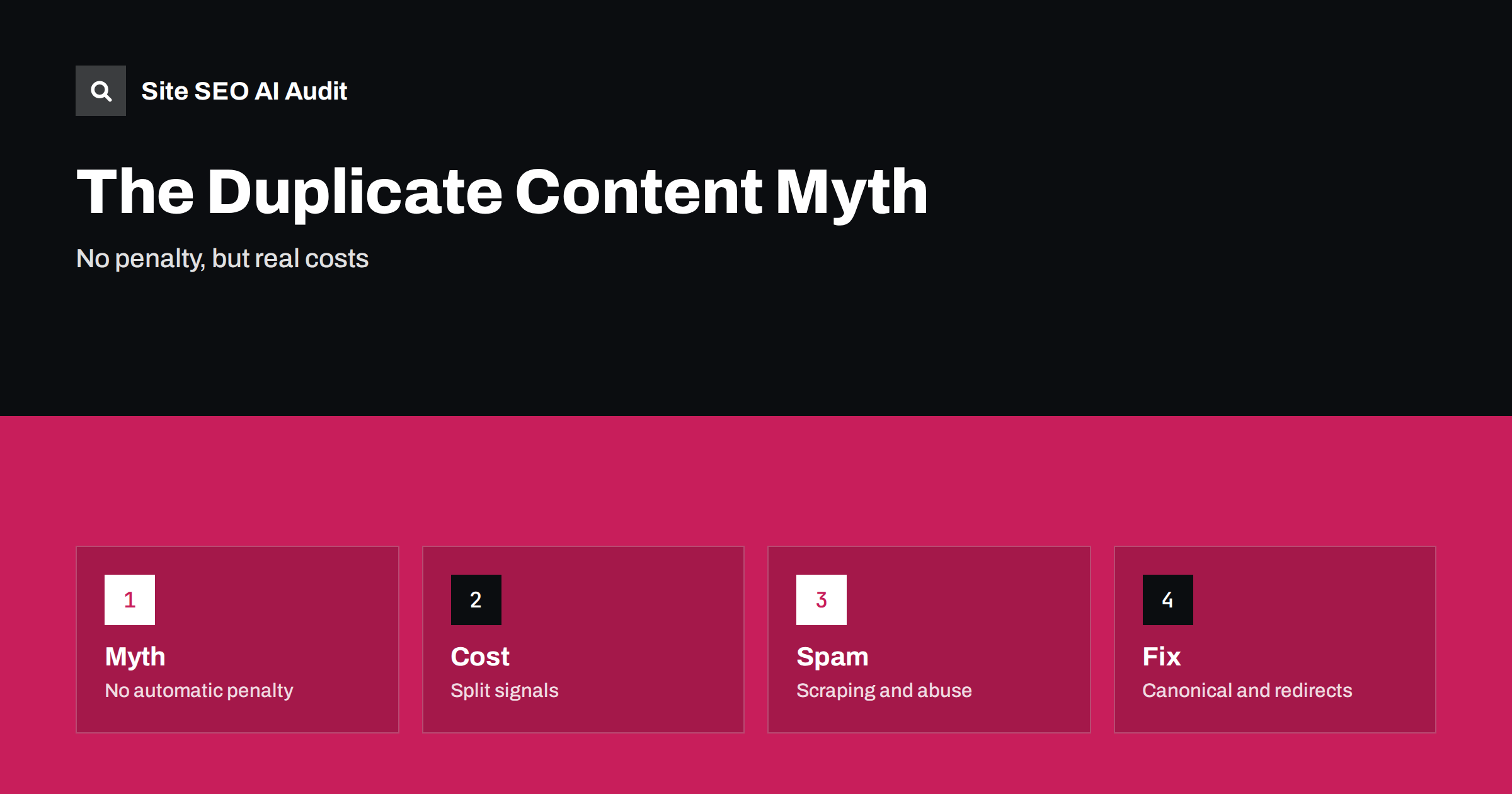
Short answer: There is no general duplicate content penalty. When the same or very similar content appears at several addresses, search engines usually group the copies, choose one to show and filter out the others. The real costs are indirect: the wrong version may be shown, links and signals can be split, crawling is wasted and your own pages compete. A penalty-like action applies only to deliberate manipulation, such as mass scraping or spam. Fix duplicates with canonical tags, redirects and a clear structure.
Few SEO worries last as long as this one. Owners fear that a repeated paragraph, a product description from a supplier or a second domain will bring a penalty that wipes out their traffic. In most cases that fear is wrong, but the full picture is more useful than a simple no. Duplicates do cause problems, and some uses of copied content are against the rules. This guide explains what happens in practice, what to worry about and what to do. For the technical side of the signals, see the guide to canonical tags.
What search engines do with copies
When a crawler finds several pages with the same or almost the same content, it groups them into a cluster and picks the version that it considers the best representative, called the canonical. That version is shown in results, and the others are generally not. This is a filter for the benefit of users, who do not want ten identical results, and not a punishment for the site. Pages in the group are still crawled, though less often.
The choice may not be the one you want. A search engine can pick a version with tracking parameters, a version on another domain or an old address. The signals that guide the choice are described in the guide to when Google chooses a different canonical. Your job is to make the right version obvious.
When rules about copying do apply
Spam policies target deceptive practices, not ordinary duplication. Examples are scraping content from other sites and republishing it with little or no added value, generating many near-copies to catch searches, using doorway pages that differ only by a place name and copying large parts of other sites to look more complete. Pages that do this can be demoted, removed from results or hit by a manual action. See the guide to Google spam policies and the guide to manual actions.
The key difference is intent. A shop with the same size chart on many product pages is not trying to deceive anybody. A network of sites that republish a stolen article to collect clicks is. If your case looks like the first, you need to tidy up. If it looks like the second, you need to change the strategy.
The real costs of duplicates
Even without a penalty, duplicates can hurt. Links may point to different versions, so the strength of the page is divided. The version that appears in results may be a poor one, such as a print view or a page with a session ID. Crawlers spend time on copies instead of on new pages, which matters on large sites, as in the guide to crawl budget. Reports become confusing because the same page appears under several addresses. And your own pages can compete for the same query, a problem covered in the guide to keyword cannibalisation.
AI assistants have the same trouble. They may cite a copy that is not your main page, as explained in the guide to duplicate pages in AI search.
Common sources on your own site
Most duplicates are created by accident. The usual sources are the same page at the version with and without www, with and without a trailing slash and over both HTTP and HTTPS; address parameters for tracking, sorting and filtering; printer-friendly and PDF copies; tag, category and date archives that repeat the same posts; pagination and faceted navigation; and test or staging copies that were left open. See the guide to URL parameters and duplicate content, the guide to www and trailing slash consistency and the guide to printable pages and PDF copies.
Content copies are common as well: product descriptions supplied by manufacturers, similar pages for each location and service, and text reused across language versions. They are not penalised, but a page that only repeats what thousands of others say has little reason to rank, as in the guide to manufacturer product descriptions.
Content on other domains
Syndication, partner republishing and the same site on two domains create cross-domain copies. The risk is that the other site is chosen instead of yours. If you syndicate, ask the partner to use a canonical tag pointing to your original or to add a link back, and publish your version first, as discussed in the guide to content syndication. For two domains with the same site, see the guide to the same site on two domains.
If others copy your text without permission, you do not have to fear a penalty for your own page. A search engine usually recognises the original. Document the copying, ask for removal or a link and use the available reporting tools if the copy outranks you. More is in the guide to content scrapers.
How to fix duplicates
Choose the main version of each page and signal it clearly. Use a permanent redirect when the extra address does not need to exist, such as the non-www version. Use a canonical tag when a variant must remain available, such as a filtered view. Link internally only to the main address, list only the main address in sitemaps and keep tracking parameters out of internal links. Use a noindex tag for pages that serve users but add nothing to search, such as thin archives. The choice between methods is covered in the guide to canonical tags versus 301 redirects.
Do not block duplicates in robots.txt if you want search engines to see the canonical or the redirect, because they cannot read what they are not allowed to fetch. For content that is similar but not identical, make each page truly different by adding useful details, or merge the pages, in line with the guide to fixing thin content.
How to find duplicates
Start with a crawl of the site and sort pages by title, by heading and by content similarity. Groups of pages with the same title or almost the same text are the first candidates. Then look at Search Console, where the page indexing report lists pages that were excluded because another page was chosen as canonical, or because the page is a duplicate without a user-selected canonical. Search for a distinctive sentence from your page in quotation marks to see whether other addresses or domains carry it.
Check the sitemap, the internal links and the redirects of the main address variants, and test a few parameter addresses by hand. For each group, write down the version that should win and the method that will make it win. A short list with the group, the main address, the action and the date makes the work easy to review. Most sites find that a handful of causes produce most of the duplicates, so fixing the pattern is faster than fixing single pages.
What not to worry about
Short repeated parts such as menus, footers, legal notes and standard disclaimers are normal. Quotes with attribution are fine. A product that is sold on several sites will have similar specifications, and that alone is no problem. Pages for different countries in the same language can be close copies, and hreflang tells the engine which one to show to whom, as in the guide to same-language country targeting. Spend effort on duplicates that split signals or confuse users, not on every repeated sentence.
Here is a short example. A small online shop saw that its category pages with sorting and filter parameters were appearing in results. The owner feared a penalty. A crawl showed thousands of parameter addresses, all with a canonical tag that pointed to themselves. After the team fixed the canonicals, cleaned internal links and removed the parameters from the sitemap, the main category pages replaced the variants in results, and crawling concentrated on the right pages.
Site SEO AI Audit crawls your website and checks status codes, titles, descriptions, canonical tags, thin and duplicate content, broken links, structured data and AI visibility settings, so you can find duplicate titles, repeated pages and conflicting canonicals. It does not check other websites for copies of your text. The first audit of up to 200 pages is free, and larger sites can see the pricing page.
Related reading
The bottom line
Duplicates rarely bring a penalty, but they split signals, so name one main version and point everything to it.
FAQ
Will Google penalise my site for duplicate content?
Not for ordinary duplication. Action is taken against deliberate spam such as scraping and mass copying.
Is syndicating my articles safe?
It can be, if the partner points a canonical tag to your original or links back, and your version is published first.
Should I use canonical tags or redirects?
Redirect when the extra address is not needed. Use a canonical tag when the variant must stay reachable.
Are repeated footers a problem?
No. Menus, footers and standard notices are normal. Focus on whole pages that are copies.
What if someone copies my content?
Search engines usually identify the original. Keep a record, ask for removal or a link and use the reporting tools if needed.