ENEnglish
 LTLietuviškai
 DEDeutsch
 FRFrançais
 RUРусский
 ESEspañol
 PLPolski
 ITItaliano
 UKУкраїнська
 CSČeština
 PTPortuguês
 JA日本語
JA日本語 LVLatviešu valoda
 ETEesti
 HUMagyar
 IDBahasa Indonesia
 TRTürkçe
 HIहिन्दी
 ELΕλληνικά
 ARالعربية
 THไทย
THไทย VITiếng Việt
 RORomână
 MSBahasa Melayu
 BNবাংলা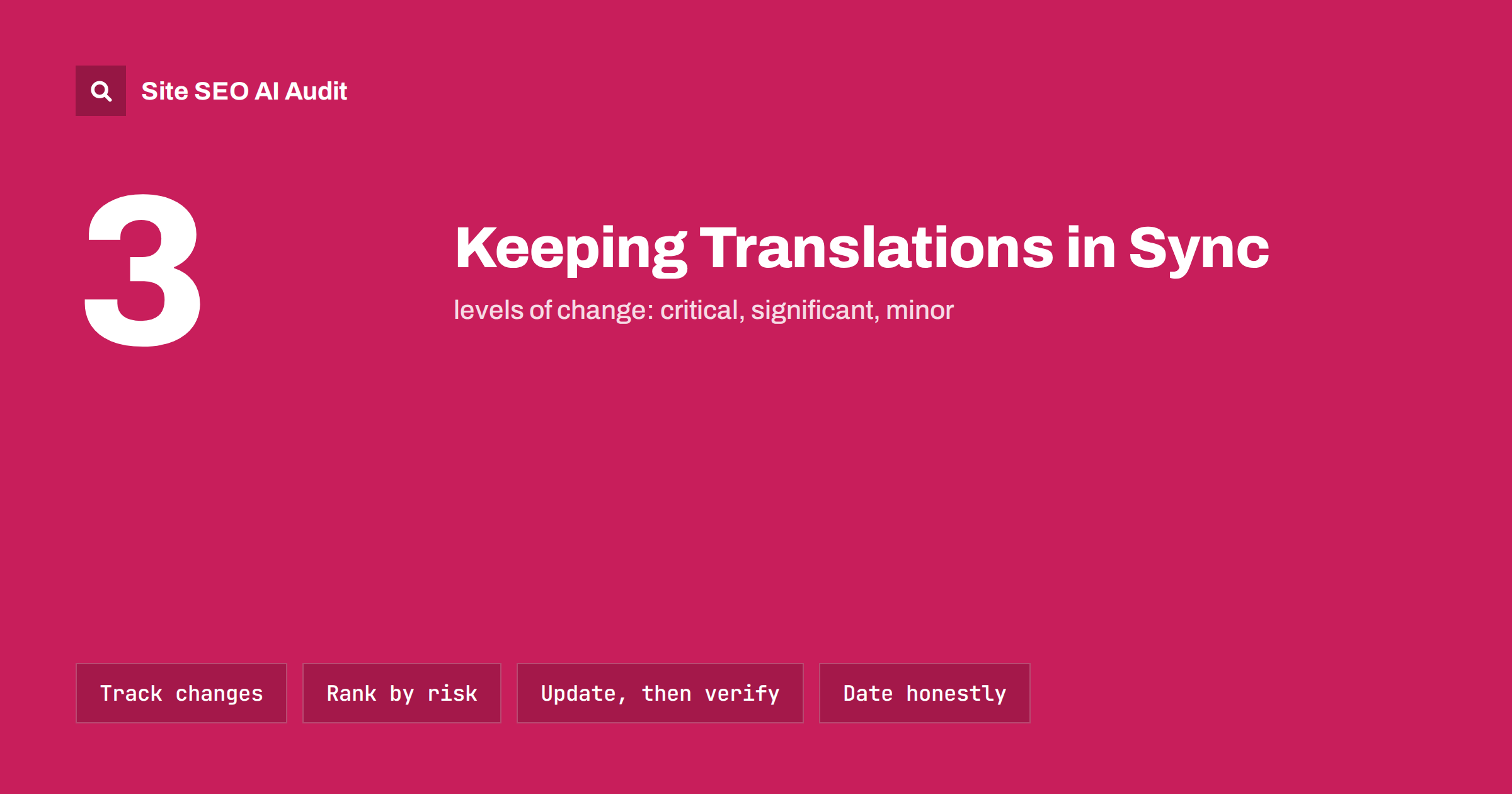
Short answer: translations drift out of date whenever the original page changes and nobody updates the other languages. To keep them in sync, track every change to source pages, classify it as critical (prices, legal terms, safety, product facts), significant (new sections, changed advice) or minor (wording), and update translations in that order, starting with the pages that bring the most traffic. After each update, check the live page in each language, and only change a version’s modified date when that version actually changed.
Why translation drift is an SEO problem
Most multilingual sites launch with all language versions matching. Months later, the English pages have new prices, new features and rewritten guides, while the German and Spanish versions still describe last year’s product. This drift causes several problems:
- Wrong information for visitors: outdated prices, discontinued features or old legal terms create complaints and lost trust.
- Weaker pages in search: an outdated translation is less helpful than its competitors in that language, and freshness matters for many queries.
- Mismatched hreflang sets: hreflang says pages are equivalent. When one version has twice the content of another, the promise no longer holds, and visitors switching languages get a different page.
- Conflicting facts for AI systems: AI answers may quote an outdated translation, especially in languages where your site is one of few sources. Our article on why AI answers care about content dates explains why this matters.
- Legal exposure: terms, privacy notices and consumer information that differ between languages can create real risk.
Classify changes by risk
Not every edit needs an immediate translation. A simple three-level classification lets small teams focus effort where it matters:
| Level | Examples | Target timing |
|---|---|---|
| Κρίσιμο | Prices, plan contents, legal and policy text, safety information, product specifications, contact details, availability by country | Same day or before the change goes live |
| Significant | New sections, changed recommendations, new features, rewritten introductions, updated FAQs | Within days to a few weeks, by traffic priority |
| Minor | Wording improvements, typo fixes, style changes, reordered paragraphs | Batch in the next scheduled review, or skip |
Agree the classification with whoever edits source content, so they flag the level when they make a change. A short note like “critical: price change” in the edit log saves a lot of detective work later.
How to track what changed in the original
You cannot update what you do not know about. Options range from simple to fully automated:
- A change log: a shared sheet where editors record each change to a source page, with the URL, date, level and a short description.
- CMS revision history: most CMSs keep revisions. Comparing the current version with the version at the last translation date shows exactly what changed.
- Multilingual plugin status: some multilingual plugins and translation management systems mark translations as outdated when the original is edited. Check whether yours does and whether the flag is reliable.
- Modified dates: a report comparing the last modified date of each source page with its translations quickly shows where source pages are newer.
- Translation memory: professional translation tools store previous translations, so only changed segments need new work, which cuts cost and time.
For small teams, the modified-date report plus a change log is often enough. The key is to have one agreed place where “this needs updating” is recorded.
Decide which pages to update first
Once you know what is out of date, prioritise. Within each risk level, update pages in this order:
- Pages with the most organic traffic and conversions in each language, from Search Console and analytics.
- Pages that sell or commit you to something: pricing, product, service, checkout and legal pages.
- Pages that other pages link to heavily, such as hubs and main guides.
- Everything else, in scheduled batches.
If a translated page gets almost no traffic and would take significant effort to update, it may be better to consolidate or retire it than keep it half-maintained. Our guide on which blog posts to translate first uses the same data-led thinking for new translations.
A workflow that works for small teams
You do not need a localisation department to keep translations current. A lightweight routine:
- At the time of change: the editor records the change and its level. For critical changes, they notify whoever handles translations before publishing, and ideally publish all languages together.
- Weekly: review the change log and the modified-date report, and assign significant updates by priority.
- Monthly or quarterly: batch minor changes and review a sample of translated pages against the originals.
- For each update: translate or adapt only the changed parts, keep local adaptations such as examples and prices, update the title and meta description if the topic changed, and have a native speaker review.
- After publishing: open the live page in each language to confirm the update appears correctly.
When using machine translation for updates, keep human review for critical and significant changes. Our article on machine translation and SEO explains where the risks are.
Check the result, not just the process
Automated translation updates can fail quietly. A plugin update might change the editor’s HTML, so the translation step picks up interface text or code fragments along with the content. A cache might keep serving the old version. A shortcode might break in one language only. A log that says “done” is not proof that the page is right.
After any batch of updates, especially automated ones, open the real pages in at least two or three languages, including ones you do not read fluently, and look for:
- Untranslated fragments or text in the wrong language.
- Stray interface labels, placeholder text or code in the content.
- Broken formatting, missing images or broken links.
- Titles and meta descriptions that still describe the old content.
- Prices, dates and numbers that match the source.
Checking a sample of live pages takes minutes and catches problems that would otherwise sit in every language for weeks.
Reduce drift before it starts
The cheapest update is the one you never need. A few habits in how source content is written make translations easier to keep current:
- Keep volatile facts in one place. Prices, plan limits, opening hours and contact details should come from a single source, such as a settings field or a pricing page, rather than being typed into dozens of articles in every language.
- Avoid dates and numbers in evergreen text. “Recently” and “this year” go stale quickly; “in 2026” is clear but needs updating. Put time-bound details in sections that are easy to find and change.
- Write modular content. Short sections with clear headings mean an update touches one section in each language, not the whole page.
- Keep a shared glossary of terms for each language, so updated sections use the same terminology as the rest of the page.
- Plan releases together. When a product change is coming, prepare the text for all languages before launch rather than after.
These habits also make the original content easier to maintain, so they pay off even on a single-language site.
Dates, hreflang and technical details
A few technical points keep synced translations clean for search engines:
- Modified dates per version: update a translation’s modified date and
dateModifiedonly when that version changed meaningfully. Bumping dates on untouched translations misleads readers and search engines. - hreflang stays in place: a temporarily outdated translation is still the equivalent page. Remove it from the hreflang set only if you retire it.
- Titles and descriptions: when the source title changes, translate the new title rather than leaving the old one. Our guide to translating title tags and meta descriptions covers how.
- New sections and URLs: if the original gains a new page, decide whether each language gets it. If not, follow a clear policy for untranslated pages.
- Sitemaps: make sure
lastmodvalues in multilingual sitemaps reflect real changes per version.
How an audit helps
Drift often shows up as technical symptoms: broken language versions, missing hreflang return links, duplicate titles left over from the source language, or pages that differ sharply in length. Site SEO AI Audit checks hreflang, language versions, x-default and lang attributes across the site, together with titles, descriptions and thin content on every page. Paid plans add re-audits, so you can confirm each round of translation updates.
Related reading
- What to Do With Untranslated Pages on a Multilingual Site
- How to Refresh Old Content: A Practical Update Process
- Multilingual WordPress SEO: A Checklist for Translated Sites
The bottom line
Translations drift unless you plan for change. Track every edit to source pages, classify it by risk, update critical changes immediately and the rest by traffic priority, use native review for anything important, and check the live pages after every batch. Keep dates, titles and hreflang honest per language, and every version stays a page worth ranking.
FAQ
How quickly should translations be updated after the original changes?
Critical changes such as prices, legal terms and product facts should be updated at the same time as the original. Significant changes can follow within days or weeks by priority, and minor wording changes can wait for a scheduled batch.
Is an outdated translation worse than no translation?
It can be when it contains wrong prices, terms or product information. For minor drift, an older translation is usually still useful. Decide based on the risk of the outdated content.
Should I update the modified date on every language when the original changes?
No. Update each version’s date only when that version itself changed meaningfully. Changing dates on untouched translations gives readers and search engines a false signal.
Can machine translation keep translations in sync automatically?
It can speed up updates, but automated output needs review, especially for critical content. Always check the live pages after automated runs, because errors can spread to every language at once.
Does translation drift affect hreflang?
hreflang still works technically, but it promises that pages are equivalent. Large differences between versions make that promise weaker and create a poor experience for visitors who switch languages.