ENEnglish
 LTLietuviškai
 DEDeutsch
 FRFrançais
 RUРусский
 ESEspañol
 PLPolski
 ITItaliano
 UKУкраїнська
 CSČeština
 PTPortuguês
 JA日本語
JA日本語 LVLatviešu valoda
 ETEesti
 HUMagyar
 IDBahasa Indonesia
 TRTürkçe
 HIहिन्दी
 ELΕλληνικά
 ARالعربية
 THไทย
THไทย VITiếng Việt
 RORomână
 MSBahasa Melayu
 BNবাংলা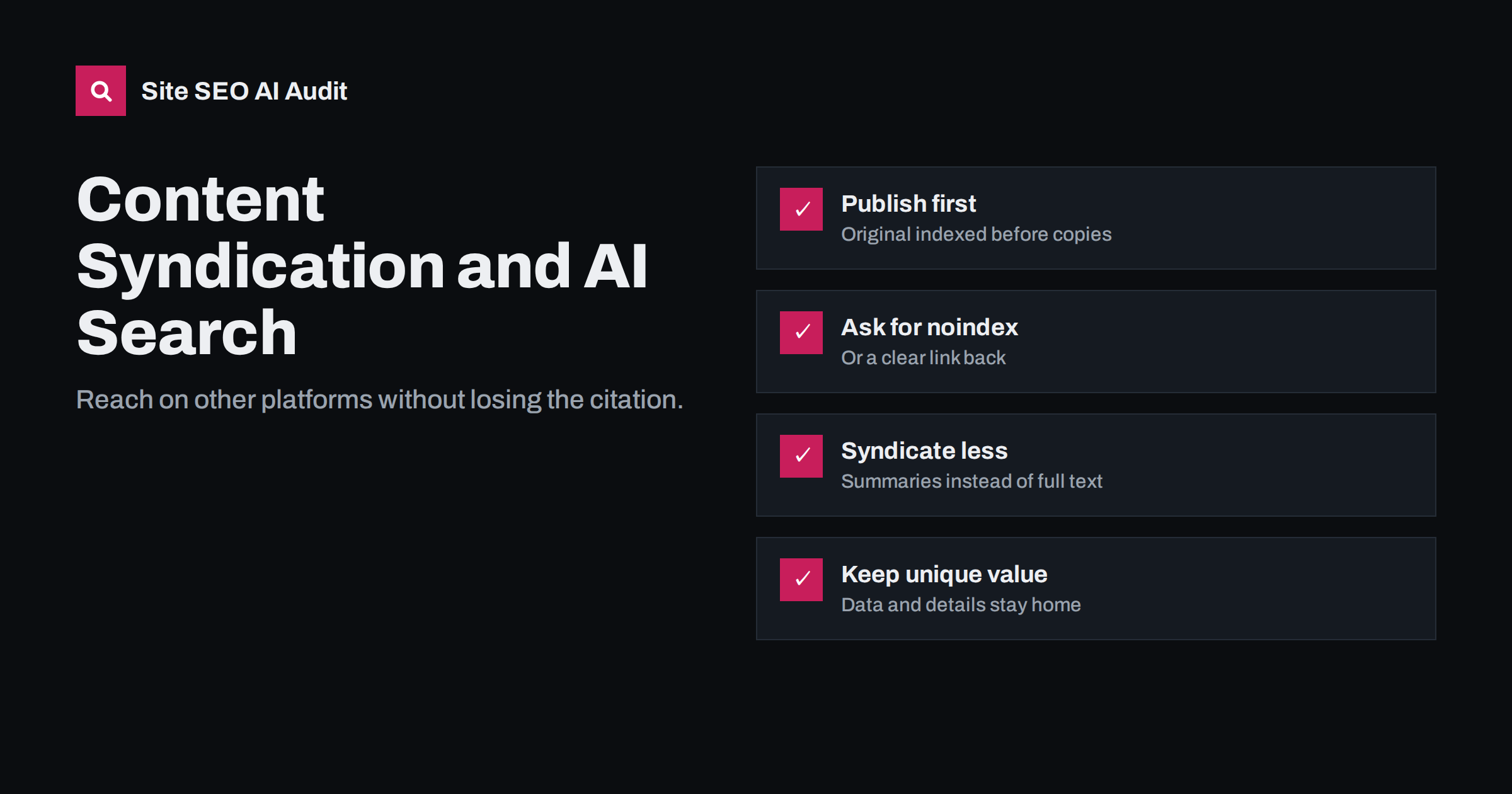
Short answer: When the same article appears on your site and on larger platforms, search engines and AI assistants may rank or cite the copy instead of your original, especially if the platform is more authoritative. To keep the credit, publish on your own site first and let it be indexed, ask partners to use noindex on the copy or at least link clearly to the original, syndicate summaries rather than full text where possible, and keep unique elements such as data, examples and tools on your own page.
What content syndication is
Syndication means republishing an article that first appeared on your site somewhere else, with permission and usually with attribution. Common forms include:
- Republishing blog posts on platforms such as Medium or LinkedIn.
- Industry publications or partner blogs running your article as a guest piece.
- News and press release distribution that places the same text on many sites.
- Newsletters or content networks that copy full posts from an RSS feed.
The benefit is reach: the platform’s audience sees your ideas and your name, sometimes far more people than your own blog reaches. Syndication can also bring referral visits, newsletter sign-ups and links from readers who discover you there. The risk is that the copy, not your page, becomes the version that search engines and AI systems use, so the long-term value of the article moves to someone else’s domain.
How search engines choose between copies
When search engines find the same content on several URLs, they usually pick one version to show for a given query and filter the others. This is not a penalty; it is how duplicate content is handled. The question is which version they choose.
The choice depends on many signals: which page was found first, which site is stronger for the topic, links between the copies, and technical hints. A syndicated copy on a well-known platform can easily win against the original on a smaller site.
Google’s guidance for syndication has changed over time. It used to suggest that partners add a cross-domain canonical tag pointing to the original. Google’s current documentation says canonical tags are not recommended for this case, because syndicated pages are often quite different from the original in layout and surrounding content. Instead, it recommends that partners who do not want their copy to compete block it from indexing with noindex. Canonical tags themselves are explained in canonical tags explained.
Why AI answers make this more important
AI assistants add another layer. When they answer a question, they retrieve passages from pages they can access and often cite them. There is no widely documented mechanism by which assistants recognise the original among several identical texts. In practice they tend to cite whichever copy they retrieved, which often means the copy on the most prominent or most frequently crawled site.
This has consequences:
- Your insight may be quoted with a link to the platform, not to you.
- If the platform’s copy lacks your author bio or brand context, the answer may not connect the idea to your business at all.
- If your own site blocks AI crawlers while the platform allows them, the copy is the only version the assistant can read.
Being named and linked in AI answers depends on being the most useful and accessible version of the content. The article on original data and first-hand experience explains why unique content is cited more often.
Publish on your own site first
Timing is the simplest protection. The original should be live and indexed before any copy appears.
- Publish the article on your site with a clear author, date and internal links from relevant pages.
- Request indexing with the URL Inspection tool or wait until the page appears in search.
- Only then send it to partners or republish it on platforms. A gap of several days to a couple of weeks is common.
Being first is not a guarantee, but it removes the easiest reason for a copy to be treated as the original.
What to ask syndication partners for
The terms you agree with a partner decide how much credit you keep. In order of preference:
| Setup on the partner site | Effect on search and AI | How common |
|---|---|---|
| noindex on the syndicated copy | Copy not indexed by search engines; original remains the searchable version | Rare on large platforms, possible with partners |
| Summary or excerpt with link to full article | Only your page has the full text | Common and easy to agree |
| Full text with “originally published at” link near the top | Helps users and crawlers find the original; copy may still compete | Common |
| Cross-domain canonical to the original | A hint that may be ignored; no longer Google’s recommendation | Offered by some platforms |
| Full text with no link | Copy competes freely and may win | Avoid |
Note that noindex keeps a copy out of search indexes, but AI crawlers that fetch pages directly may still read it. Only the partner’s robots.txt rules decide that, and you rarely control them.
Syndicate less, and differently
Full-text syndication is not the only way to reach other audiences. Often it is better to create a companion piece instead of a copy:
- Summaries: the key points in a few paragraphs, with a link to the full guide.
- Adapted versions: the same idea written for the platform’s audience, with different examples and structure.
- Excerpts: one section of a long article, clearly marked as part of a larger piece.
- Posts that reference the original and add a personal take, which suits LinkedIn and community platforms.
These give the platform useful content while keeping your page the most complete version. They also avoid many of the problems described in duplicate content guides, because the texts are genuinely different.
Keep unique value on the original
If full-text syndication is part of the deal, make the original page more useful than the copy. Things that usually stay on your site:
- Original data tables, charts and downloadable files.
- Interactive tools, calculators and templates.
- Updates: when you refresh the article, the copies stay old. Visible update dates help, as described in content dates and freshness.
- Detailed author information and links to related guides on your site.
Also make sure your own site is readable for the crawlers you want. If the platform copy is accessible to an AI assistant and your original is not, the choice is made for it.
How to check who gets the credit
A few simple checks, repeated every month or after each syndication, show whether your original is winning:
- Exact-phrase search. Search for a distinctive sentence from your article in quotes and see which URL appears first.
- Topic search. Search for the main question the article answers and note whether your page or the copy ranks.
- AI assistant test. Ask the main assistants questions the article answers and record which domain they cite, if any.
- Search Console. Compare impressions for the original before and after syndication. A drop right after a copy appears is a warning sign.
- Brand mentions. Track whether answers name your brand, using the approach in measuring brand visibility in AI answers.
If a partner copy consistently outranks or out-cites your original, renegotiate the terms, switch to summaries or stop syndicating that type of content. Keep a simple record of where each article was republished and on what terms, so you can follow up when something changes.
How Site SEO AI Audit helps
Site SEO AI Audit focuses on your own site, the version you want to be credited. It checks canonical tags, indexability and duplicate content across your pages, and its AI visibility area verifies that AI crawlers are allowed in robots.txt and that your content can be read without JavaScript. That makes sure the original is at least as accessible as any copy. You can start with a free audit of your website.
Related reading
- Entity SEO: Helping AI Systems Understand Your Brand
- How to Get Your Website Cited in ChatGPT Search
- How to Write Content That AI Answers Actually Quote
The bottom line
Syndication buys reach, but the copy on a bigger platform can take the ranking and the AI citation. Publish first on your own site, ask partners for noindex or at least a prominent link to the original, prefer summaries and adapted pieces over full copies, and keep the unique, updated material on your page. Then check regularly which version search engines and assistants actually use.
FAQ
Does syndicating content hurt SEO?
It does not cause a penalty, but a syndicated copy on a stronger site can rank instead of your original. Publishing first and agreeing on noindex or a clear link back reduces that risk.
Should syndicated copies use a canonical tag to my site?
Google no longer recommends cross-domain canonicals for syndication and suggests noindex on the partner’s copy instead. A canonical can still be a helpful hint where a partner offers it, but it may be ignored.
Which version do AI assistants cite?
There is no documented rule. Assistants usually cite the copy they retrieved, which is often the one on the most prominent or most frequently crawled site. Making your original the most complete and accessible version improves your chances.
Is republishing on LinkedIn or Medium a good idea?
It can bring readers, but full copies may compete with your site. Posting a summary or adapted version with a link to the full article is usually a better balance.
How long should I wait before syndicating?
Wait until your original is indexed. For many sites that takes a few days; waiting one to two weeks gives search engines time to associate the content with your URL.