ENEnglish
 LTLietuviškai
 DEDeutsch
 FRFrançais
 RUРусский
 ESEspañol
 PLPolski
 ITItaliano
 UKУкраїнська
 CSČeština
 PTPortuguês
 JA日本語
 LVLatviešu valoda
 ETEesti
 HUMagyar
 IDBahasa Indonesia
 TRTürkçe
 HIहिन्दी
 ELΕλληνικά
 ARالعربية
 THไทย
 VITiếng Việt
 RORomână
 MSBahasa Melayu
 BNবাংলা
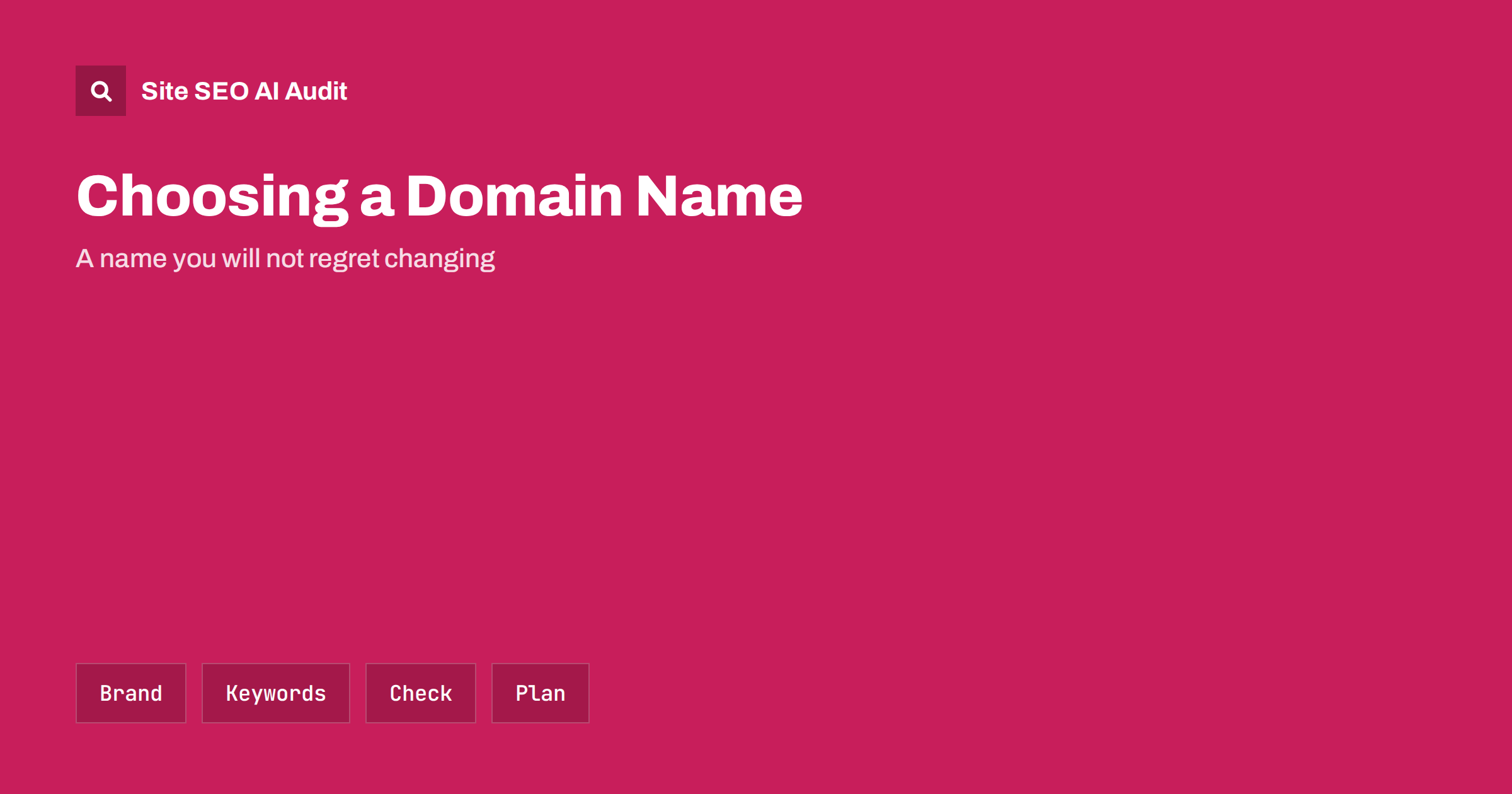
Short answer: Choose a domain name that is short, easy to spell and say aloud, and that fits your brand for many years. Keywords in the name are optional and give little direct ranking benefit today. Check the history of the domain, make sure the name does not infringe a trademark, pick an extension your audience trusts, and remember that changing a domain later is a costly migration with real risk.
A domain name is one of the few website decisions that is expensive to reverse. Content, design and technical settings can be changed in an afternoon, but a new domain means redirecting every page, rebuilding trust with search engines and updating every link and profile. Because of this, the choice deserves time before launch. This guide covers the questions to ask, the traps to avoid and the checks to run, and it links to detailed guides on parts of the topic such as generic and country extensions.
Start with the brand, not the keyword
A name that people remember and type correctly brings direct visits, word of mouth and branded searches, which are some of the most valuable traffic a site can have. Short names with common spelling are easier to share and harder to mistype. Say the name aloud on the phone to a friend: if they need to ask how it is spelled, consider another. Avoid names that look like several other brands, because confusion costs visitors and invites trouble, a theme covered in the guide to brand name confusion in AI search. Also think about how the name will look in a logo, on a vehicle or in a social profile.
Are keywords in the domain still useful?
Years ago, a domain made of the exact search phrase had a strong advantage. Search engines have reduced that effect, and a long, keyword-stuffed name may look spammy to people and limit your future. A descriptive word can still help visitors understand what you do, and it may appear in anchor text when people link using the site name. But a good brand with strong content will outperform a clumsy exact-match name. If you do include a keyword, keep it natural and short, and do not tie the name to a single product if you may add others later.
Choose the extension with your audience in mind
The extension should match how your audience expects to find you. A country extension signals a local focus and can support local trust, while a generic extension suits a business that serves several countries. Newer extensions work for search, but some users and spam filters treat unfamiliar ones with caution. If you expect to run international versions, think ahead about whether you will use country domains, subfolders or subdomains, as compared in the guide to ccTLDs, subdomains and subfolders. If a name is available on one extension and taken on the extension your customers expect, think carefully before settling for a lookalike.
Keep it simple: hyphens, numbers and length
Hyphens and numbers make names harder to say and easier to mistype. A hyphen is not a penalty, but a name full of hyphens often looks like a low-quality site. Aim for a name that is short enough to fit on a business card and in a mobile browser bar. Avoid special characters and consider whether accented letters are needed. If your audience uses a language with non-Latin letters, internationalised names are possible, but they bring technical details described in the guide to internationalised domain names. Register obvious misspellings only if they are cheap and you will redirect them to the main name.
Check the history of the domain
A domain that has been used before carries a past. It may have been used for spam, have unwanted links pointing to it or have a manual action in its record. Before buying a second-hand domain or registering a recently dropped one, look at its previous content in web archives, its backlink profile and whether it was ever blocked. The guide to checking a used domain’s history lists the steps. A clean new domain starts without baggage but also without authority, which means that rankings must be earned through content and links.
Check trademarks and legal risks
A name that is free to register may still belong to someone else as a trademark. Registering a domain that copies or closely imitates a known brand can lead to disputes and the loss of the domain. Search trademark databases in your target markets, check social handles and search engines for similar names, and ask a legal adviser when the name matters to your business. Do not rely on the domain registrar to warn you, since registration is automatic and does not check rights. Treat this as a business risk, not a technical detail.
Think about structure from the start
Decide early whether your blog, help centre, shop and language versions will live on the same domain or on separate ones. Putting content in subfolders of one domain usually concentrates authority, while separate domains and subdomains split it, as discussed in the guide to blog subdomains and subfolders. A name that suits only your first product can limit later growth, and a name that is too broad can be hard to defend. Choose a name that allows new products without forcing a rename.
Set up the basics correctly
After you register, choose one preferred version of the address, with or without www, and redirect the others to it. Use https from day one and keep the certificate renewed. Set up email authentication so that mail from your domain is trusted, and register the domain in Search Console to receive messages about problems. Keep the registration under company control, with a role-based contact and automatic renewal, so that the domain is not lost when a person leaves. The guide on DNS changes and SEO explains how to handle records safely when you move hosting.
Plan renewals with care. Domains are often lost not through attacks but through expired payment cards and outdated contact emails. Set the renewal for several years where the price allows, keep the account protected with strong authentication, and record who holds the login. An expired domain can be picked up by someone else within days, and recovering it is difficult and sometimes impossible.
Think about the name in other languages and cultures. A word that is neutral in your own language may have another meaning elsewhere, and a name that is easy to spell for you may be hard for an international audience. If you plan to expand abroad, ask native speakers in your target markets before you commit, and check that the name works in speech, in text and in the alphabets your readers use.
Finally, accept that no name is perfect. Choose one that is good enough, available, defensible and clear, then invest your effort in content, links and service. Many successful sites have names that were chosen quickly, and many sites with perfect keyword names have failed. What matters is that the name works for years without needing a change.
Compare candidate names side by side before you decide. Make a short list of five or six, and for each one check availability on the extensions you care about, social handles, spelling variants, possible trademark conflicts and how the name looks in a web address, an email address and a logo. Ask a few people who do not know the project to read the names aloud, write them down from memory a day later and say what kind of business they think each name belongs to. The results often show that the favourite of the team is the hardest for outsiders to remember.
Think about email as well. Your domain will appear in every message you send, so a name that is long or awkward to spell makes business email harder to share by phone. Avoid names where two words run together to form an unfortunate third word, which is a surprisingly common problem when words are joined without a separator. Read the name written in capital letters and in lower case, since web addresses are usually shown in lower case and the boundaries between words disappear.
If you are replacing an old name, document why. A rename usually happens because the business changed direction, a product was renamed or the earlier name was unsuitable. Write down what you expect to gain, such as clearer branding or better reach, and what you risk, such as a temporary loss of traffic and a period of confusion among customers. If the gain is small, it may be wiser to keep the old name and improve the site around it. A rename is justified when the old name actively harms the business, for example through legal conflict or constant confusion.
Site SEO AI Audit crawls your site and checks redirects between address versions, https setup, canonical tags, status codes, titles and sitemaps, so you can confirm that the chosen domain is used consistently. It does not register domains or check trademarks. The first audit of up to 200 pages is free; larger sites can see the pricing page.
Related reading
The bottom line
Pick a short, memorable, legally safe name on a suitable extension, check its history, plan the site structure around it and protect the registration, because a later change is a risky migration.
FAQ
Does an exact-match domain help rankings?
Very little today. A strong brand and good content matter far more than keywords in the name.
Is a hyphen in a domain bad for SEO?
It is not a penalty, but hyphens make names harder to say and type, so avoid them when you can.
Should I buy several extensions of my name?
Register the ones that protect your brand or that customers might type, and redirect them to one main domain.
Can I change my domain name later?
Yes, but it needs a full migration with redirects and monitoring, and traffic often dips for a time.
Is a new extension worse for SEO?
Search engines treat most extensions equally, but users may trust familiar ones more.