ENEnglish
 LTLietuviškai
 DEDeutsch
 FRFrançais
 RUРусский
 ESEspañol
 PLPolski
 ITItaliano
 UKУкраїнська
 CSČeština
 PTPortuguês
 JA日本語
 LVLatviešu valoda
 ETEesti
 HUMagyar
 IDBahasa Indonesia
 TRTürkçe
 HIहिन्दी
 ELΕλληνικά
 ARالعربية
 THไทย
 VITiếng Việt
 RORomână
 MSBahasa Melayu
 BNবাংলা
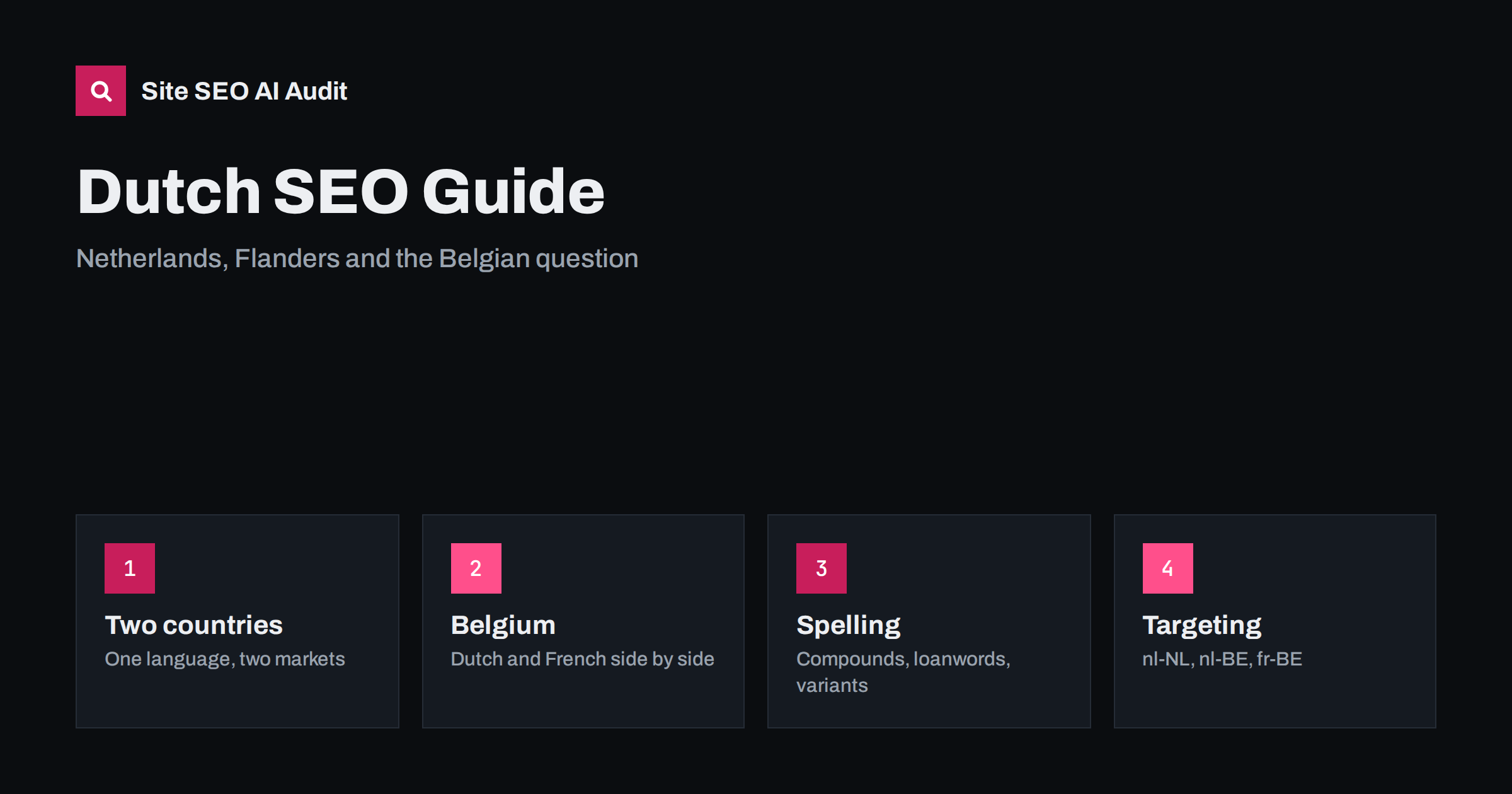
Short answer: Dutch is the language of the Netherlands and of Flanders, the northern part of Belgium, but the two markets search, shop and read differently. The Netherlands is a single Dutch-speaking market with high English fluency and strong local marketplaces. Belgium is officially trilingual, with Dutch in the north, French in the south and both in Brussels, so a Belgian site usually needs Dutch and French versions targeted with nl-BE and fr-BE. Vocabulary, spelling of loanwords and even product names differ between the Netherlands and Flanders, so a single Dutch version for both countries works only if the text is written to be neutral and the targeting is set with hreflang.
Companies entering the Benelux often start with a Dutch translation for the Netherlands and later discover that Belgian visitors bounce, that the French-speaking half of Belgium never arrives, or that Flemish customers notice phrases that mark the text as Dutch from the Netherlands. The problems are small individually but add up to lower rankings and conversions. This guide explains the language and market differences, the right technical setup for one or two countries, and the local signals that buyers in each market expect. It complements the general approach in targeting countries that share a language.
One language, two markets
Standard Dutch is shared, and a text written in the Netherlands is fully understandable in Flanders. The differences are in everyday vocabulary, tone and some spelling preferences for loanwords. Flemish speakers use words that sound regional or old-fashioned to Dutch readers and vice versa, and a few product and service terms differ outright. Flemish marketing tone is usually more reserved; Dutch copy from the Netherlands is more direct. Search volumes reflect this: the same product can be searched with different words in the two countries, and keyword tools show separate figures for Google in the Netherlands and Belgium. Treat them as two markets in research and in reporting, even if you serve them with one site. The research approach is described in multilingual keyword research.
The Netherlands
The Dutch market is highly online, with one of the highest e-commerce penetration rates in Europe. Google dominates search. Large national marketplaces and comparison sites take a big share of product queries, and many consumers start a purchase there rather than in a search engine, so a listing on them can be part of the plan. Local payment by bank transfer through the national scheme is expected at checkout, and delivery to parcel points is common. English is read by most of the population, which tempts companies to leave parts of the site in English; that is acceptable for technical B2B content but reduces trust and rankings for consumer pages. Dutch consumers check company registration numbers, reviews and return policies before buying; publishing them clearly, as described in local trust signals for country sites, matters more than in many markets.
Belgium: Dutch, French and Brussels
Belgium has three official languages: Dutch in Flanders, French in Wallonia and German in a small eastern area. Brussels is officially bilingual with French dominant in daily use. A Belgian site therefore needs at least Dutch and French versions, each a proper localisation rather than a translation of the other, with hreflang nl-BE and fr-BE. French for Belgium differs slightly from French for France, mainly in vocabulary and numbers, and the French guide in French-language SEO covers those points. Choosing a default language for a .be domain is sensitive; many sites show a neutral landing page or detect the browser language and offer both, while making sure every version has its own crawlable URL. Legal and consumer pages must be available in the language of the customer. Searches from Belgium in Dutch often include Flemish terms, so the nl-BE version should use them. A German version is rarely needed unless you serve the eastern cantons.
Domains, subfolders and hreflang
There are three common setups. A single .com or .eu domain with subfolders for /nl-nl/, /nl-be/ and /fr-be/ is the simplest to manage and lets you share authority. Country domains, .nl and .be, look more local and are preferred by many consumers, with the .be site split into Dutch and French subfolders. A hybrid uses a .nl site for the Netherlands and the main domain for Belgium. Whatever you choose, set hreflang for every pair, including x-default, and set the target country in Search Console for each subfolder or domain. If you serve the Netherlands and Flanders with one Dutch version, use nl without a country code for that version and still add fr-BE for the French one; if you keep two Dutch versions, use nl-NL and nl-BE and make them genuinely different. The structure decision is explained in ccTLD, subdomain or subfolder and the hreflang details in the hreflang tags guide.
Spelling, compounds and keyword forms
Dutch writes compound nouns as single words, so “customer service” is one word and “web shop” is written together. People search both ways, and a space in the wrong place changes the query. Choose the official spelling for headings and body text and let search engines match variants. Loanwords from English are common in both countries, and the Dutch market uses English terms in marketing more readily than Flanders does. Plurals, diminutives and verb forms create additional keyword variants; research them by meaning. Avoid machine-translated text that chooses the wrong compound form or a regional word for the wrong market, since native readers notice immediately; the risks are covered in machine translation and SEO. For URLs, use lowercase Dutch slugs without diacritics; Dutch has few special characters apart from the occasional diaeresis, which should be dropped in slugs.
Local signals for each market
Show prices in euro with the local format, use local date and phone formats, name the local delivery carriers and parcel point networks, and publish the local company identifiers: the chamber of commerce number and VAT number in the Netherlands, the enterprise number in Belgium. Reviews should appear on platforms that locals trust, and a business profile is needed for each physical location with the right language. Content references matter too: Dutch and Belgian holidays, school calendars and sales periods differ, and campaign dates should follow each country. For local services, separate pages per city with real details, as explained in multi-country local SEO, work better than one Benelux page.
Writing and content planning for the Benelux
Copy length and tone should follow the market. Dutch consumers in the Netherlands respond to short, direct pages with the price, the delivery time and the return policy near the top; long persuasive introductions are skipped. Flemish readers accept a slightly more formal tone and are more likely to notice copy that reads as imported from the Netherlands, so a native Flemish editor should review the nl-BE version even when the base text is shared. For French-speaking Belgium, do not reuse the French for France unchanged: numbers, some product words and formal address differ, and buyers notice.
Plan content per country rather than per language. The sales calendar, public holidays, school holidays and the typical shopping peaks differ between the Netherlands and Belgium, and a campaign page launched on the wrong date in one country wastes the effort. Local news, regulations and institutions are useful hooks for articles that earn links from local sites. Blog posts that explain Dutch or Belgian rules, taxes or delivery practices for foreign buyers also rank well, because few international competitors write them. The method for selecting which posts to localise is in deciding which blog posts to translate.
Checklist and audit
- Decide: one Dutch version with nl, or two with nl-NL and nl-BE; always fr-BE for Belgium.
- Correct html lang on every page and hreflang pairs with return links and x-default.
- Country targeting in Search Console per subfolder or domain.
- Separate keyword research and reporting for the Netherlands and Belgium.
- Localised vocabulary per market, official compound spelling, native review.
- Local identifiers, payment methods, carriers and legal pages per country.
Site SEO AI Audit crawls every language version of your site, flags hreflang errors, wrong lang attributes, duplicate titles between the Dutch versions and missing country pages, and ranks the fixes by impact. The first audit of up to 200 pages is free; larger multi-country sites can see the pricing page.
Related reading
- German-Language SEO: Germany, Austria and Switzerland
- French-Language SEO: France, Belgium, Switzerland, Canada
- Targeting Countries That Share a Language
- Hreflang x-default Explained
The bottom line
Dutch SEO means two markets: the Netherlands, a single Dutch-speaking market with high English fluency and strong marketplaces, and Belgium, where Dutch and French must sit side by side. Choose between one neutral Dutch version and two localised ones, always add French for Belgium, set hreflang and country targeting correctly, use the right compound spellings and show the local identifiers and payment methods each market expects.
FAQ
Can one Dutch version serve both the Netherlands and Belgium?
Yes, if the text avoids regional vocabulary and you set hreflang nl for it. Two versions with nl-NL and nl-BE perform better when you can localise vocabulary, prices and delivery details.
Does a Belgian site need French?
Almost always. About 40 percent of Belgians speak French, and Brussels is largely French-speaking. Use fr-BE and localise it rather than reusing the French for France.
Is English enough for the Dutch market?
For technical B2B content it can be acceptable, but consumer pages in English rank and convert worse than Dutch ones, and trust signals such as legal pages must be in Dutch.
Should I register .nl and .be domains?
They build local trust and are easy to obtain. Subfolders on one domain are easier to manage. Both work when hreflang and targeting are correct.
How do I handle Dutch compound words in keywords?
Use the official single-word spelling in content and headings. Search engines match the spaced variants. Research demand by meaning across the forms.