ENEnglish
 LTLietuviškai
 DEDeutsch
 FRFrançais
 RUРусский
 ESEspañol
 PLPolski
 ITItaliano
 UKУкраїнська
 CSČeština
 PTPortuguês
 JA日本語
JA日本語 LVLatviešu valoda
 ETEesti
 HUMagyar
 IDBahasa Indonesia
 TRTürkçe
 HIहिन्दी
 ELΕλληνικά
 ARالعربية
 THไทย
THไทย VITiếng Việt
 RORomână
 MSBahasa Melayu
 BNবাংলা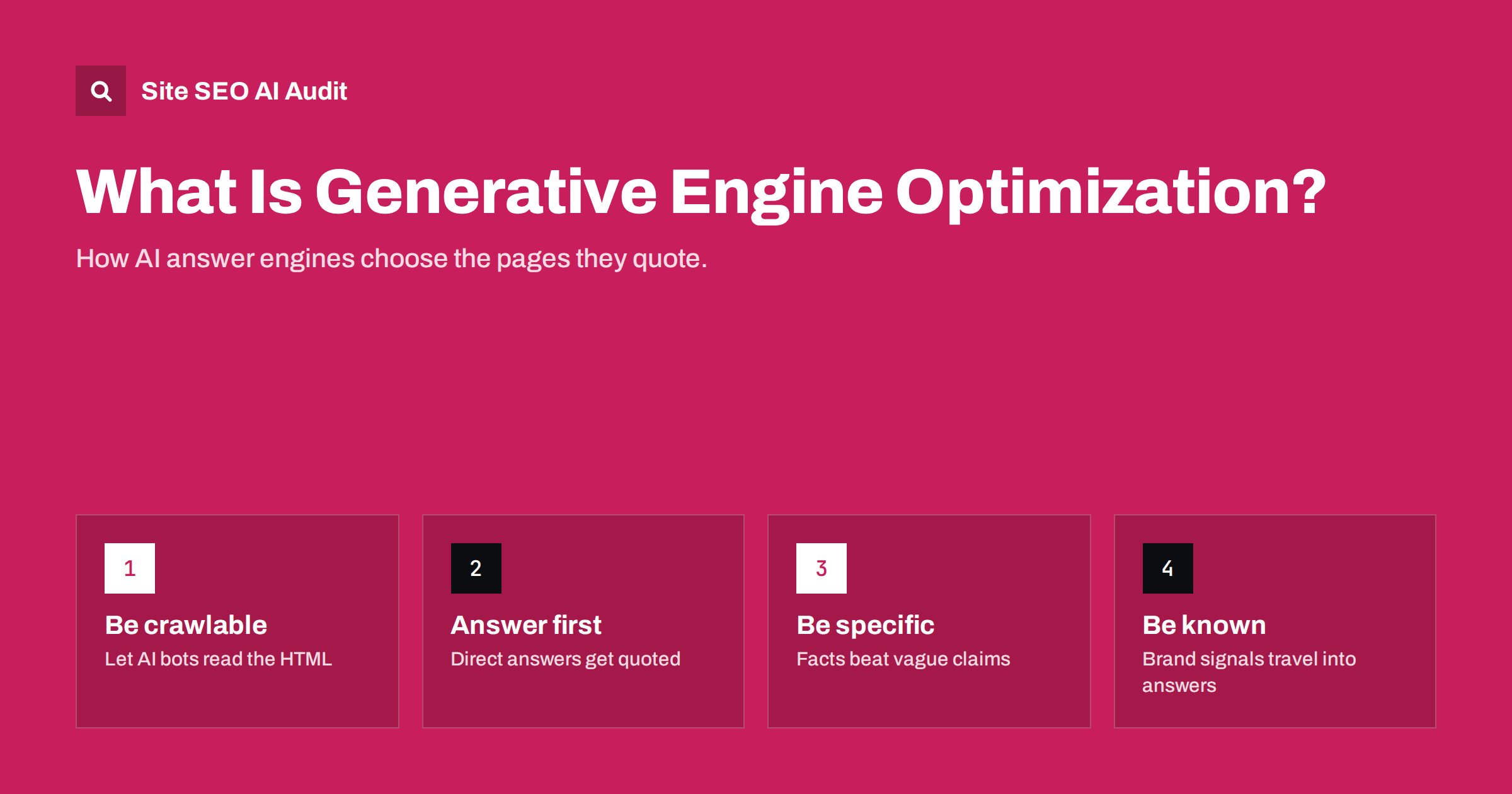
Short answer: Generative engine optimization (GEO) is the work of making your pages easy for AI answer engines to find, understand and quote. It rests on the same foundation as SEO: crawlable, indexable pages with clear, accurate content. What GEO adds is attention to how passages get lifted into answers, which rewards direct answers, clean structure, specific facts and a recognisable brand.
Where the term comes from
The phrase “generative engine optimization” appeared in a 2023 academic paper that tested how different content changes affected the chance of a source being cited in AI-generated answers. Marketers picked it up quickly, and today it is used loosely for anything related to visibility in AI assistants, AI Overviews in Google and answer engines such as Perplexity.
You will also see related labels: AEO (answer engine optimization), LLMO (large language model optimization) and “AI SEO”. They describe roughly the same goal. Rather than argue about names, it is more useful to understand the mechanism these systems share, because that mechanism tells you what you can actually influence.
How AI answer engines pick sources
Most AI search products follow a similar pattern, usually called retrieval-augmented generation. When a user asks a question, the system does not rely only on what the model memorised during training. It runs one or more searches, retrieves a handful of pages or passages, and then writes an answer based on them, often with citations.
- Discovery and crawling. The page must be reachable by a crawler, either the search engine’s main bot or a dedicated AI bot.
- Indexing. The content must be stored in an index the AI system can query. For AI Overviews that is Google’s index; many other assistants rely on Bing’s index or their own.
- Retrieval. For each query, the system selects candidate passages that look relevant. Clear headings and self-contained paragraphs help here.
- Synthesis. The model reads the candidates and writes an answer. Passages that state facts plainly are easier to use than marketing copy that circles around the point.
- Citation. Some of the sources used are shown as links. You do not control which ones, but you control whether your page is a good candidate.
The practical lesson is that the first two steps are pure technical SEO. If a page is blocked, broken or invisible without JavaScript, no amount of clever writing will get it cited.
GEO vs SEO: what is actually different
A lot of GEO advice is simply good SEO with a new label. That is not a criticism; it means your existing work still counts. The differences are real but narrower than the hype suggests.
| Area | Classic SEO focus | Extra GEO focus |
|---|---|---|
| Access | Googlebot and Bingbot can crawl and index | AI crawlers are not blocked in robots.txt, firewall or CDN |
| Rendering | Search engines render JavaScript eventually | Key text is in the raw HTML, because many AI bots do not run scripts |
| Content shape | Page satisfies the search intent | Individual passages answer questions on their own |
| Success metric | Rankings, clicks, conversions | Citations and brand mentions in answers, plus AI referral visits |
| Trust | Links and E-E-A-T signals | Consistent facts about your brand across the web |
Notice what is not in the table: secret prompts, hidden text for bots or special “AI keywords”. Those tactics either do nothing or backfire, because AI systems retrieve from the same kind of index that search engines build and they are designed to ignore manipulation.
The technical foundation: can AI systems read your site?
Start with access, because it is binary and easy to check. A surprising number of sites block AI crawlers without anyone deciding to do so, through a copied robots.txt template, a security plugin or a CDN bot-management setting.
- robots.txt. Look for rules that name AI user agents such as GPTBot, OAI-SearchBot, ClaudeBot or PerplexityBot, and for broad
Disallow: /rules underUser-agent: *. - Firewalls and CDNs. Many services now offer one-click AI bot blocking. Check whether it is on and whether that was intended.
- Raw HTML. Fetch a page with JavaScript disabled or view the source. If the main text, headings or links are missing, many AI bots will see an empty page.
- Status codes and redirects. Broken pages, redirect chains and soft 404s waste crawl effort for every bot, not only AI ones.
- Indexing in Google and Bing. Pages that are not indexed in these engines rarely appear in the AI products built on them.
Deciding whether to allow training crawlers is a separate business question. Many sites choose to block training bots while allowing search and user-triggered bots, so they stay citable in answers without contributing to model training.
Content that gets quoted
Once access is solved, the content itself decides whether your page is a useful source. AI systems favour text they can lift and trust. In practice that means a few habits:
- Answer first. Put a direct, two to four sentence answer near the top of the page, then expand. Long introductions push the useful part out of reach.
- Descriptive headings. Headings phrased like real questions or clear topics help retrieval systems match a passage to a query.
- Self-contained paragraphs. A paragraph that says “this method” without naming it loses meaning when quoted alone. Name the thing.
- Specific facts. Numbers, definitions, steps, requirements and comparisons are more quotable than adjectives. Only use numbers you can support.
- Visible dates and authors. Readers and machines both use these to judge freshness and credibility.
- Lists and tables where they help. Structured formats make steps and comparisons easy to extract.
None of this is writing for robots. A busy reader wants exactly the same thing: the answer quickly, then the detail.
Brand and trust signals beyond your own site
AI answers often mention brands, especially for “best tool for” or “which company” questions. Those mentions draw on what the wider web says about you, not only on your own pages. That is why consistent business information, genuine reviews, industry directory listings and mentions in reputable publications matter.
Structured data such as Organization markup with sameAs links to your official profiles helps machines connect the dots. So does using the same company name, product names and descriptions everywhere. If your pricing page, your social profiles and a directory listing all describe your business differently, an assistant may repeat the wrong version.
Measuring GEO without fooling yourself
Measurement is the weakest part of GEO today. There is no equivalent of Search Console for most AI assistants, and answers vary between users and sessions. A realistic approach combines several signals:
- Referral traffic from AI assistants in your analytics, grouped into its own channel.
- Search Console data for queries where AI Overviews are likely to appear, watching impressions versus clicks.
- Manual spot checks of a fixed list of important questions in the main assistants, recorded monthly.
- Server logs showing whether AI crawlers actually fetch your pages and receive 200 responses.
Be sceptical of tools that promise a precise “AI visibility share”. Answers are personalised and change often, so treat any single number as a rough indicator.
Common GEO myths to ignore
Because the field is new, it attracts confident advice with little evidence behind it. A few claims come up often and are worth treating with caution:
- “Keyword stuffing for AI works.” Repeating phrases does not make a passage more useful to a model. It makes it harder to read and less likely to be chosen.
- “Hidden text for bots helps.” Showing different content to crawlers than to users is cloaking. Search engines treat it as spam, and AI products built on their indexes inherit that judgement.
- “Longer pages always win.” Retrieval works on passages. A focused 1,200-word page with a clear answer can beat a padded 5,000-word page.
- “One file makes you visible.” Files such as llms.txt may help some tools navigate your site, but no single file replaces crawlable pages and good content.
- “You can optimise for one prompt.” Users phrase questions in endless ways. Covering a topic thoroughly and clearly is more reliable than chasing individual prompts.
When a tactic sounds like a shortcut, ask whether it would also help a human reader. If not, it is unlikely to help for long.
How Site SEO AI Audit helps
AI visibility is one of the seven areas in every Site SEO AI Audit report. The crawler checks whether AI crawlers are allowed in your robots.txt, whether you have an llms.txt file, whether page content depends on JavaScript to appear, and whether pages have the structure and dates that AI answers tend to quote. Because the same crawl covers indexing, canonicals, links and structured data, you see the technical foundation and the AI-specific checks side by side, ranked by how many points each fix adds. You can run a free audit to see where your site stands.
Related reading
- How to Write Comparison Pages That AI Answers Trust
- How to Write Content That AI Answers Actually Quote
- AI Search for Publishers and Bloggers: A Practical Strategy
The bottom line
Generative engine optimization is not a replacement for SEO but a layer on top of it. Make sure AI crawlers can reach and read your pages, write content that answers questions directly and specifically, keep your brand information consistent across the web, and measure with a mix of referral data and manual checks. Sites that do the basics well are already most of the way there.
FAQ
Is GEO different from SEO?
GEO builds on SEO rather than replacing it. Crawling, indexing and content quality work the same way, while GEO adds attention to AI crawler access, raw HTML content and passages that can be quoted on their own.
Do I need a separate GEO strategy?
Most small and medium sites do not need a separate strategy. Adding AI crawler checks, answer-first writing and AI referral tracking to your existing SEO routine covers the essentials.
Can I pay to appear in AI answers?
Organic citations in AI answers cannot be bought. Some platforms are testing advertising formats, but those are clearly separate from the sources an answer cites.
How long does GEO take to show results?
Technical fixes such as unblocking a crawler can have an effect once the pages are recrawled, which often takes days or weeks. Brand and content signals build more slowly, typically over months.
Does GEO guarantee that my site will be cited?
No. AI systems decide which sources to cite and answers vary between users. GEO improves your chances by making your pages accessible, clear and trustworthy.