ENEnglish
 LTLietuviškai
 DEDeutsch
 FRFrançais
 RUРусский
 ESEspañol
 PLPolski
 ITItaliano
 UKУкраїнська
 CSČeština
 PTPortuguês
 JA日本語
JA日本語 LVLatviešu valoda
 ETEesti
 HUMagyar
 IDBahasa Indonesia
 TRTürkçe
 HIहिन्दी
 ELΕλληνικά
 ARالعربية
 THไทย
THไทย VITiếng Việt
 RORomână
 MSBahasa Melayu
 BNবাংলা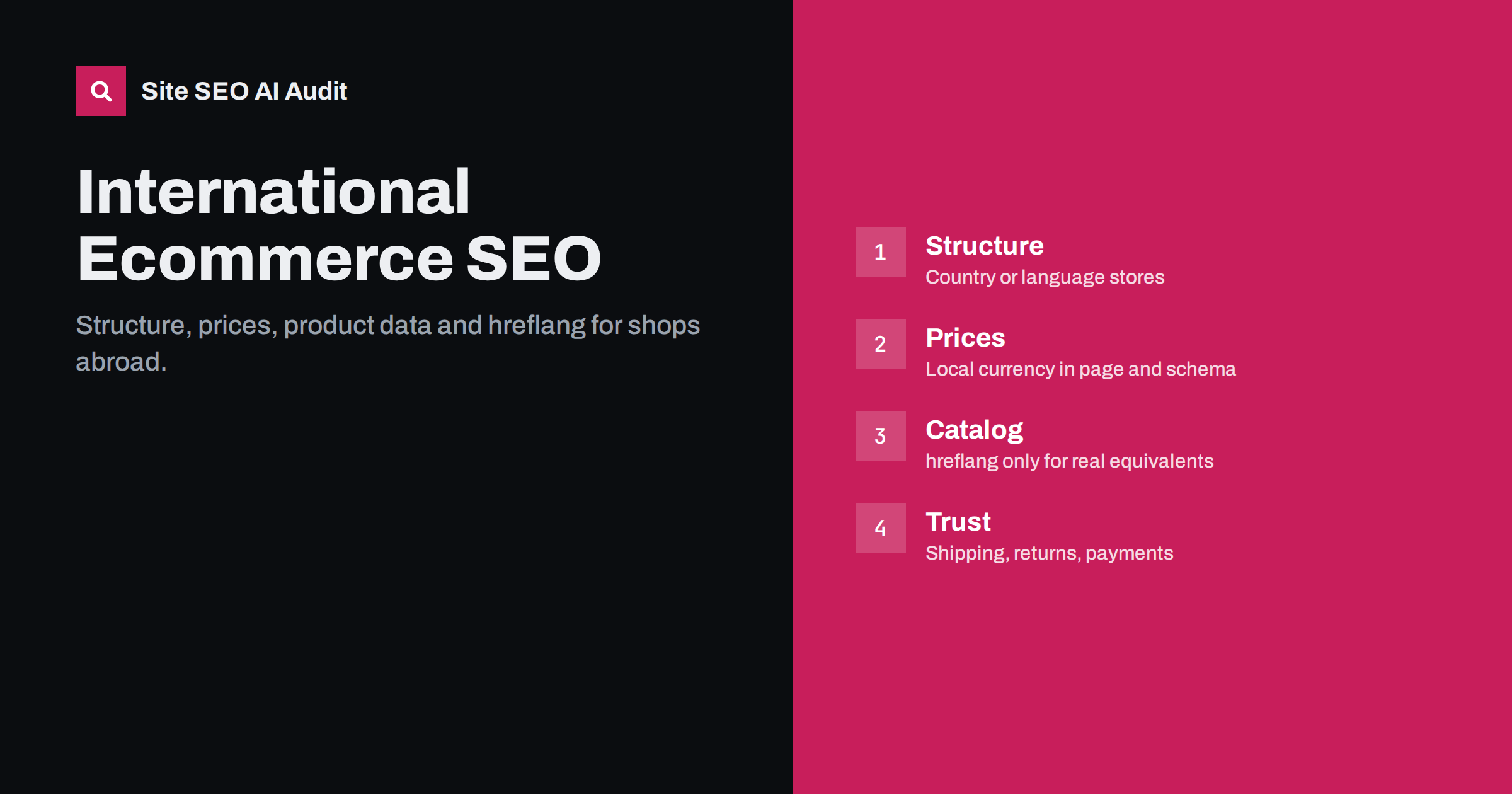
Short answer: To rank an online shop in several countries, give each market its own crawlable store version, usually a folder or domain, with prices in local currency, localized product text, and structured data that matches what the page shows. Connect equivalent products and categories with hreflang, but only where the same product really exists in both stores. Localize shipping, returns, payment and legal information, avoid forced geo-redirects, and keep product data in sync across markets.
Why shops are harder than content sites
A content site going international mainly translates articles. A shop has to translate and localize a catalog that changes every day. Prices, stock levels, product ranges, shipping rules, taxes and legal requirements all differ by country. Every one of these differences affects what the page should show, what structured data it carries and whether it has an equivalent in another market.
Shops also have far more URLs than typical content sites: categories, filters, product variants, pagination and search pages. Multiplying all of that by several markets magnifies every technical problem. A small hreflang or canonical mistake in a product template can affect tens of thousands of pages at once.
Finally, the stakes are commercial. Showing a German visitor the UK store with prices in pounds and no delivery to Germany is not just an SEO issue; it is a lost sale.
Choose the store structure: language or country
The first decision is whether your stores are organised by language or by country. Shops almost always need country versions, because prices, currency, delivery and legal terms differ by country even when the language is the same.
- Country folders on one domain, such as /de-de/, /de-at/ and /fr-fr/, keep everything in one site and share authority. Most shop platforms and multi-store set-ups support this.
- Country domains, such as example.de and example.fr, give the strongest local signal and are common for established retailers, but each domain builds authority separately.
- Language-only folders, such as /de/, work when prices and delivery are the same for all speakers of that language, which is rare for physical goods.
Whichever you choose, each store version needs its own URLs. Changing the currency or product range on the same URL based on the visitor’s location means search engines see only one version.
Prices, currency and structured data
Product pages in each store should show prices in the local currency, with taxes displayed the way local consumers expect. In many European countries, consumers expect prices including VAT; in the United States, sales tax is usually added at checkout.
Structured data must match the visible page. Product markup typically includes the price, the currency, availability and, where relevant, shipping details and return policy. If the German store shows 49.90 EUR but the markup says 45 GBP, the mismatch can prevent rich results and confuse search engines. Google’s documentation on product structured data describes the required and recommended properties.
- Generate product markup from the same data source that renders the price on the page.
- Use the correct ISO currency code in each store.
- Keep availability accurate per market; a product in stock in one country may be unavailable in another.
- Localize product names and descriptions in the markup, not just in the visible text.
hreflang for products and categories
hreflang for a shop follows the same rules as for any site, with one important difference: catalogs are rarely identical across markets. Apply hreflang only between true equivalents:
- Same product in several stores: connect the product pages with hreflang, using country codes such as de-de, de-at and fr-fr.
- Product sold only in one market: no hreflang alternates for that page. Do not point to a category page or the home page of another store as a substitute.
- Categories: connect category pages that represent the same set of products. Deep pagination pages often differ in content, so many shops use hreflang only on the first page of each category.
- Filters and sorting: usually no hreflang; these URLs should canonicalise to the unfiltered category in the same store.
With large catalogs, generating hreflang in XML sitemaps from the product database is often easier than adding it to every page template. Either way, the product relationships must come from reliable data, such as a shared product ID or SKU across stores.
Localize product content properly
Product descriptions are where many international shops cut corners. Machine translation of thousands of descriptions without review produces pages that are hard to trust and hard to rank. Priorities for localization include:
- Product titles using the terms local shoppers search for, including local names for product types.
- Sizes, units and technical specifications in local conventions, such as EU and UK clothing sizes or metric units.
- Compatibility information that differs by market, such as plugs, voltages or regional standards.
- Category names and descriptions that match local search terms.
- Reviews that are clearly marked if they are translated from another language.
Start with your best-selling products and main categories in each market, and extend review coverage over time.
Shipping, returns, payments and legal pages
Trust decides whether a foreign shop converts. Local shoppers look for clear answers to practical questions, and search engines increasingly surface this information too:
- Shipping: delivery times and costs to that country, shown on product pages and in a dedicated shipping page.
- Returns: the return window and process under local consumer rules.
- Payments: the methods local shoppers expect. Preferred payment methods vary widely between countries.
- Legal pages: terms, privacy policy, imprint or company details as required locally, in the local language.
- Customer service: contact options, languages spoken and hours in local time.
These pages are not just legal necessities; they are often searched directly, for example “brand name returns”, and they support the credibility of every product page in that store.
Traps that hurt international shops
- Geo-redirects that lock visitors in a store. Crawlers and travellers cannot reach other stores; hreflang targets become redirects.
- One URL, many currencies. Prices change by location on the same URL, so search engines see one currency and structured data may mismatch for others.
- Canonicals from country stores to the main store, which removes the other stores from search.
- Out-of-stock handling that differs by market, such as 404s in one store and live pages in another, breaking hreflang clusters.
- Duplicate product text across same-language stores with no differences beyond currency, which makes it harder for search engines to choose the right version.
- Stale feeds and sitemaps that list discontinued products or old URLs.
Product feeds and marketplaces per country
Many shops also send product data to shopping platforms, comparison sites and marketplaces. These feeds are separate from organic search, but they draw on the same catalog, and errors often travel in both directions. A feed that lists a product in the Austrian store at the German price, or points to a URL that redirects, usually reflects the same data problem that affects the Austrian product page.
Treat feeds per country as part of international SEO hygiene:
- Generate one feed per store, with the store’s own URLs, currency, language and availability.
- Make sure every URL in a feed returns status 200 and is the canonical URL of that product in that store.
- Keep product identifiers such as GTIN or SKU consistent across stores, so the same product can be matched across markets.
- Remove discontinued products from feeds at the same time they are removed or redirected on the site.
When feeds and pages come from one reliable data source, prices, availability and URLs stay consistent everywhere shoppers and search engines see them. That consistency is one of the clearest signals of a well-run international store.
Keeping multiple stores healthy
International shops change constantly: new products, price updates, seasonal categories, discontinued items. Technical health therefore needs regular checks, not a one-time audit. Useful habits include a crawl after every major catalog import or platform update, monitoring indexed product counts per store in Search Console, and alerts for sudden jumps in 404 pages or redirects.
Site SEO AI Audit is built for this kind of routine. It crawls the site like a search engine and reports issues across seven areas, including Languages (hreflang return links, broken language versions, x-default, lang attributes), structured data, crawl and indexing, links and speed, weighted by how many pages each issue affects. Paid plans include regular re-audits and comparisons over time; see the plans.
Related reading
- Same language, different countries: how to target en-US and en-GB
- Canonical tags and hreflang: how to use them together
- hreflang in XML sitemaps vs HTML head vs HTTP headers
- Automatic language redirects: why they hurt international SEO
The bottom line
International ecommerce SEO combines catalog management with international signals. Give each market its own store URLs, show local prices and match them in structured data, connect only true product and category equivalents with hreflang, localize product content and trust pages, avoid forced geo-redirects and cross-store canonicals, and check the stores regularly as the catalog changes.
FAQ
Should an online shop use country or language versions?
Usually country versions, because prices, currency, delivery and legal terms differ by country. Language-only versions work when those details are the same for everyone who speaks the language.
Can I show different currencies on the same URL?
You can convert prices for display, but search engines generally see only one version of a URL. For real market differences, separate store URLs with hreflang are clearer.
Do all products need hreflang?
Only products that exist in more than one store. Products sold in one market have no alternates, and they should not point to unrelated pages in other stores.
How should out-of-stock products be handled across stores?
Handle them consistently. Temporarily unavailable products usually stay live with correct availability in structured data, while permanently discontinued products can redirect to a close alternative or return 404 or 410, with hreflang updated in all stores.
Does structured data need to be localized?
Yes. Product names, descriptions, prices, currency and availability in the markup should match the localized page in each store.