ENEnglish
 LTLietuviškai
 DEDeutsch
 FRFrançais
 RUРусский
 ESEspañol
 PLPolski
 ITItaliano
 UKУкраїнська
 CSČeština
 PTPortuguês
 JA日本語
JA日本語 LVLatviešu valoda
 ETEesti
 HUMagyar
 IDBahasa Indonesia
 TRTürkçe
 HIहिन्दी
 ELΕλληνικά
 ARالعربية
 THไทย
THไทย VITiếng Việt
 RORomână
 MSBahasa Melayu
 BNবাংলা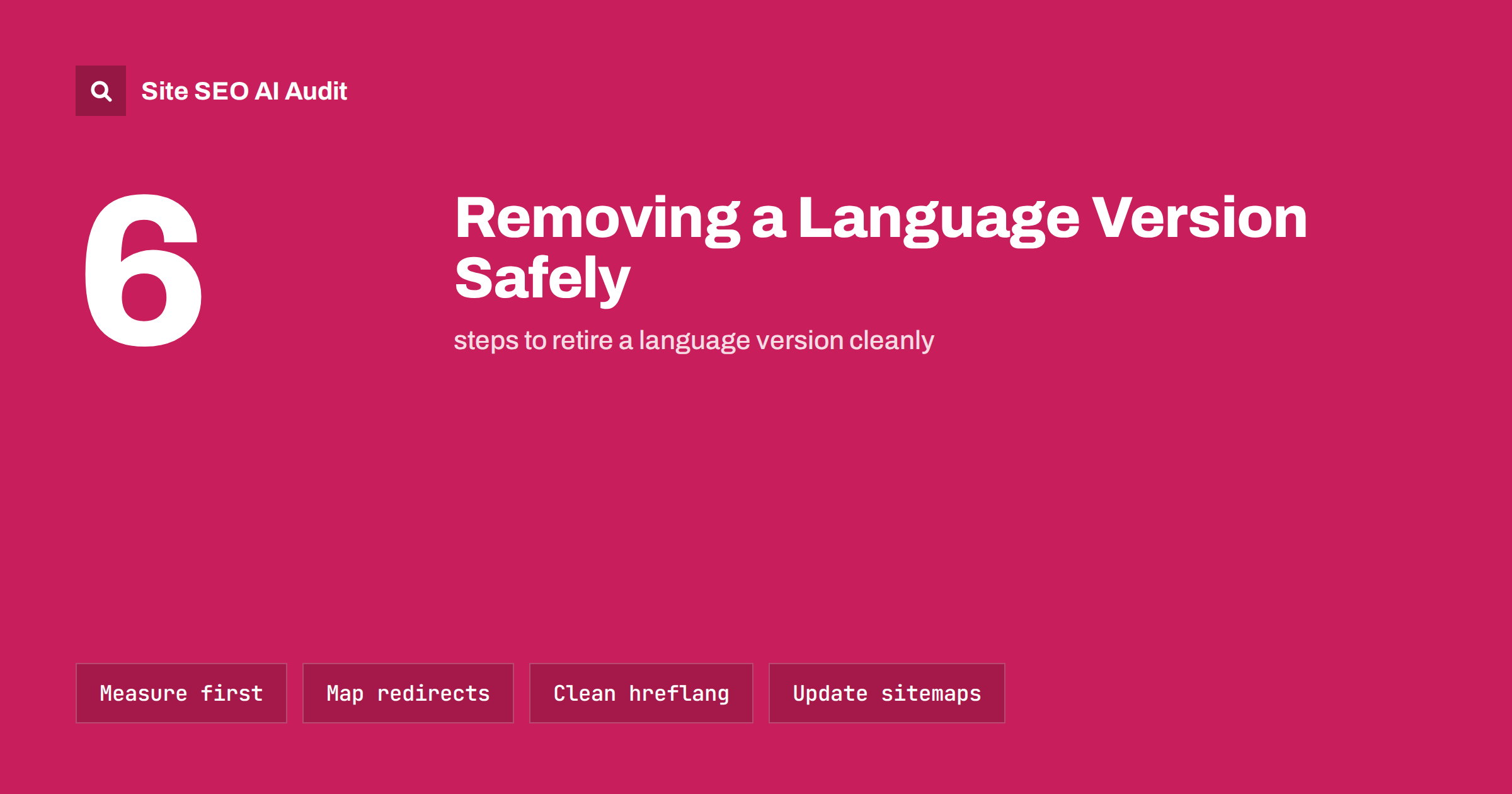
Short answer: to remove a language version safely, first measure what it still brings in, then decide page by page whether to redirect to the closest remaining language version or return 410. Remove every hreflang reference to the retired version from all remaining pages and sitemaps, take it out of the language switcher and internal links, and monitor Search Console for errors and traffic for a few weeks. Done in this order, the other language versions keep their rankings and the retired URLs drop out cleanly.
Why sites remove language versions
Launching a language version is exciting; maintaining it is harder. Sites commonly retire a version for a few reasons:
- The market did not work out, and sales or leads from that language never justified translation costs.
- The translation fell behind, so pages show outdated prices, features or legal text that now does more harm than good.
- Consolidation, for example merging separate English versions for the UK, US and Australia into one international English version.
- Machine-translated content that was published quickly and now looks thin or unreliable.
- A platform change where rebuilding every language at once is not realistic.
Whatever the reason, the removal touches more than the retired pages. hreflang annotations, sitemaps and navigation on every other version point to the old URLs, so a careless removal creates errors across the whole site.
Alternatives to removing a version completely
Removal is final in practice: once rankings for a language are gone, rebuilding them takes months. Before you commit, consider whether a smaller change solves the real problem:
- Shrink the version. Keep the home page, the main service or category pages and the contact page, and retire only the blog posts and pages that nobody reads. A small, accurate version is better than a large, outdated one.
- Freeze and label. If budget for updates is the issue, keep evergreen pages and remove anything with prices, dates or legal terms that go stale.
- Merge regions, keep the language. Several country versions in the same language can often become one language version, which removes duplication without abandoning the audience.
- Noindex temporarily. If a version is being rebuilt, a temporary noindex keeps weak pages out of search while the URLs and hreflang stay intact. Use this only for a short, planned period.
If none of these fits, go ahead with a full removal, but do it deliberately, following the steps below, rather than by simply switching the language off in a plugin.
Step 1: measure what the version still brings
Before deleting anything, collect the facts. In Search Console, filter the Performance report by page URL prefix, for example /it/, and note clicks, impressions and top queries for the last 12 months. In analytics, look at sessions, conversions and revenue from those pages. Then check which retired URLs have external links pointing to them, using your backlink tool of choice.
This tells you what you are giving up and which URLs deserve careful redirects. It also sometimes changes the decision: a version with low traffic overall may still have a handful of pages that rank well and convert. Those pages might be worth keeping and updating even if the rest goes. If only part of the version is outdated, our guide on handling untranslated pages on a multilingual site may offer a lighter option.
Step 2: decide between redirect and 410
There is no single right answer for every page. Choose based on whether a meaningful replacement exists:
| Situation | Recommended response | Why |
|---|---|---|
| Same content exists in another language most of the audience can read | 301 to the equivalent page, e.g. /de-at/ to /de/ |
Visitors land on useful content and link signals are consolidated |
| Merging country versions in the same language | 301 each page to its counterpart in the kept version | Nearly identical content, so the redirect is a true replacement |
| Content exists only in a language the audience may not read | 301 to the closest equivalent, or 410 if it would confuse visitors | Redirecting Japanese readers to English content may or may not help them |
| Page has no equivalent anywhere | 410 Gone, or 404 | A redirect to an unrelated page is usually treated as a soft 404 |
Avoid sending every retired URL to the home page. Search engines tend to treat mass redirects to unrelated pages as soft 404s, and visitors arrive somewhere they did not expect. Page-to-page mapping takes longer but keeps value where it exists. Our comparison of 301 and 302 redirects explains why the redirect must be permanent in this case.
Step 3: clean up hreflang on every remaining page
This is the step most often missed. Each remaining page that listed the retired version in its hreflang set now points to a URL that redirects or returns 410. Search engines report these as errors, and a broken hreflang set can weaken how the remaining alternates are understood.
- Remove the retired language and region codes from hreflang in the HTML head, the XML sitemap or HTTP headers, whichever method you use.
- Check that the remaining pages still reference each other with correct return links.
- Review
x-default. If it pointed to the retired version, move it to the version that should now serve unmatched visitors. - If a region-specific code such as
de-ATis retired, decide whether the genericdeversion should now cover Austrian searchers. Usually it already does through the language-only code.
Multilingual plugins and platforms often update hreflang automatically when a language is disabled, but not always when pages are deleted or redirected manually. Verify the output rather than assume. Our guide to fixing hreflang return link errors shows what a consistent set looks like.
Step 4: update sitemaps, navigation and internal links
Next, remove every internal path to the retired version so crawlers and visitors stop being sent there:
- Remove retired URLs from XML sitemaps, or delete the language-specific sitemap and its entry in the sitemap index.
- Take the language out of the language switcher on every page.
- Search the remaining content for links into the retired folder or domain, including footers, menus and old blog posts.
- Update canonical tags that may point across languages by mistake.
- Remove structured data or Open Graph references that use retired URLs.
Internal links to redirected URLs still work for visitors, but they waste crawl activity and create redirect hops. Link directly to the final destination. Our checklist for multilingual XML sitemaps covers the sitemap side in detail.
Step 5: handle domains, subdomains and Search Console
If the retired version lived on its own ccTLD or subdomain, a few extra steps apply. Keep the old domain registered and keep the redirects running for at least a year, ideally longer, because external links and bookmarks will keep arriving. Letting a retired ccTLD expire can hand your old links to whoever registers it next.
In Search Console, keep the property for the old domain or folder so you can watch it drop out of the index. For a full domain move, the Change of Address tool applies only when the whole domain moves to another domain; removing one language from a multilingual domain does not need it. Do not use the URL removal tool for the retired version: it only hides URLs temporarily and is not needed when redirects or 410 responses are in place.
Step 6: monitor the weeks after removal
Search engines take time to recrawl retired URLs and update hreflang clusters. Over the following weeks, watch for:
- Indexing reports showing retired URLs moving to “Page with redirect” or “Not found (404)”, which is expected.
- hreflang errors from third-party crawls pointing to missing or redirected alternates.
- Traffic on the target versions, to confirm redirected pages pass visitors to their new homes.
- Unexpected drops on unrelated languages, which usually point to a broken hreflang set or a template change that went too far.
Site SEO AI Audit checks hreflang return links, broken language versions, x-default and lang attributes across your whole site, together with redirects and broken internal links. Running an audit before and after the removal shows immediately whether any page still references the retired version. Paid plans include re-audits, so you can confirm the cleanup is complete.
Related reading
- How to Launch a New Language Version Without SEO Problems
- Migrating an International Site: ccTLDs to Subfolders and Back
- Language Switcher Best Practices for SEO and Usability
The bottom line
Removing a language version is a small migration. Measure what it brings, map each URL to its closest real equivalent or return 410, strip the retired version from every hreflang set, sitemap and menu, keep old domains and redirects alive, and monitor for a few weeks. The remaining versions then carry on without errors.
FAQ
Should I redirect a removed language version to the home page?
No. Mass redirects to the home page are often treated as soft 404s and frustrate visitors. Redirect each page to its closest equivalent in another language, and return 410 where no equivalent exists.
Will removing one language hurt my other language versions?
Not if you clean up properly. Problems usually come from hreflang sets that still point to retired URLs, so remove those references everywhere and check the output after the change.
Is 404 or 410 better for retired pages?
Both remove pages from the index over time. A 410 states more clearly that the page is gone for good and may be processed slightly faster, but either is acceptable when no replacement exists.
How long should I keep redirects from a retired ccTLD?
At least a year, and longer if the domain still receives links and visits. Keep the domain registered so that old links cannot be picked up by someone else.
Do I need to update x-default when removing a language?
Only if x-default pointed to the retired version. In that case, point it to the version that should now serve visitors whose language does not match any remaining version.