ENEnglish
 LTLietuviškai
 DEDeutsch
 FRFrançais
 RUРусский
 ESEspañol
 PLPolski
 ITItaliano
 UKУкраїнська
 CSČeština
 PTPortuguês
 JA日本語
JA日本語 LVLatviešu valoda
 ETEesti
 HUMagyar
 IDBahasa Indonesia
 TRTürkçe
 HIहिन्दी
 ELΕλληνικά
 ARالعربية
 THไทย
THไทย VITiếng Việt
 RORomână
 MSBahasa Melayu
 BNবাংলা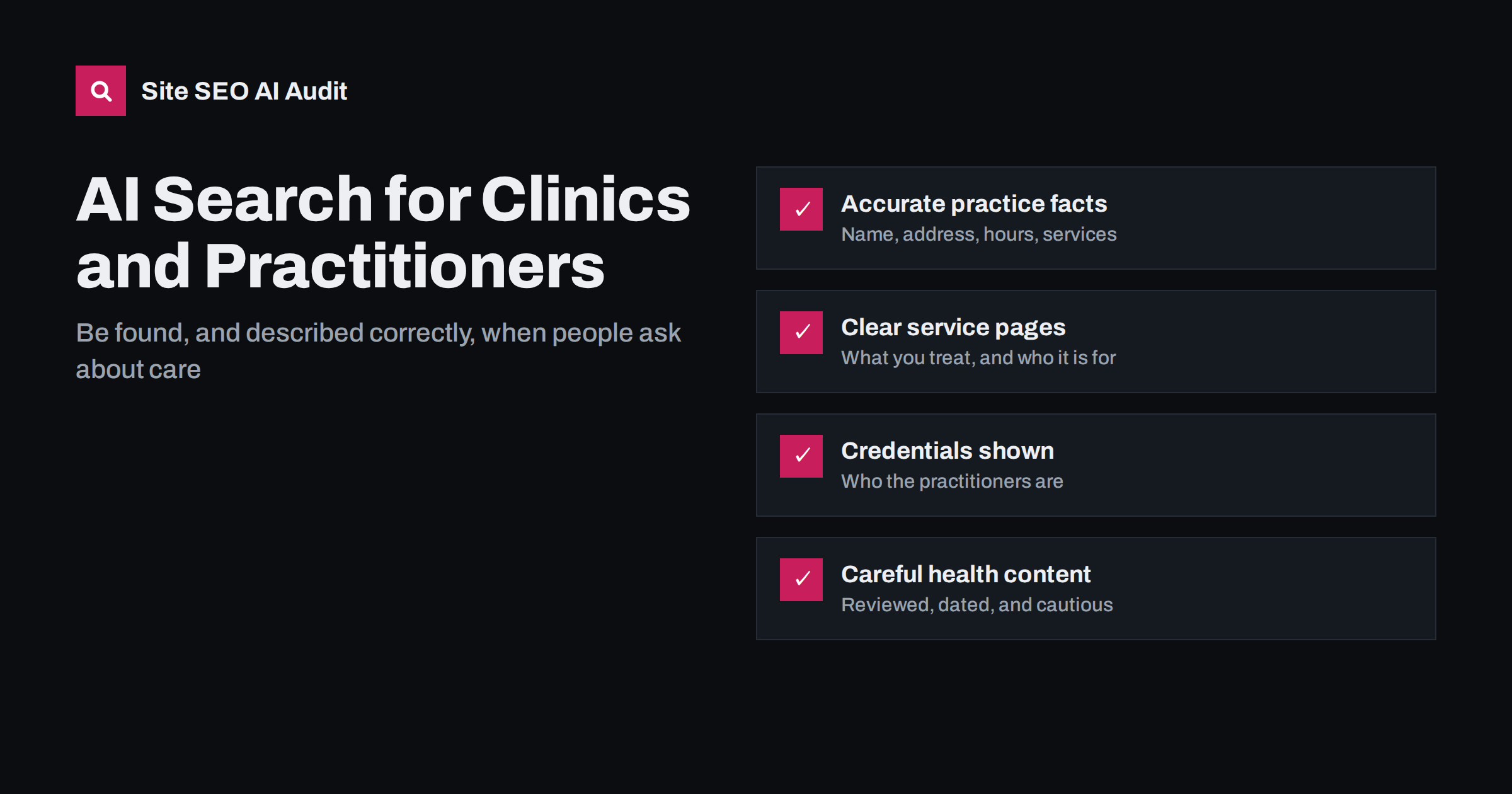
Short answer: People increasingly ask AI assistants where to find a dentist, physiotherapist or clinic, and what a treatment involves. To be described correctly, a practice needs consistent public facts (name, address, hours, services), clear pages for each service, visible practitioner credentials, accurate local listings and cautious, reviewed health content. Health is a sensitive topic, so assistants favour sources that look trustworthy. Never make promises about outcomes, never publish private patient information, and follow the rules of your profession and country.
Choosing a healthcare provider is a high-stakes decision, and more people start the search by asking a question in plain words: “Which clinic near me treats back pain?” or “What happens at a first dental visit?” The answers they receive draw on websites, listings, reviews and professional sources. For a clinic, the aim is not to push marketing claims into an assistant, but to make sure the true and useful facts about the practice are easy to find and to quote.
Why health is treated more carefully
Search engines and AI assistants treat medical and wellbeing topics as sensitive, because wrong information can cause harm. Content in this area is judged by a higher standard of expertise, accuracy and trust. For a practice, that has two practical consequences:
- Who writes and reviews the content matters. Pages written or checked by qualified professionals, with their names and roles visible, are more convincing than anonymous text.
- Unsupported claims are risky. Statements about cures, guaranteed results or comparisons with other providers can break professional rules and damage trust.
Our article on YMYL topics in AI search explains the wider principles for health, money and safety content.
Start with the facts about the practice
Before any content strategy, make sure the basic facts are correct everywhere. An assistant that finds three different phone numbers or opening hours may repeat the wrong one. Check:
- The official practice name, and any trading names, written the same way across the site and profiles.
- The address, phone number and opening hours, including holiday hours and how to reach you out of hours.
- The services you provide, and those you do not. Say clearly if you need a referral, accept walk-ins or work by appointment only.
- The languages spoken, accessibility of the building, and parking or transport details.
- The insurance or payment arrangements you accept, only if they are current and certain.
Put these facts in plain text on the contact page and in the footer, and mirror them in your local business listings. Our advice on contact page SEO and AI search for local businesses applies directly.
Create a clear page for each service
A single page that lists every treatment in a paragraph does not help patients or assistants. Create a separate page for each main service, with the following parts:
- What it is and who it is for, in plain language, without unexplained jargon.
- What happens during a visit, including how long it takes and how to prepare.
- Who provides it, with a link to the practitioner’s profile.
- Practical details: cost range if you can state it reliably, booking method and aftercare.
- Honest limits: when the treatment is not suitable and when a patient should seek a different kind of care.
Pages built this way answer the follow-up questions that people ask assistants. Use headings that match real questions, as described in answer-first introductions, and avoid copying text from manufacturers or other clinics. See service page SEO for a general structure.
Show who the practitioners are
For health content, expertise is not an abstract idea. Visitors want to know who will treat them. Create a profile page for each practitioner with:
- Full name, role and professional registration or licence number where your country publishes it.
- Qualifications, areas of focus and years of practice.
- A real photograph and, where appropriate, languages spoken.
- Links to articles, talks or professional memberships that you can verify.
Credit authors and medical reviewers on informational articles, and show the date they were last checked. This follows the ideas in author pages and bylines and E-E-A-T for AI search.
Publish helpful and careful health content
Educational content brings people to the practice before they need an appointment. Some principles keep it safe and useful:
- Answer real patient questions: symptoms to watch for, what a procedure involves, how to prepare, what recovery looks like.
- Be cautious. Describe general information, say when to see a professional, and never replace an individual assessment.
- Have a qualified person review it and date the review. Update the page when guidance changes.
- Cite reliable sources such as public health bodies and professional associations where it adds value.
- Avoid promises: no guaranteed outcomes, no unverified before-and-after claims, and no pressure tactics.
Check your local advertising rules for health professionals. In many countries they limit comparative claims, testimonials and certain wording, and those limits apply to your website as well as to printed material.
Reviews, listings and local signals
When someone asks an assistant for a clinic nearby, the answer often relies on local listings and reviews. Keep your business profile complete, with the right category, services, photos and hours. Respond to reviews politely and without disclosing any patient information, even to confirm that a person was a patient, since confidentiality rules usually apply. Encourage patients to leave honest feedback, but do not offer incentives that the platform forbids.
Consistency across directories matters as much as the number of reviews. Our guide to reviews and reputation in AI recommendations explains how assistants weigh this kind of evidence.
Structured data for practices
Structured data helps machines identify the type of organisation and its details. Schema.org includes types for medical organisations, clinics and physicians, as well as the general local business types. A cautious approach:
- Use markup for facts that are stable and visible: name, address, phone, opening hours, services and the practitioners’ names.
- Do not mark up reviews of your own practice on your own pages, because ratings about the organisation itself are treated as self-serving.
- Keep the data identical to the visible text, and test it after each change.
The basics are covered in structured data for AI search. Markup does not guarantee that an assistant will quote you, but it removes ambiguity about who you are.
Privacy and security basics
A clinic website often handles sensitive data through booking forms and patient portals. Use HTTPS everywhere, collect only the data you need, tell visitors what you do with it, and keep private areas out of search results. Make sure confirmation pages, patient portals and test pages are not indexed, and that your forms do not display personal details in URLs. A secure site is part of trust, and our guide to hacked site SEO spam shows what can go wrong when it is neglected.
Finally, keep a simple routine. Once a quarter, review the practice facts on your site and in every listing, update staff and service pages, check that no page mentions a treatment you no longer offer and read the latest reviews for recurring questions that deserve a clear answer on the website. Small, regular corrections do more for accurate AI answers than a one-time campaign, because the sources that assistants rely on change constantly.
Also think about accessibility of the information itself. Patients searching for care may be anxious, elderly or reading on a small phone screen. Use plain language, short paragraphs, readable font sizes and a visible phone number that can be tapped. Pages that are easy for people to use are usually easy for machines to read as well.
Check how your practice appears
Ask a few assistants the questions your patients ask, and compare the answers with the truth: are the address, hours and services correct, and are the right practitioners named? Write down every error and trace it to its source, which is often an old listing or an outdated page. Site SEO AI Audit crawls your whole site like a search engine and checks titles, descriptions, headings, structured data, AI crawler access in robots.txt and the content that AI answers can read, with a fix list ranked by points. The first audit of up to 200 pages is free.
Related reading
The bottom line
AI assistants describe a clinic using the evidence they can find. Make that evidence accurate and consistent: correct practice details, a clear page for each service, visible practitioner credentials, careful reviewed health content and tidy local listings. Avoid outcome promises and protect patient privacy at every step. Trust is the main ranking factor in healthcare, and it is built slowly with accurate information.
KKK
Can a clinic appear in AI answers without a big marketing budget?
Yes. Accurate local listings, clear service pages and visible practitioner details cost time more than money. Assistants favour reliable, consistent information, which small practices can provide as well as large ones.
Should a clinic publish medical advice articles?
Educational articles can help, if they are written or reviewed by a qualified professional, dated, cautious and based on reliable sources. They should never replace individual advice or promise results.
Can I respond to patient reviews?
You can respond politely and generally, but avoid confirming that someone was a patient or discussing treatment details in public, because confidentiality rules usually apply. Invite the person to contact you privately instead.
Which structured data fits a clinic?
Schema.org offers medical organisation, clinic and physician types, besides local business types. Use the one that matches reality, keep the data identical to the visible text and do not mark up reviews of your own practice.
How do I check what AI assistants say about my practice?
Ask the questions patients would ask, compare the answers with your real details, and fix the sources of any errors, such as outdated listings or old pages. Repeat the check every few months.