ENEnglish
 LTLietuviškai
 DEDeutsch
 FRFrançais
 RUРусский
 ESEspañol
 PLPolski
 ITItaliano
 UKУкраїнська
 CSČeština
 PTPortuguês
 JA日本語
JA日本語 LVLatviešu valoda
 ETEesti
 HUMagyar
 IDBahasa Indonesia
 TRTürkçe
 HIहिन्दी
 ELΕλληνικά
 ARالعربية
 THไทย
THไทย VITiếng Việt
 RORomână
 MSBahasa Melayu
 BNবাংলা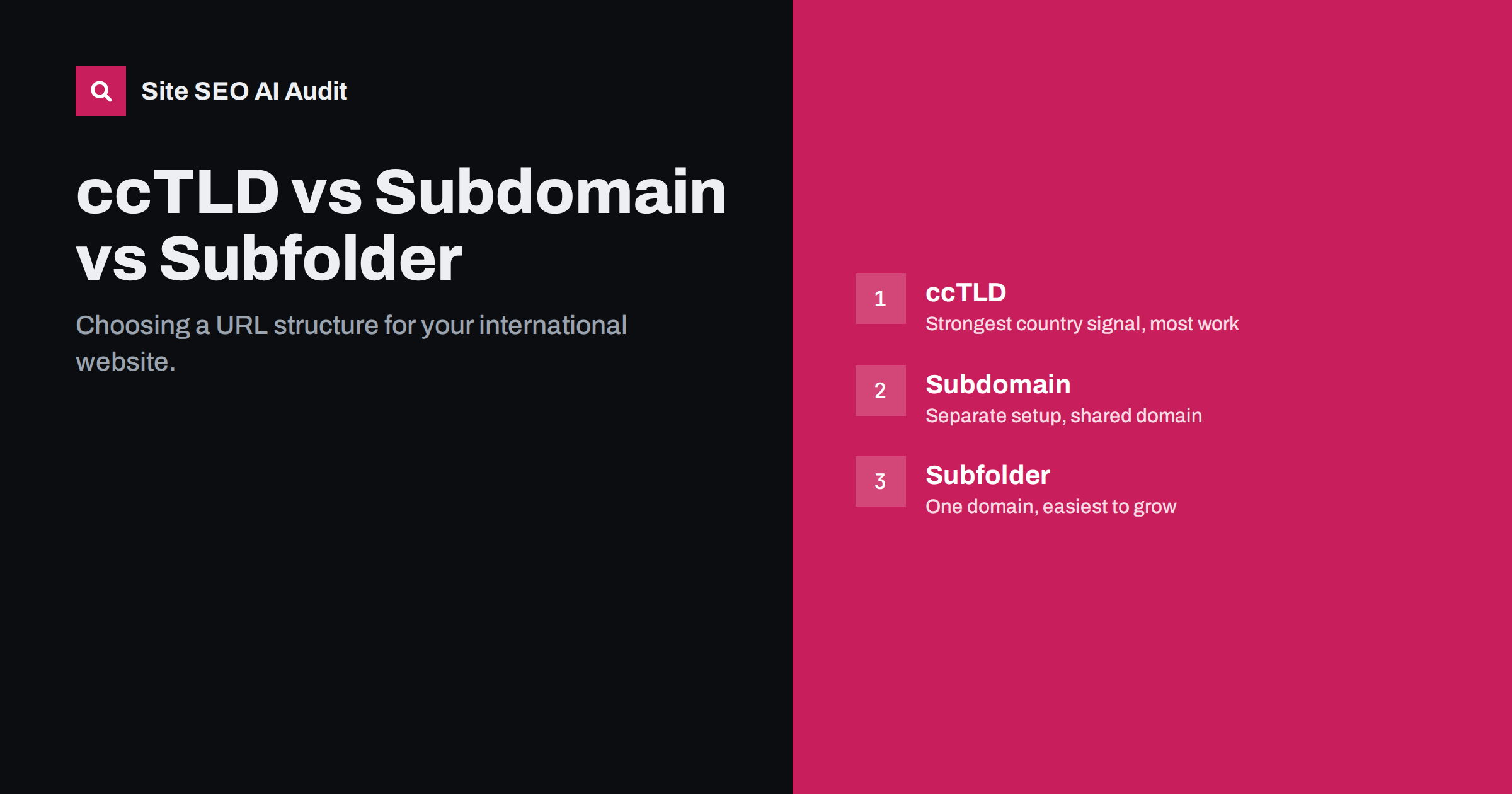
Short answer: For most businesses, subfolders such as example.com/de/ are the best default for an international site, because they keep everything on one domain and are the cheapest to run. Country-code domains such as example.de give the strongest local signal but multiply the work of building and maintaining separate sites. Subdomains such as de.example.com sit in between and rarely offer an advantage over subfolders.
Why the URL structure decision matters
When a website expands into new languages or countries, the first technical question is where the new versions will live. The choice affects more than SEO. It shapes hosting, analytics, content workflows, legal set-up and how easy it is to add the next market.
It is also a decision that is expensive to reverse. Moving from country domains to subfolders later, or the other way round, is a full site migration with redirects for every URL. So it is worth thinking it through before the first translated page goes live.
Google’s own guidance on managing multi-regional and multilingual sites lists the same three main options and their trade-offs. None of them is forbidden, and none of them is a ranking trick. They differ mainly in how clearly they signal a target country and how much work they create.
The three options at a glance
| Structure | Example | Country signal | Cost and effort | Typical fit |
|---|---|---|---|---|
| Country-code domain (ccTLD) | example.de, example.fr | Strong and clear | High: many domains, often many sites | Large brands with local teams per country |
| Subdomain | de.example.com | Weak on its own; needs hreflang | Medium: separate set-up per subdomain | Platforms that must separate hosting or systems |
| Subfolder | example.com/de/ | Weak on its own; needs hreflang | Low: one domain, one site | Most small and medium businesses, SaaS, shops |
| URL parameter | example.com/?lang=de | Weak and fragile | Low to set up, hard to maintain | Not recommended |
The last row is included because it still appears on older sites. Parameters are easy to lose in links, often get stripped by caches, and make it harder to separate language versions in reports. Google advises against them for language versions.
Country-code domains: strong signal, heavy load
A ccTLD such as .de, .fr or .lt tells both users and search engines that a site is meant for one country. Local visitors often trust a local domain more, especially in markets where buying from a foreign site feels risky.
The downsides are practical:
- Availability and rules. Your brand name may already be taken in some countries, and some registries require a local presence or company.
- Authority starts from zero. Each domain has to earn its own links and reputation. Links to example.de do not directly strengthen example.fr.
- More of everything. Separate certificates, DNS, analytics properties, Search Console properties, and often separate CMS installations.
- Language is not country. A .de domain targets Germany, but German speakers in Austria and Switzerland are a separate question.
Note that some country codes are widely used as generic domains, for example .io, .co, .me or .tv. Google treats a list of these as generic top-level domains rather than country signals, so they do not help with geotargeting.
Subdomains: separation without a clear benefit
Subdomains such as de.example.com keep the brand domain but separate each version technically. They make sense when each market really runs on different infrastructure, for example when a regional partner hosts its own shop, or when a platform limits what you can do inside one site.
From an SEO point of view, subdomains give no country signal by themselves. You still need hreflang and, where relevant, local content signals. In practice, search engines may treat subdomains as partly separate sites, which means authority is not always shared as smoothly as within one domain. Opinions differ on how much this matters, but there is rarely an SEO reason to prefer subdomains over subfolders.
Operationally, subdomains often add the same overhead as separate domains: separate server blocks, certificates, analytics filters and Search Console properties.
Subfolders: the practical default
Subfolders such as example.com/de/ or example.com/en-gb/ keep all versions inside one site. For most businesses this is the easiest structure to build and grow:
- Shared authority. Links to any language version strengthen the same domain.
- One system. One CMS, one hosting set-up, one certificate, one analytics property.
- Easy expansion. Adding a new market means adding a folder, not buying and configuring a domain.
- Clear reporting. Search Console and analytics can filter by folder, so each market can still be measured separately.
The weakness is that a subfolder carries no country signal by itself. That is what hreflang is for, together with local content such as currency, addresses, phone numbers and language. For language-only targeting (German for all German speakers), subfolders plus hreflang are usually all you need.
How to choose: a short decision checklist
Answer these questions honestly before choosing:
- Are you targeting languages or countries? If the goal is “German speakers anywhere”, a language folder such as /de/ fits. If the goal is “customers in Germany, with German prices, shipping and law”, country versions make more sense, and a ccTLD becomes an option.
- Do you have local teams? Separate domains work best when each market has people who create content and earn links locally. Without them, separate domains tend to stay weak.
- How many markets will you add? Two markets can be managed on any structure. Ten or twenty are much easier on one domain.
- What does your platform support? Many CMS and multilingual plugins handle subfolders well. Some shop platforms push you towards one structure. Work with the platform rather than against it.
- What already exists? If you already have established country domains with their own links and traffic, a move to subfolders is a migration with real risk. It can still be worth it, but it should be a deliberate project.
Mistakes to avoid with any structure
- Mixing structures without a reason. Some markets on ccTLDs, others in folders and one on a subdomain is hard to maintain and hard to audit.
- Forgetting hreflang. Whatever the structure, language and country versions still need hreflang with return links.
- Redirecting by IP. Forcing visitors, and crawlers, to a version based on location can stop search engines from seeing all versions.
- Half-translated folders. A /de/ folder with English navigation and German body text sends mixed signals. Translate templates, menus and metadata too.
- Inconsistent URL patterns. Choose /de/ or /de-de/ and stick to it. Changing patterns later means more redirects.
Signals that matter more than the URL
It is easy to spend weeks debating domains and forget that the URL is only one of several signals. Whichever structure you pick, search engines and visitors look at the page itself to decide who it is for. These signals usually carry more weight in practice:
- The language of the main content. Search engines detect the language from the visible text. A page tagged as German but written in English will be treated as English.
- Local details. Prices in the local currency, local phone numbers and addresses, shipping and return terms for that country, and local payment methods all show which market a page serves.
- Consistent hreflang. A complete cluster with return links tells search engines exactly which version to show where.
- Local links and mentions. Links from sites in the target country, local directories and local press help a version earn trust in that market.
- Translated metadata. Titles, meta descriptions, image alt texts and structured data should be in the page’s language, not left in the original.
A subfolder with strong local signals will usually do better than a country domain with thin, half-translated content. The structure sets the frame; the content and signals inside it do most of the work.
It also helps to write down the decision and the reasons for it. Teams change, and a year later someone will ask why the site uses folders rather than domains. A short internal note saves a repeat of the whole debate and reduces the risk of someone adding a new market on a different structure.
Checking your structure after launch
Once language versions are live, the structure needs regular checks, because problems tend to creep in quietly. Site SEO AI Audit crawls the whole site the way a search engine does and reviews its Languages area on every page: hreflang return links, broken language versions, x-default and lang attributes. The same crawl covers canonicals, redirect chains and the sitemap, which is where structure changes often break things. You can start with a free audit of your site.
Related reading
- Multilingual vs Multi-Regional Sites: What Is the Difference?
- hreflang Errors: The Complete List and How to Fix Each One
- International SEO Glossary: Key Terms Explained Simply
The bottom line
ccTLDs give the clearest country signal but cost the most to run and grow. Subdomains separate systems without a clear SEO advantage. Subfolders keep everything on one domain and suit most businesses, as long as hreflang and local content do the targeting work. Choose once, deliberately, based on whether you target languages or countries and how many markets you plan to serve.
KKK
Is a subfolder or a subdomain better for SEO?
For most sites a subfolder is the simpler and safer choice, because all versions share one domain and one set-up. A subdomain can work just as well technically, but it usually adds work without an SEO benefit.
Do I need a ccTLD to rank in another country?
No. Many sites rank well abroad with subfolders or a generic domain, using hreflang and local content. A ccTLD is a strong signal, but it is not a requirement.
Does server location affect international rankings?
Server location is a minor factor at most. Speed matters more, and a content delivery network can serve pages quickly worldwide regardless of where the origin server is.
Can I use a .io or .co domain to target a country?
Not really. Google treats several popular country codes, including .io and .co, as generic domains, so they do not signal a target country.
Should the language folder include a country code?
Only if you have different versions for different countries in the same language. If you have one German version for everyone, /de/ is enough; use /de-at/ and /de-de/ only when the pages really differ.