ENEnglish
 LTLietuviškai
 DEDeutsch
 FRFrançais
 RUРусский
 ESEspañol
 PLPolski
 ITItaliano
 UKУкраїнська
 CSČeština
 PTPortuguês
 JA日本語
 LVLatviešu valoda
 ETEesti
 HUMagyar
 IDBahasa Indonesia
 TRTürkçe
 HIहिन्दी
 ELΕλληνικά
 ARالعربية
 THไทย
 VITiếng Việt
 RORomână
 MSBahasa Melayu
 BNবাংলা
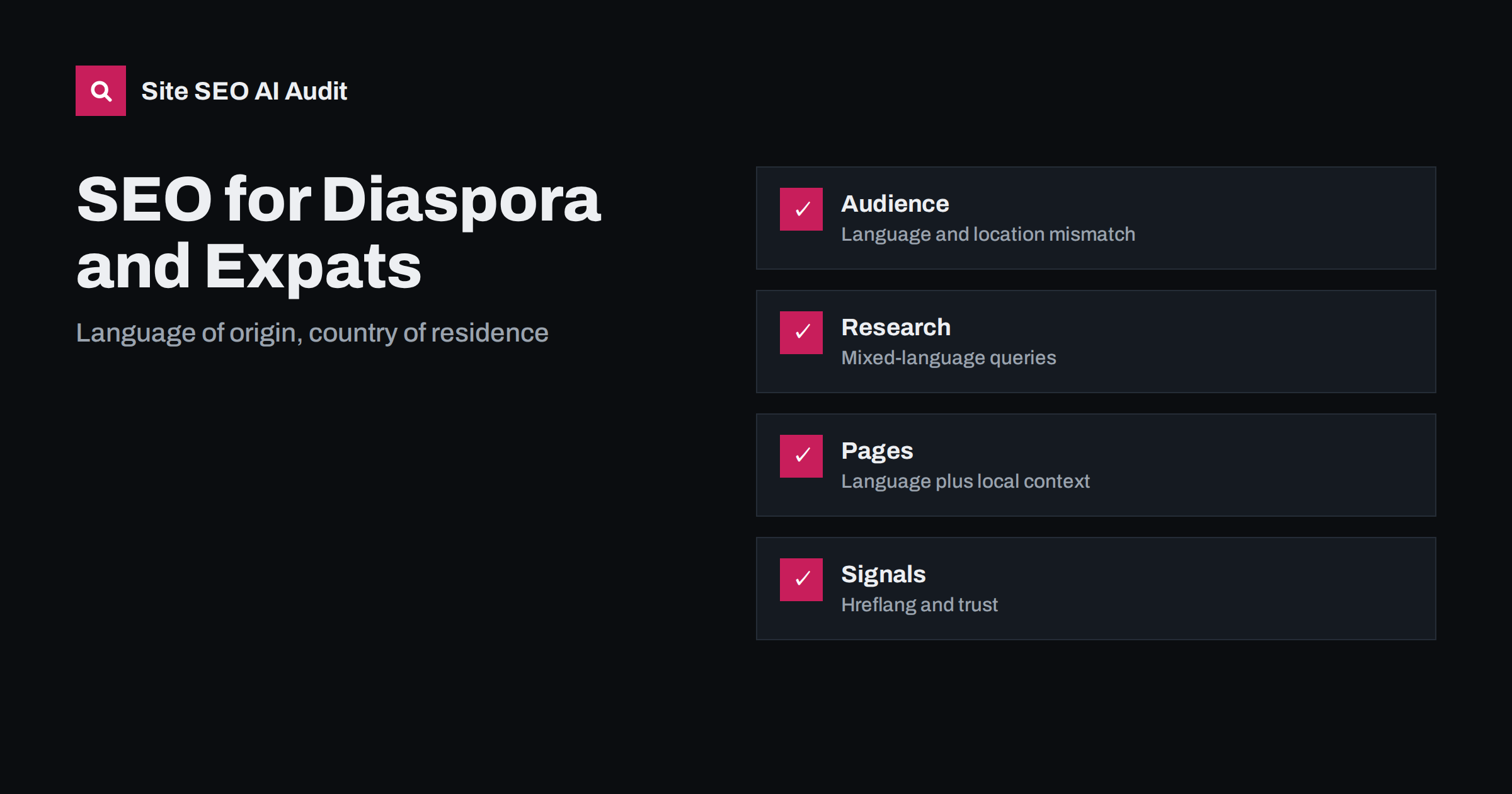
Short answer: Diaspora and expat audiences speak one language but live in another country, so they often search in their home language, in the local language or in a mix, and expect information that fits their situation abroad. Reach them with language versions aimed at the language and not only the country, research queries in both languages, write content that connects the two places, state shipping, legal and payment details for their country of residence and use hreflang, clear navigation and local trust signals so that search engines show the right page to the right person.
Many international plans assume that language and country go together: a Spanish page for Spain, a German page for Germany. Diaspora audiences break that rule. A Polish speaker in Ireland, a Portuguese speaker in Switzerland, an Indian family in Canada or a student from Turkey in Germany may search in the language they feel most comfortable in, yet need information about the country they live in. They look for services that understand both worlds: money transfers, food, legal help, schools, travel, shipping and community. Businesses that serve them often rank poorly because search engines see a mismatch between the language of the query and the location of the user. This guide explains how to handle it. For the basics of targeting, see targeting the same language in several countries.
Understand the audience and what they need
Diaspora and expat groups are not uniform. Some are long-settled families who speak the local language fluently and use the heritage language for culture and family. Others are recent arrivals who need help with everyday matters, in their own language. Students, workers on short contracts and retirees have different needs again. Define the segment you serve, the countries where they live and the topics they need. Talk to customers, join community groups and look at your own analytics and Search Console data for queries and countries that do not match your plan. These sources often reveal demand that you are not aware of, such as visitors from a country you have never targeted who read your pages in another language.
Research queries in two languages
Keyword research for these audiences must cover more than translated terms. People mix languages, using a local word for an institution inside a sentence in their own language, or an English brand name inside a foreign query. They also search for things that exist only abroad: how to register an address, how to send money home, how to get a certificate recognised. Use search suggestions, forums, community groups and your site search to find real phrases, and check the results pages in the language and country of the audience. Record variants and spellings, including those without diacritics, since people on foreign keyboards often omit them. A structured approach is described in multilingual keyword research.
It helps to write down two or three typical people before you plan content, for example a family that moved a year ago and needs school information, a student who wants food and community, or a retiree who sends money home. For each, list the questions they ask in the first month, the first year and later, and the language in which they ask them. The result is a content map that follows life stages instead of products, and it often shows gaps, such as a missing page on registration or healthcare, that no keyword tool would suggest.
Choose a language and country structure
You have several options, and the right one depends on scale. A language-only version, such as a Polish section with no country, works if your content is the same everywhere. Country and language combinations, such as Polish for Ireland and Polish for the United Kingdom, make sense when prices, laws, delivery and examples differ. A single page that explains a topic for people from one country living in another may be the best answer to a specific need and does not require a full version of the site. Compare structures in country domains, subdomains and subfolders, and decide which markets deserve full versions with the help of how to choose target markets.
Write content that bridges both places
The best pages connect the language of origin with the realities of the new country. Explain procedures in the home language while using the local names of offices, documents and forms, with the local term in brackets so that people can search for it. Compare how things are done in both countries, give practical examples, include contact details and links to official resources and state the date of the last check, because rules change. Do not translate word for word if the context differs, and have a native speaker who lives in the target country review the text. This is the difference between translation and adaptation, as explained in translation versus localization.
Show the right details for the country of residence
Practical details decide whether a visitor becomes a customer. State prices in the currency of the country where they live, give delivery times and costs to that country, accept local payment methods, show phone numbers and addresses that work there and explain legal and tax matters that apply. For products from the home country, say clearly what is imported, how long it takes and what happens with customs or returns. For services, say whether they can be delivered remotely and in which time zones support is available. If you serve people in many countries, a country selector that does not force a redirect lets them choose, which is better than guessing from the address, as discussed in language redirects and SEO.
Use hreflang and signals correctly
Annotations tell search engines which version suits which audience. Use language codes, and add region codes only when you have distinct content for a region. Every version should link to the others and itself, and the annotations should agree with canonical tags and with the pages in the sitemap. A version meant for speakers of a language everywhere can use the language code alone, and a general fallback version can be marked as the default. Do not rely on automatic redirects based on location, which block people whose phone language or location differs from what they need. The principles are in the hreflang guide and the language codes guide.
Navigation matters as well. People who arrive from search in their own language should be able to stay in it: translated menus, footers, forms, error messages, confirmation emails and legal pages, not only the main text. A page in one language that sends the reader to a form in another language is a common cause of abandonment. Offer a visible language switcher that links to the equivalent page, not to the home page, as described in the language switcher guide.
Build trust and community links
Diaspora audiences value belonging. Show that you understand the community: customer stories with permission, local events, partnerships with community organisations and signs that real people from the group work in the business. Earn links from community news sites, associations and cultural centres, which also give search engines context about who your audience is. Make sure the contact information includes the languages in which you provide support and the opening hours in the user’s time zone. Avoid stereotypes and generic imagery, and check the tone with people from the community. For link ideas that cross borders, see international link building.
Measure and adjust
Use Search Console to segment queries and pages by country and language, and watch for the mixed patterns that signal diaspora demand. Compare traffic from the country of residence with traffic from the country of origin and look at conversion by market, not only visits. Test a small number of pages first, such as a guide and a service page, and expand when results show demand. Revisit the pages when rules, prices or delivery change, and remove content that is no longer accurate. Keep a record of what you learn from each market and from customer questions, since these feed the next round of keyword research and often suggest products or services you had not considered.
Site SEO AI Audit crawls a multilingual site like a search engine, checks the language attribute, hreflang annotations and return links, canonicals, titles, status codes and speed on each page, and ranks the fixes by the points they add. The first audit of up to 200 pages is free; larger sites can see the pricing page.
Related reading
- International SEO Beginner’s Guide
- SEO for Multilingual Countries
- Local Trust Signals for Country Sites
- AI Search in Other Languages
The bottom line
Diaspora and expat audiences search in one language from another country. Research queries in both languages, choose a structure that targets language and place, write content that connects the two, show details for the country of residence and use hreflang and trust signals carefully.
KKK
Should I use a country or a language to target expats?
Often a language version is enough. Add a country when prices, laws or delivery differ. Choose by whether the content needs to change for that place.
Do expats search in their own language?
Many do, but others search in the local language or mix both. Check real queries in both languages and look at results pages for each.
Can one page serve people from one country living in another?
Yes. A page that answers a specific need, such as paperwork for newcomers, can work without a full version of the site and may rank well for that need.
Should I redirect users based on their location?
Avoid forced redirects. People abroad may need a different version from the one their location suggests, so offer a clear selector and respect their choice.
How do I know there is demand?
Look in Search Console for queries in a language from countries you do not target. Then check community forums, customer questions and a small test page.