ENEnglish
 LTLietuviškai
 DEDeutsch
 FRFrançais
 RUРусский
 ESEspañol
 PLPolski
 ITItaliano
 UKУкраїнська
 CSČeština
 PTPortuguês
 JA日本語
JA日本語 LVLatviešu valoda
 ETEesti
 HUMagyar
 IDBahasa Indonesia
 TRTürkçe
 HIहिन्दी
 ELΕλληνικά
 ARالعربية
 THไทย
THไทย VITiếng Việt
 RORomână
 MSBahasa Melayu
 BNবাংলা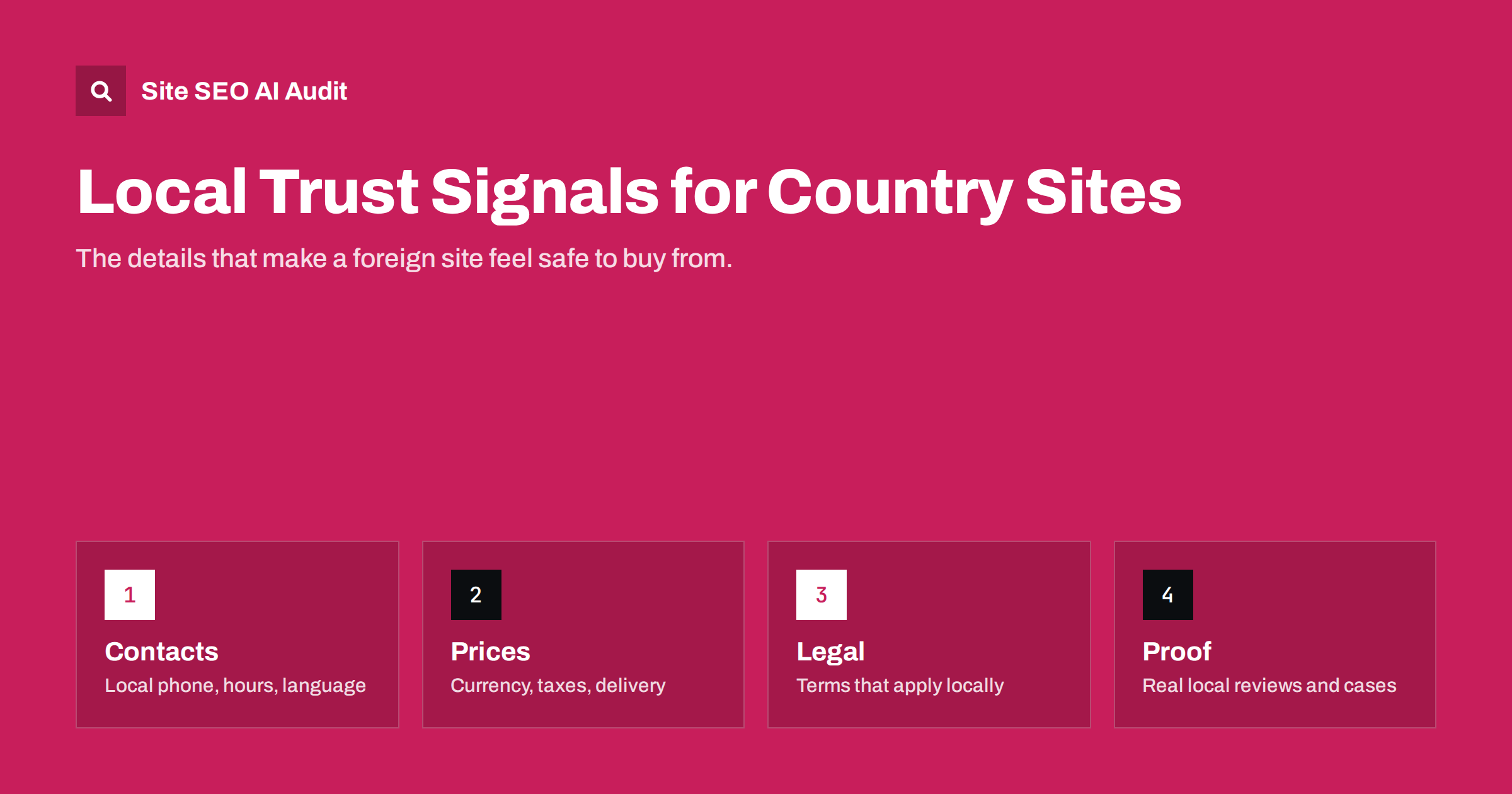
Short answer: People in a new market decide quickly whether a foreign website is trustworthy. They look for local details: a way to reach you in their language, prices in their currency with the right tax display, delivery and returns terms for their country, familiar payment methods, legal information that applies to them and genuine proof from local customers. These details help conversions first, and they also give search engines clear, consistent signals about which market each version serves.
Why trust matters more abroad
At home, your brand may be known, and visitors share assumptions about how buying works. Abroad, you are an unknown company from another country. Visitors wonder whether you deliver to them, whether they can return products, whether customs or extra taxes apply, whether anyone will answer their questions and whether the business is real.
If the site does not answer those questions quickly, many visitors leave, however good the translation is. That is why localization goes beyond language: the details that make a site feel local are what turn international visitors into customers.
Search engines increasingly look for signals that a page is helpful and trustworthy for its audience. Clear, accurate, local information is part of that picture, and it gives search engines a consistent story about which market each version is for.
Contact and support in the local context
- A way to reach you in the visitor’s language. Email, chat or phone support in the language of the version, or at least a clear statement of which languages support speaks.
- Local phone numbers where you have them, written in the local format with the country calling code.
- Support hours in local time, not only in your home time zone.
- A real address, including the country, so visitors know where the business is based. If you have a local office or partner, show it on that market’s version.
Honesty matters more than appearance. If you serve a market from your home country, say so plainly and explain delivery and support. Do not invent local addresses or phone numbers; visitors notice, and it can breach consumer protection rules.
Response times matter as much as contact options. An email address in the local language that nobody answers for a week does more harm than good. If support in a language is limited, say what visitors can expect, for example answers within one business day in English and German, so expectations match reality.
Prices, taxes and delivery
Pricing uncertainty is one of the biggest reasons international visitors abandon a purchase:
- Show prices in the local currency, or clearly state the billing currency.
- Display taxes the way local customers expect, for example prices including VAT for consumers in most European countries.
- State delivery costs and times to that country on product pages and in a dedicated shipping page.
- Explain whether customs duties or import taxes may apply, and who pays them.
- Make the returns process and time limit for that country easy to find.
Keep these details consistent across the product page, the shipping page, the checkout and the structured data. A price that changes between the product page and the checkout destroys trust instantly.
Payment methods
Preferred payment methods vary widely between countries. In some markets, cards dominate; in others, bank transfers, local payment systems, invoices or digital wallets are expected. Showing the methods people use locally, with recognisable logos, signals that you are set up for their market. Listing payment options on the pricing or checkout page before the final step helps visitors decide to continue.
Security reassurance works the same way. Visitors look for signs that their payment is handled safely: an HTTPS connection without warnings, a checkout on your own domain or a well-known payment provider, and clear information on what happens after payment, such as a confirmation email in their language and an invoice that meets local requirements.
Legal and company information
Many countries require specific information on commercial websites, and visitors use it to judge legitimacy:
- Company name, registration details and address, as required by local rules. Some countries require a dedicated imprint page.
- Terms and conditions, privacy policy and cookie information in the local language, or a clear note on which language version is binding.
- Consumer rights information, such as withdrawal periods, where it applies.
- VAT or tax identification details for business buyers.
Legal content should be prepared or reviewed by someone who knows the local requirements. Machine-translated legal text without review can be both unhelpful and risky.
Proof from local customers
People trust people like them. Evidence that others in their country use and like your product is one of the strongest trust signals:
- Reviews in the local language, from real local customers, shown on the relevant version. If you show translated reviews, label them as translated.
- Case studies or references from local businesses, with their permission.
- Local press mentions, partnerships and certifications that are recognised in the market.
- Presence on local review platforms that people in the country actually use.
Never invent reviews, testimonials or customer logos. Beyond the ethical and legal issues, fake proof is often easy to spot and does lasting damage.
Design, tone and small details
Trust is also built by many small details that visitors notice without thinking about them. A page can be correctly translated and still feel foreign because of details that nobody localized:
- Formats. Dates, times, numbers, addresses and phone numbers in the local format. A date written in the home-market order can even be misread.
- Units. Metric or imperial units, clothing and shoe sizes, and technical standards familiar to the market.
- Forms. Address forms that accept local postal code formats, fields in the order locals expect, and no mandatory fields that do not exist in that country, such as a state field where there are no states.
- Tone. Formal or informal address, directness of calls to action and use of humour, which vary widely between cultures.
- Images. Photos and examples that feel natural to local visitors, and screenshots of the localized interface where relevant.
- Seasonal content. Campaigns and messages that fit the local calendar, holidays and seasons.
Forms deserve particular attention because they sit at the moment of commitment. A checkout that rejects a valid local postal code or phone number, or insists on a field that makes no sense in the visitor’s country, loses customers at the last step. Test forms with real local addresses and numbers from each market before launch.
None of these details is dramatic on its own, but together they decide whether a site feels like it was made for the visitor or merely translated for them. Ask a local reviewer to point out anything that feels foreign; they will usually find a handful of quick fixes.
Marking up local details for search engines
Structured data helps search engines read local details reliably:
- Organization markup with the company’s legal name, logo and contact points, including local telephone numbers and the languages supported.
- LocalBusiness markup for real physical locations, on the page for each location.
- Product and Offer markup with the local price, currency and availability.
- Shipping and return policy details in product markup where supported.
- Reviews markup only for genuine reviews that are visible on the page, following search engine guidelines.
Markup must match what the page shows. Local details in markup that visitors cannot see, or that differ from the visible page, are a problem rather than a signal.
Checking your country versions
Look at each country version as a first-time visitor from that country would. Can you find how to contact the company, what delivery costs, how to return a product and how to pay, within a minute? Ask someone from the market to do the same and note where they hesitate.
The technical side can be checked at scale. Site SEO AI Audit checks structured data on every crawled page, including invalid JSON-LD and Open Graph, and the Languages area, including hreflang return links, broken language versions and lang attributes, which makes it easier to see whether each country version carries consistent signals. The first audit is free.
Related reading
- Translation vs localization for SEO: what actually changes
- Structured data on multilingual sites: what to translate
- E-E-A-T and AI search: showing real expertise on the page
The bottom line
Translation makes a site understandable; local trust signals make it usable and credible. For each country version, show how to reach you in the local language, prices with the right currency and taxes, delivery and returns terms for that country, familiar payment methods, the legal information that applies and genuine proof from local customers. Mark up what you show, keep it consistent everywhere and never invent local details.
KKK
Do I need a local address to sell in another country?
Not necessarily. Many businesses serve other countries from their home base. What matters is being clear about where you are, how delivery and support work and which terms apply.
Should prices include VAT on European country versions?
Consumers in most European countries expect prices including VAT, while business buyers often expect prices without it. State clearly which applies on each version.
Can I show reviews from other countries on a country version?
Yes, but local reviews are more persuasive. If you show reviews translated from another language, label them as translated.
Do trust signals affect SEO?
They mainly affect whether visitors trust and buy. They also give search engines consistent information about which market a version serves, and structured data helps them read it.
Is a local phone number required?
It is not required, but it helps in many markets. If you do not have one, offer another clear way to contact you and state which languages support speaks.