ENEnglish
 LTLietuviškai
 DEDeutsch
 FRFrançais
 RUРусский
 ESEspañol
 PLPolski
 ITItaliano
 UKУкраїнська
 CSČeština
 PTPortuguês
 JA日本語
JA日本語 LVLatviešu valoda
 ETEesti
 HUMagyar
 IDBahasa Indonesia
 TRTürkçe
 HIहिन्दी
 ELΕλληνικά
 ARالعربية
 THไทย
THไทย VITiếng Việt
 RORomână
 MSBahasa Melayu
 BNবাংলা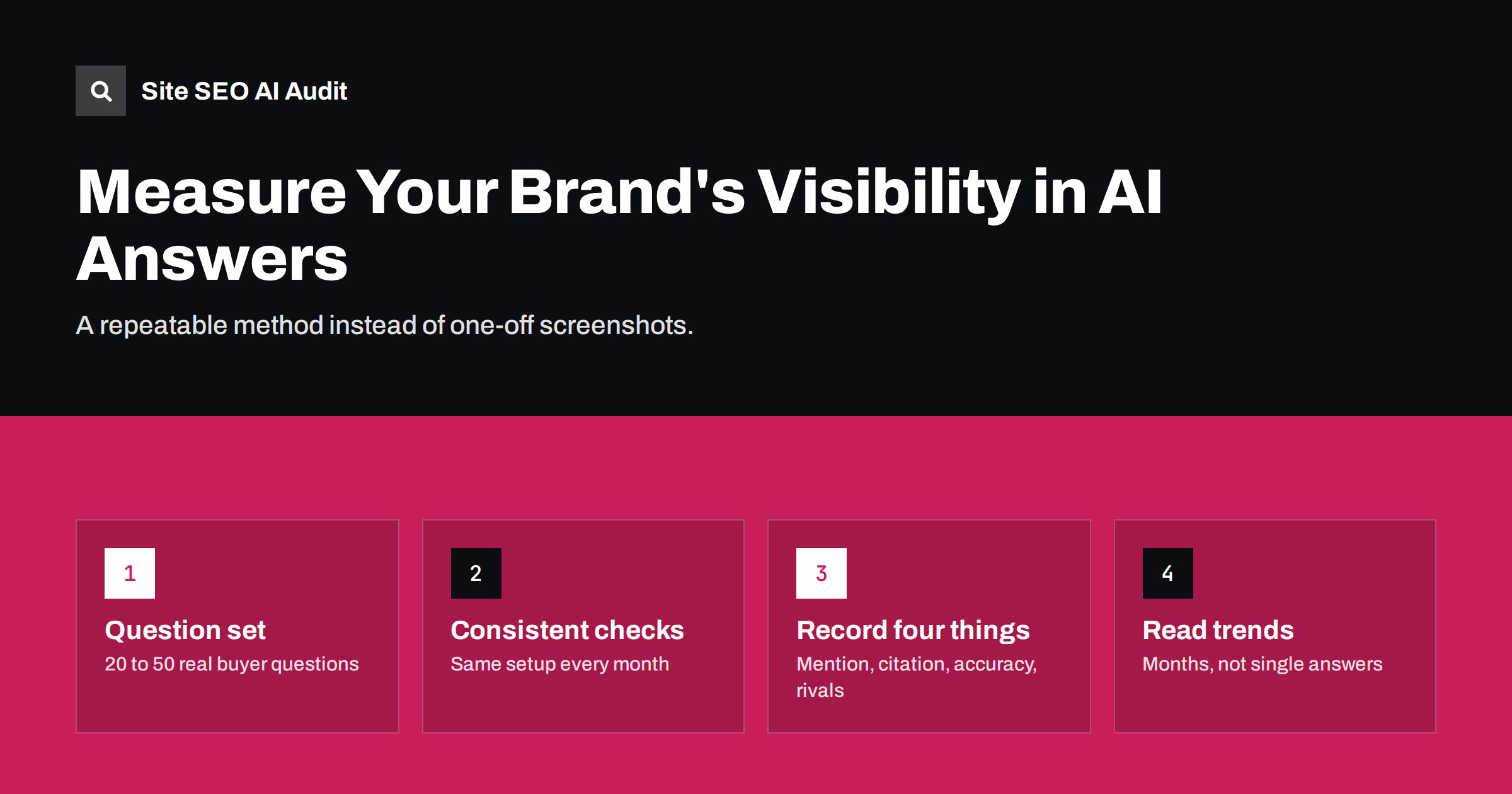
Short answer: To measure brand visibility in AI answers, build a fixed set of realistic questions your customers ask, run them in the main assistants on a regular schedule under consistent conditions, and record whether your brand is mentioned, whether your site is cited, whether the description is accurate and which competitors appear. Combine these checks with AI referral traffic, crawler logs and branded search trends. Because answers vary, judge progress by trends across many questions and months, not by any single answer.
Why this is harder than rank tracking
Classic rank tracking works because search results for a query are fairly stable and measurable: position three today is probably position three or four tomorrow. AI answers are different. They are generated fresh each time, they depend on the wording of the question and the conversation so far, they may vary by location, language, account and time, and they can mention a brand without linking to it or link to a site without naming its brand.
That does not make measurement impossible, only different. Instead of positions, you measure frequencies: in how many of a set of relevant questions does your brand appear, how often is your site cited, and how accurately are you described. Instead of daily checks, you look for movement over weeks and months.
It also helps to be clear about what you are measuring. Visibility in AI answers has several parts: being mentioned at all, being recommended rather than just listed, being described correctly, and being linked as a source. A brand can score well on one and poorly on another. A company that is often mentioned but described with an outdated price has a different problem from one that is rarely mentioned at all, and each needs a different fix.
Step 1: build a realistic question set
The question set is the foundation. It should reflect how real customers ask, not how you would like them to ask. Good sources include sales call notes, support tickets, site search logs, “People also ask” boxes, forum threads and your own knowledge of the buying process. Aim for twenty to fifty questions in several groups:
- Category questions: “What are the best tools for [job] for a small business?”
- Situation questions: “Which [service] in [city] is good for [specific need]?”
- Comparison questions: “[Your brand] vs [competitor]: which is better for [use case]?”
- Brand questions: “What is [your brand]?”, “How much does [your brand] cost?”, “Is [your brand] reliable?”
- Problem questions: “How do I fix [problem your product solves]?”
Keep the wording fixed once chosen. Changing questions every month makes trends meaningless. If you need new questions, add them as a separate group and keep the original set intact.
Step 2: run checks under consistent conditions
Because answers vary, consistency in how you check matters more than precision in any single result:
- Choose the assistants that matter for your audience, typically a few of the major ones, plus Google’s AI features if your customers use Google heavily.
- Use a fresh conversation for each question, so earlier questions do not influence the answer.
- Use neutral settings, such as a clean account or logged-out session where possible, and note the location and language.
- Run each question more than once if you can, for example two or three times, and record how often the brand appears.
- Check at a regular interval, monthly for most businesses.
- Save the answers, as text or screenshots, with the date. You will want to compare wording later.
A shared spreadsheet is usually enough. Create one row per question, assistant and date, with columns for the fields below. It sounds basic, but a consistent spreadsheet kept for a year is far more useful than a folder of screenshots taken whenever someone remembered.
Step 3: record four things per answer
| Field | What to record | Why it matters |
|---|---|---|
| Mention | Is your brand named? In what position among options? | Shortlist presence and prominence |
| Citation | Is your site linked as a source? Which page? | Which content earns citations |
| Accuracy | Are facts about you correct: prices, features, location? | Errors to trace and fix |
| Competitors and sources | Which rivals appear, which third-party sites are cited | Where influence comes from |
Optionally, add a note on tone: is the description positive, neutral or negative, and what reasons are given? This helps connect visibility with reputation issues such as review themes.
Step 4: turn records into metrics
With a few months of data, simple metrics show direction:
- Mention rate: the share of questions in which your brand appears, per assistant and overall.
- Citation rate: the share of answers that link to your site.
- Accuracy rate: the share of brand mentions with no factual errors.
- Share of voice: your mentions compared with named competitors across the same question set.
- Top cited pages: which of your URLs appear as sources most often.
- Top third-party sources: which outside sites are cited in your category, and whether they mention you.
Treat these as indicators, not precise measurements. With forty questions, one answer changing moves a rate by more than two percentage points, so small movements are noise.
Break the metrics down by question group as well. A rising mention rate in brand questions but a flat rate in category questions tells you something different from the reverse.
Step 5: add signals from your own data
Manual checks show what answers say. Your own data shows what happens afterwards:
- AI referral traffic in analytics, grouped into a dedicated channel for assistant domains, with landing pages and conversions.
- Crawler logs showing AI search crawlers and user-triggered fetchers requesting your pages.
- Branded search impressions in Search Console and Bing Webmaster Tools, which often rise when a brand is mentioned more.
- “How did you hear about us” answers in forms and sales conversations, with an explicit AI assistant option.
None of these signals is complete on its own. AI referrals undercount because many visits lose their referrer, branded search reflects all marketing activity, and survey answers depend on memory. Together they point in a direction, and when several of them move the same way as your manual checks, you can be reasonably confident the change is real.
About automated tracking tools
A growing number of tools run prompts at scale and report AI visibility scores. They can save time and cover more questions than manual checks. Evaluate them with care: ask how prompts are chosen, how often they run, which assistants and settings they use, whether they repeat questions to account for variation, and how they handle location. A precise-looking score built on a small or unrepresentative prompt set can mislead. Whatever tool you use, keep a small manual set that you understand fully as a sanity check.
Acting on what you find
Measurement is only useful if it leads to changes:
- Wrong facts: trace the source, usually an outdated page, directory or review site, and correct it.
- Missing from category answers: check whether you have a clear page for that use case, whether AI crawlers can read it and whether independent sources mention you in that context.
- Competitors cited from one site: see whether that site would include you, for example a directory or industry roundup.
- Your pages cited but brand not named: make sure your brand appears in the passages likely to be quoted.
Report the results in the same format every month: the main rates, the notable changes, the errors found and the actions taken. Over time this becomes a record of cause and effect that is far more persuasive than any single screenshot.
How Site SEO AI Audit helps
When measurement shows you are missing from answers, technical access is the first thing to rule out. Site SEO AI Audit checks whether AI crawlers are allowed in robots.txt, whether content needs JavaScript to appear, and whether pages have the structure and dates AI answers quote, alongside a full crawl for indexing and on-page issues. Pro plans add weekly audits and audit comparisons, listed on the pricing page, which pair well with a monthly visibility report.
Related reading
- How to Track AI Referral Traffic in Google Analytics 4
- How to Find and Verify AI Crawlers in Your Server Logs
- Zero-Click Search: How to Get Value When Nobody Clicks
The bottom line
AI visibility cannot be tracked like rankings, but it can be measured. Build a fixed question set from real customer language, check it regularly under consistent conditions, record mentions, citations, accuracy and competitors, and combine the results with referral traffic, logs and branded search. Read the trend over months and use it to decide what to fix.
KKK
How many questions should my tracking set include?
Twenty to fifty questions is a practical range for most businesses. Fewer makes results too noisy; many more becomes hard to check manually without a tool.
How often should I check AI answers?
Monthly is enough for most businesses. Answers vary from day to day, so more frequent checks mostly add noise unless you are testing a specific change.
Why does the same question give different answers?
Answers are generated fresh, and retrieval can vary with wording, context, location and time. That is why you should repeat questions and look at patterns rather than single results.
Are AI visibility scores from tools reliable?
They can be useful indicators if the prompt set is realistic and large enough and the method is transparent. Treat any single score with caution and keep a manual sample as a check.
What should I do if an assistant describes my business incorrectly?
Find the likely source of the wrong fact, such as an outdated page or listing, and correct it. Make sure your own site states the correct information clearly and consistently.