ENEnglish
 LTLietuviškai
 DEDeutsch
 FRFrançais
 RUРусский
 ESEspañol
 PLPolski
 ITItaliano
 UKУкраїнська
 CSČeština
 PTPortuguês
 JA日本語
JA日本語 LVLatviešu valoda
 ETEesti
 HUMagyar
 IDBahasa Indonesia
 TRTürkçe
 HIहिन्दी
 ELΕλληνικά
 ARالعربية
 THไทย
THไทย VITiếng Việt
 RORomână
 MSBahasa Melayu
 BNবাংলা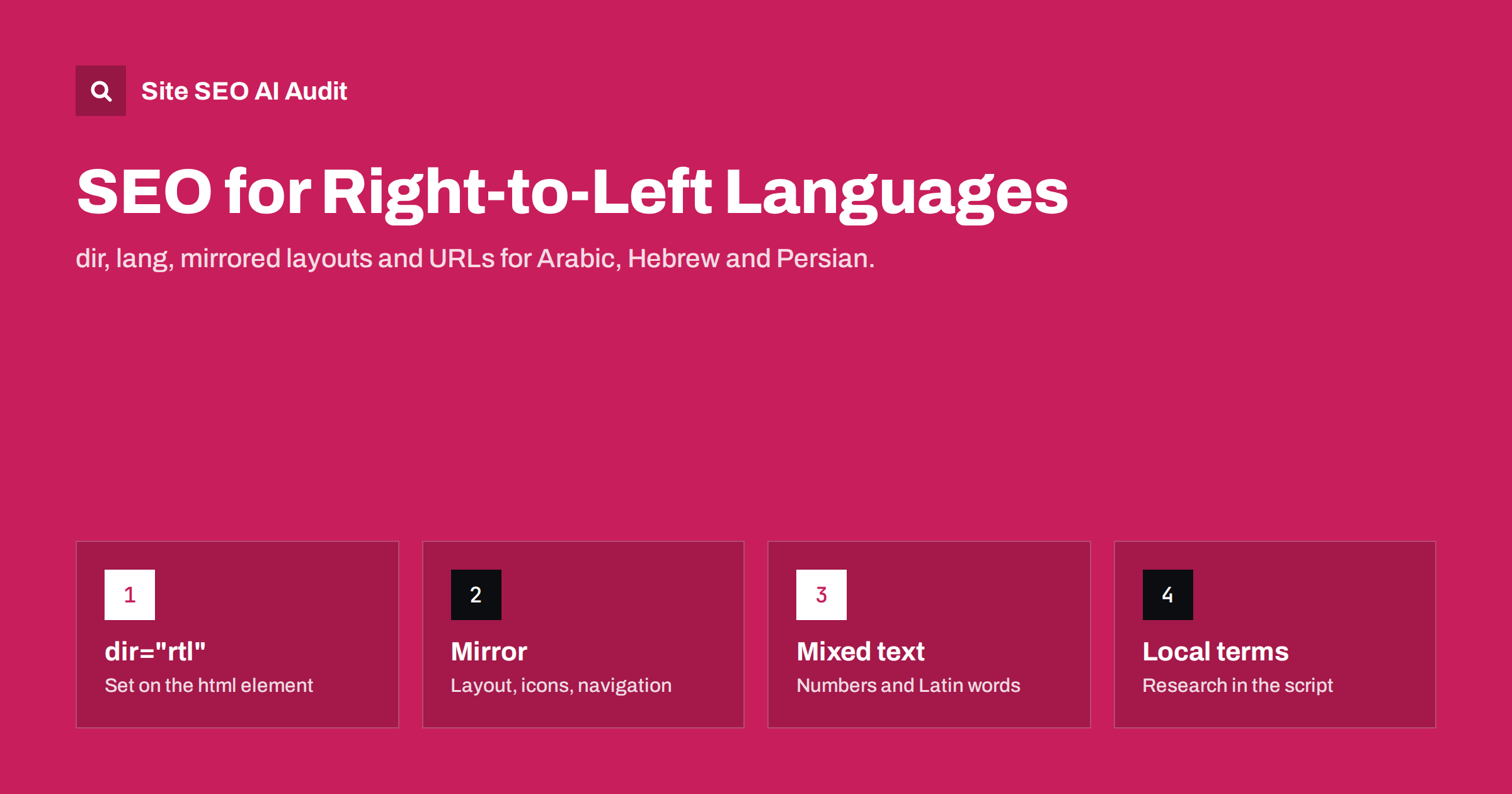
Short answer: Right-to-left (RTL) language versions, such as Arabic, Hebrew, Persian and Urdu, follow the same international SEO rules as any other language: their own URLs, full translation, hreflang with return links and a correct lang attribute. In addition, each page needs dir="rtl" on the html element, a mirrored layout, careful handling of mixed right-to-left and left-to-right text, and keyword research done in the native script. Most RTL problems are layout and text-direction errors that make pages look broken to native readers.
What makes RTL languages different
In Arabic, Hebrew, Persian, Urdu and a few other languages, text runs from right to left. That affects much more than the order of letters. Readers scan pages from the top right, expect navigation and logos to start on the right, and read lists, tables and forms in the mirrored direction.
These languages also mix directions constantly. Numbers are usually written left to right, and Latin-script words such as brand names, product codes, email addresses and URLs appear inside right-to-left sentences. Browsers handle this with a bidirectional text algorithm, but they need correct markup to do it well.
From a search perspective, the rules are the same as for any language. Search engines detect the language from the text, use hreflang to connect versions and index each URL separately. What changes is the amount of care needed to make the page usable, and usability is what ultimately decides whether RTL pages succeed.
The dir and lang attributes
Every RTL page should declare both its language and its direction on the html element:
<html lang="ar" dir="rtl">for Arabic,<html lang="he" dir="rtl">for Hebrew,<html lang="fa" dir="rtl">for Persian,<html lang="ur" dir="rtl">for Urdu.
The lang attribute tells screen readers and browsers which language to use; the dir attribute tells the browser to lay out the page and its text from right to left. Without dir, text may display in the right order inside paragraphs, but punctuation ends up on the wrong side, lists and tables align incorrectly and mixed-direction text becomes scrambled. The MDN reference for the dir attribute explains the options, including dir="auto" for user-generated content whose direction is unknown.
A note on codes: Hebrew is he. Older systems sometimes use iw, which is deprecated. Use the current code in both lang and hreflang.
Mirroring the layout
An RTL page should feel like it was designed for RTL readers, not like an LTR page with translated text. Typical elements to mirror include:
- Logo and main navigation, which usually start on the right.
- Sidebars, which move to the opposite side.
- Directional icons such as arrows, “next” and “back” buttons, chevrons in menus and progress indicators.
- Breadcrumbs, which read from right to left.
- Form fields, labels and checkboxes, which align to the right.
- Carousels and sliders, whose direction should reverse.
Not everything should be mirrored. Logos, photos, media player controls, clocks and brand graphics usually stay as they are. Modern CSS helps a great deal: logical properties such as margin-inline-start and padding-inline-end adapt to the text direction automatically, so one stylesheet can serve both LTR and RTL versions.
Mixed-direction text
Mixed text is where RTL pages most often look broken. Common problem areas include:
- Brand and product names in Latin script inside Arabic or Hebrew sentences, especially when they end in punctuation.
- Numbers with units, prices and phone numbers, which can appear reversed or with symbols on the wrong side.
- Email addresses, URLs and code, which must stay left to right.
- User-generated content such as reviews and comments, where the direction depends on what users typed.
Techniques that help include wrapping embedded LTR fragments in elements with dir="ltr", using the bdi element for user-generated names and values whose direction is unknown, and testing real content, not placeholder text. A native reader reviewing the finished page will spot direction errors immediately.
URLs, slugs and search results
For RTL versions, the usual URL patterns apply: a folder such as /ar/ or /he/, a subdomain or a country domain. For slugs, you can use native script or Latin transliteration:
- Native-script slugs are readable for local users in the address bar, but they are percent-encoded when copied into some tools, emails and logs, which makes them very long.
- Transliterated or English slugs are short and portable, but less meaningful to local readers.
Both are indexable. Many sites in RTL markets use native-script slugs for content pages and short Latin slugs for technical or product URLs. Whatever you choose, apply it consistently and make sure redirects, analytics and CDN rules handle encoded characters correctly.
Titles and meta descriptions should be written natively in the RTL language. Pay attention to how brand names and separators, such as a hyphen or a vertical bar, display at the ends of titles; mixed direction can move them to unexpected positions.
Keyword research in RTL markets
As with any language, research keywords in the target language rather than translating them. RTL markets add a few considerations:
- Dialects and regional variants. Written Arabic is shared across many countries, but vocabulary and search habits vary between regions. If you target specific countries, research each one.
- Spelling variants. Some letters and diacritics are used inconsistently in searches. Local tools and autocomplete show which forms are common.
- Transliterated searches. Some users type local words in Latin script, especially on devices without a native keyboard. Check whether this happens for your terms.
- English terms. In technology and business, English terms are often used alongside local ones.
Fonts, typography and performance
RTL scripts place specific demands on typography, and those choices affect both readability and page speed. Arabic script, for example, connects letters and changes their shapes depending on position, and many Latin-oriented web fonts simply do not include it. When a font lacks the script, the browser falls back to a system font, which can look inconsistent next to the rest of the design.
- Choose fonts designed for the script, with proper support for letter joining, diacritics and numerals.
- Check line height and size. Arabic and Persian text often needs more line height and a slightly larger size than Latin text to stay readable.
- Load only what you need. Script-specific fonts can be large. Subsetting and loading them only on RTL pages keeps the rest of the site fast.
- Avoid text in images. Banners with baked-in English text need separate RTL versions; live text is easier to translate and better for accessibility and search.
- Measure speed on RTL pages separately. Extra fonts and mirrored stylesheets can make RTL pages heavier than their LTR equivalents.
Good typography is not a ranking factor in itself, but it decides whether readers stay long enough for the content to do its job. Pages that load quickly and read comfortably are the foundation of every successful RTL version.
Common RTL mistakes found in audits
- Missing
dir="rtl", so the page lays out left to right with translated text. - Wrong or deprecated codes, such as
iwfor Hebrew, or a hard-codedlang="en"from the theme. - Unmirrored navigation and arrows pointing the wrong way.
- Scrambled prices, phone numbers and brand names in mixed text.
- Fonts without proper support for the script, falling back to system fonts that look inconsistent.
- Untranslated templates, such as footers and cookie banners, left in English on an otherwise Arabic page.
- hreflang missing for the RTL version, or pointing to URLs that redirect.
Testing and checking RTL versions
Before launch, have native readers review key templates on both desktop and mobile: home page, a content page, a product or service page, a form and the checkout if you have one. Ask them specifically about direction, alignment, numbers and mixed text, not just translation quality.
After launch, the technical signals can be checked at scale. Site SEO AI Audit crawls a site like a search engine and checks the Languages area on every page, including lang attributes, hreflang return links, x-default and broken language versions, together with titles, descriptions and alt texts. RTL versions are often added later than other languages, so they are also where template gaps tend to appear. You can run a free audit to check.
Related reading
- The HTML lang attribute: what it does for SEO and users
- Should you translate URL slugs on a multilingual site?
- Multilingual keyword research: finding real local search terms
The bottom line
RTL language versions need everything other language versions need, plus correct direction. Set lang and dir=”rtl” on every page, mirror the layout with logical CSS properties, handle mixed-direction text carefully, choose a consistent slug approach, research keywords in the native script and test with native readers. Search engines will index RTL pages like any others; readers will only stay if the pages look and read right.
KKK
Does dir=”rtl” affect SEO?
Not directly as a ranking signal. It affects how the page displays, and a page that looks broken to native readers performs worse. It is essential for usability and accessibility.
What is the correct hreflang code for Hebrew?
Use he, for example hreflang=”he” or he-il. The older code iw is deprecated and should not be used in new markup.
Should Arabic URLs use Arabic characters?
They can. Native-script slugs are indexable and readable in the browser, but they become long when percent-encoded. Many sites choose based on how URLs are shared in their market.
Do I need separate Arabic versions for different countries?
Only if content differs by country, for example prices, products or vocabulary. Otherwise one Arabic version with hreflang=”ar” can serve Arabic speakers everywhere.
How do I handle English brand names in Arabic text?
Wrap them in an element with dir=”ltr” or use the bdi element where direction is uncertain. Test with real content, because punctuation and numbers next to the name often move.