ENEnglish
 LTLietuviškai
 DEDeutsch
 FRFrançais
 RUРусский
 ESEspañol
 PLPolski
 ITItaliano
 UKУкраїнська
 CSČeština
 PTPortuguês
 JA日本語
JA日本語 LVLatviešu valoda
 ETEesti
 HUMagyar
 IDBahasa Indonesia
 TRTürkçe
 HIहिन्दी
 ELΕλληνικά
 ARالعربية
 THไทย
THไทย VITiếng Việt
 RORomână
 MSBahasa Melayu
 BNবাংলা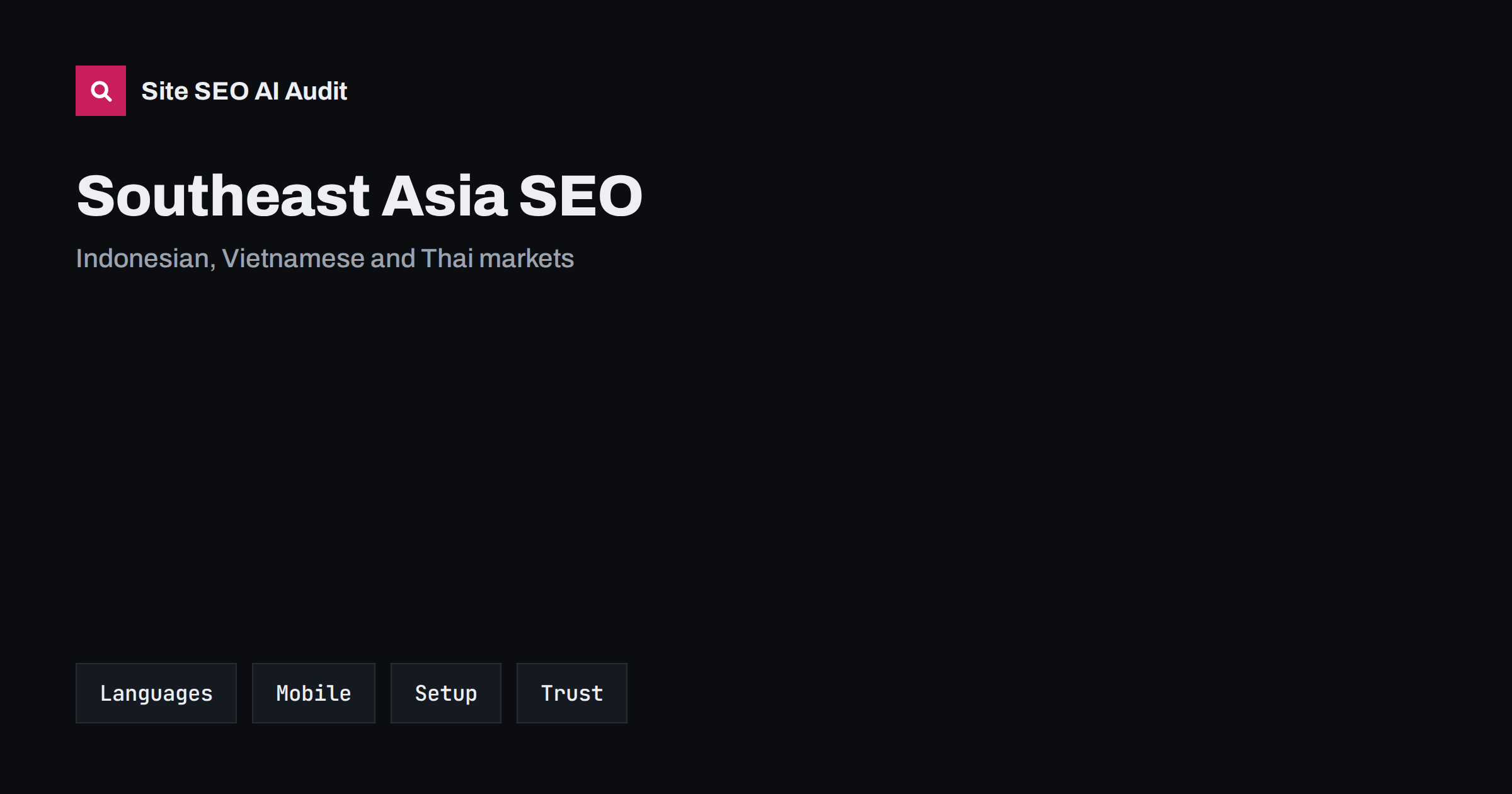
Short answer: Southeast Asia is not a single market. Indonesia, Vietnam and Thailand each have their own language, script, search habits, payment methods and legal setting. Publish a properly written version for each country you serve, research keywords locally, make the site fast and easy to use on phones, set up hreflang correctly and show local prices, contact details and trust signals.
The region is large, young and increasingly online, which makes it attractive for ecommerce, software, travel, education and many other sectors. But success depends on respecting local differences. A company that translates an English site by machine, keeps prices in dollars and offers only credit card payments will struggle, even with good products. This guide focuses on three major language markets, Indonesian, Vietnamese and Thai, and explains what search specialists need to know about language, mobile use, technical setup and trust. The same principles apply to neighbouring markets, such as Malaysia and the Philippines, with their own details.
Three markets, three languages
Indonesian (Bahasa Indonesia, code id) is the national language of Indonesia and is used across the country, alongside many regional languages. It is written in the Latin alphabet and has a relatively simple structure, which makes keyword matching easier than in some other languages. Be aware of the difference between formal and informal registers: business content normally uses a polite, clear style, while social content is more casual. Do not confuse it with Malay, which is closely related but differs in vocabulary and spelling; Malaysia needs its own version.
Vietnamese (code vi) also uses the Latin alphabet, but with many diacritics and tone marks. Spelling with the correct marks changes the meaning of words. Many people type searches without the marks, especially on phones, so search engines have to match both forms. Your page text should be written with correct diacritics, and your keyword research should include unmarked variants so that you understand real queries. Encoding must be UTF-8; see character encoding and SEO.
Thai (code th) has its own script and is written without spaces between words. Search engines segment the text with language tools, and poorly written or machine-translated text can lead to odd results. Title tags and descriptions in Thai can look longer or shorter than their English equivalent, so check how they display in results. Thai also uses the Buddhist Era calendar in many official and everyday contexts, which means that a year such as 2026 is written as 2569. If you show dates, decide which system to use and be consistent, and check that structured data uses the standard date format.
Start with the right markets
Do not try to launch everywhere at once. Pick one or two markets where you have demand, a delivery option or a clear partner, and treat each as a separate project. The guide to choosing which countries to target first gives a simple scoring method, and international SEO for small businesses explains when the investment pays off. Check your Search Console data first: you may already receive impressions from these countries, and they can show which pages are most relevant.
Plan for phones first
In many Southeast Asian markets, the phone is the main or only device people use to go online, and connections vary in speed and quality. Design with that in mind. Keep pages light, compress images, avoid heavy scripts and test on mid-range phones and slower networks rather than only on a fast office connection. The practical advice in mobile-first indexing, page weight and compression and Core Web Vitals applies strongly here. Server location and a content delivery network can also reduce delay; see server location, CDNs and speed for international SEO.
Messaging apps, social platforms and marketplaces play a major role in how people discover and buy. Your website will not be the only place where customers meet you, so keep your name, descriptions and contact details consistent across profiles, and make it easy to move between the site and the channels people use. Do not assume that search is the only route; use it as one part of the mix.
Research keywords in the local language
Literal translation of keywords fails often. People in each market use their own words for products, problems and services, including borrowed English terms and local slang. Begin with your topic list, then study suggestions, related searches, marketplace listings and competitor pages in each language. Ask native speakers to review the list. Include the unmarked variants in Vietnamese, the common spellings in Indonesian and the spacing and word choices in Thai. For a method, see multilingual keyword research. Search intent can also differ by country, so check the results pages to see what type of page ranks, such as marketplace pages, videos, forums or articles, and plan your content to match; see search intent.
Set up languages and URLs correctly
Use a clear structure for each country. Country domains such as .id, .vn and .th send a strong local signal, while subfolders such as /id/, /vi/ and /th/ are simpler to manage under one domain. Choose based on budget, brand and long-term plan; see ccTLD vs subdomain vs subfolder. Then connect the versions with hreflang. Typical codes are id-ID for Indonesian in Indonesia, vi-VN for Vietnamese in Vietnam and th-TH for Thai in Thailand. If you also have an English version for the region, give it its own code and consider whether it should target one country or be a general version. Every page in the set must point to all the others and to itself. Add an x-default if you want a fallback. The details are in what hreflang is and language and region codes.
Set the HTML language attribute on each page to match the content, as explained in the HTML lang attribute. Avoid redirecting visitors automatically by their location or browser language, because that can block crawlers and frustrate users; offer a visible language switcher instead. See automatic language redirects.
Social platforms, marketplaces and local search engines
Google is widely used across the region, but it is not the only way people look for products and answers. Video platforms, social networks and marketplaces take a large share of product discovery, and some people search directly inside them. For many businesses, the best plan is to make the website the reliable home for information, and to use these other channels as entrances. Check which sites rank for your main queries in each country. If marketplaces dominate the results, decide whether to sell there, to compete with content that marketplaces do not offer, such as guides and comparisons, or both. For a wider view, read search engines beyond Google.
Whatever the channel, keep one consistent identity: the same name, logo, description and contact details. Systems that read the web combine many sources, and consistent facts make it easier for them to connect your pages and profiles to the same business.
Localize prices, dates, payments and formats
Show prices in the local currency, with tax and delivery stated clearly. Number formats differ by market. Indonesia and Vietnam commonly use a dot as the thousands separator and a comma as the decimal mark, while Thailand uses the style familiar to English readers, with a comma for thousands. Dates, phone formats and address formats also differ, and so do popular payment methods. Offer the payment options that customers in each market expect, including local bank transfers and wallets where relevant, and explain how they work. For a general checklist, see local currency and prices and localizing dates, numbers and units.
Check legal and consumer requirements in each country, such as company information, privacy rules and return conditions. Do not guess; ask a local adviser. Publishing the right information also builds trust.
Show local trust signals
Visitors from a new market need reasons to trust you. Add a local contact route, such as a phone number or a messaging channel that your team monitors in the local language, local customer reviews, familiar payment logos and clear delivery and return rules. If you have a local office, partner or team, mention it. See local trust signals for country versions for ideas. Always keep claims honest and verifiable.
Keep quality high and measure each market
Review all translated pages with a native speaker, especially titles, headings, buttons and legal text. Machine translation can be a starting point, but publish only after review; see machine translation and SEO. Keep versions in sync when the original changes, and avoid leaving pages half-translated; see what to do with untranslated pages.
Track each market separately: impressions, clicks, positions, conversions and speed by country and language. Check whether the correct language version appears in each country, and use hreflang testing to find mistakes. A crawl audit finds missing return links, wrong codes, broken language versions and slow pages. Site SEO AI Audit checks language setup as one of its seven areas, and the first audit of up to 200 pages is free. For re-checks and larger sites, see the pricing page.
Related reading
- International SEO for Beginners: How to Take a Site Global
- Translation vs Localization for SEO: What Actually Changes
- Beyond Google: Bing, Baidu, Naver and Other Local Search Engines
- International SEO Audit Checklist for Multilingual Sites
The bottom line
To succeed in Southeast Asia, treat Indonesia, Vietnam and Thailand as separate markets. Write natively in each language, plan for mobile and slower networks, set up hreflang and URLs carefully, localize prices and payments, and show trust signals. Measure each market on its own and improve step by step.
KKK
Can one site serve Indonesia, Vietnam and Thailand?
Yes, with separate language versions under a clear structure and hreflang. A single English page rarely serves all three well.
Should I write Vietnamese with or without diacritics?
Write with correct diacritics. Many users type without them, so research both forms, but your published text should be correct.
Is Indonesian the same as Malay?
No. They are related but differ in vocabulary and spelling. Use a separate Malay version for Malaysia.
Which hreflang codes should I use?
Typical codes are id-ID, vi-VN and th-TH. Use plain codes such as id, vi and th if you have only one version per language.
Do I need local payment methods?
Often yes. Customers expect familiar options, so research the common payment methods in each country before launch.