ENEnglish
 LTLietuviškai
 DEDeutsch
 FRFrançais
 RUРусский
 ESEspañol
 PLPolski
 ITItaliano
 UKУкраїнська
 CSČeština
 PTPortuguês
 JA日本語
JA日本語 LVLatviešu valoda
 ETEesti
 HUMagyar
 IDBahasa Indonesia
 TRTürkçe
 HIहिन्दी
 ELΕλληνικά
 ARالعربية
 THไทย
THไทย VITiếng Việt
 RORomână
 MSBahasa Melayu
 BNবাংলা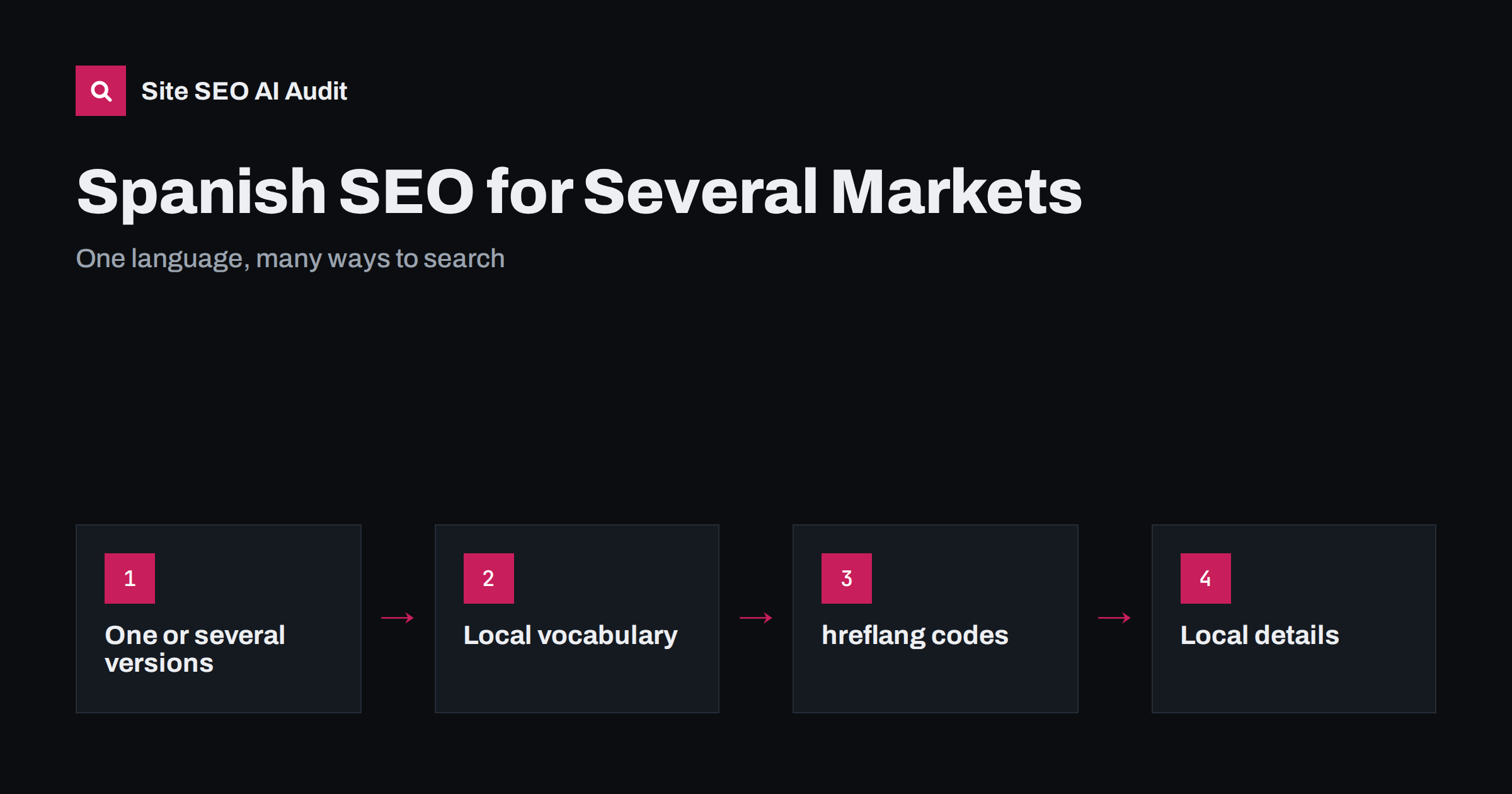
Short answer: Spanish is one language but many markets. A single neutral Spanish version, marked with hreflang="es", is often enough when you sell the same thing everywhere at the same price. Separate versions for Spain, Mexico, the US or other countries make sense when products, prices, currencies, shipping or search vocabulary really differ. Use ISO country codes such as es-ES and es-MX in hreflang, adapt vocabulary and formats to each market, and never publish country versions that differ only by a flag.
Spanish is one of the most widely spoken languages in the world, with large audiences in Spain, Mexico, Colombia, Argentina, the rest of Latin America and the United States. For a business expanding into Spanish, that is an opportunity and a decision: write one Spanish version for everyone, or adapt it for each market? The right answer depends less on grammar than on what you sell, where and how.
One Spanish version or several?
Start from the business, not the language. A single Spanish version usually works when:
- the product or service is the same in every Spanish-speaking country;
- prices are shown in one currency, or not shown at all;
- you have no local offices, delivery differences or legal differences to explain;
- you do not have the resources to maintain several versions properly.
Separate country versions make sense when:
- prices, currencies, taxes or delivery options differ by country;
- the product range differs;
- the main search terms are clearly different in each market;
- you have local teams, offices or support for specific countries.
Many businesses start with one neutral version and add a country version only for their largest market, such as Spain or Mexico. Our guide to choosing which countries to target first helps with that decision.
Vocabulary differs more than you might expect
Everyday product words vary between Spanish-speaking countries, and search volumes follow local usage. A few well-known examples:
| English | Spain | Mexico and much of Latin America |
|---|---|---|
| computer | ordenador | computadora |
| mobile phone | móvil | celular |
| car | coche | carro or auto, depending on the country |
| juice | zumo | jugo |
| you (plural) | vosotros | ustedes |
Usage is not uniform within Latin America either: Argentina and Uruguay use vos in everyday speech, and many product words differ from country to country. Do not guess. Run keyword research separately for each market you target, with local settings, and ask native speakers from that country to review key pages. Our guide to multilingual keyword research explains the process.
For a single neutral version, choose words that are widely understood, avoid strong regional slang and use ustedes rather than vosotros if your main audience is in the Americas. Where an important term differs, you can mention both naturally, for example in a product description.
hreflang codes for Spanish
Hreflang tells search engines which version is meant for which audience. Google’s documentation on localized versions expects an ISO 639-1 language code, optionally followed by an ISO 3166-1 alpha-2 country code. For Spanish, common combinations are:
esfor Spanish speakers anywhere, used for a neutral version or as a fallback;es-ESfor Spain;es-MXfor Mexico;es-USfor Spanish speakers in the United States;es-AR,es-CO,es-CLand so on for other countries.
The code es-419 (Latin American Spanish) is a valid language tag in other contexts, but 419 is a numeric region code, not an ISO 3166-1 alpha-2 country code, so it does not fit Google’s hreflang format. For a Latin American version, use plain es or list the specific countries. Our hreflang codes reference covers the rules, and a combination such as es-ES plus es for everyone else is a common, simple setup.
Prices, currency and formats
Country versions earn their place through local details. Typical differences include:
- Currency: euros in Spain, Mexican pesos, Argentine pesos, Colombian pesos, US dollars. Show prices in the local currency on each country version, as described in our guide to local currency and prices.
- Number formats: Spain usually writes 1.234,56 with a decimal comma, while Mexico usually writes 1,234.56 with a decimal point.
- Taxes and legal text: value added tax (IVA) rates and rules differ by country, and so do consumer information requirements.
- Delivery and returns: carriers, delivery times and return conditions by country.
- Contact details: local phone numbers and business hours in the right time zone.
Our guide to dates, numbers and units covers formats in more depth.
Spanish for the United States
The US Spanish-speaking audience is large and varied. Many people in the US search in both English and Spanish, sometimes mixing the two, and vocabulary often follows Mexican or Caribbean usage depending on the region. A es-US version makes sense when you sell in the US and want to serve Spanish-speaking customers there with US prices, US delivery and US contact details. If your Spanish content is aimed at Spain or Latin America, do not mark it as es-US just to cover more ground.
URL structure for Spanish versions
Common structures include:
/es/for one neutral Spanish version;/es-es/,/es-mx/and/es-us/folders for country versions;- country domains such as
.esor.mxwhere you have strong local businesses.
Subfolders are usually the easiest to manage for smaller companies. Whatever you choose, keep it consistent and do not redirect visitors automatically based on location; let them switch versions with a visible selector. Our article on same-language country targeting explains the general approach using English as an example.
Writing and reviewing Spanish content
Good Spanish content for several markets depends on the people who write and check it. A translator from Spain will naturally write for Spain, and a translator from Mexico for Mexico. That is an advantage when you have country versions, and a risk when you want one neutral version. A practical workflow:
- Decide the target first: tell writers and translators whether a page is for Spain, for a specific Latin American country, for the US or for all Spanish speakers.
- Create a short glossary of product terms with the preferred word for each market, so that the same item is not called three different things across the site.
- Brief translators on SEO: give them the target keywords for each market, the title and description length, and the internal links to keep. Our guide to SEO briefs for translators explains what to include.
- Review key pages locally: ask a native speaker from the target country to read the home page, main category pages and checkout before launch.
- Translate the metadata too: titles, meta descriptions, image alt texts and structured data are often forgotten.
Tone matters as well. Formal usted and informal tú are both common in marketing copy, and the right choice depends on your brand and the market. Pick one per version and use it consistently in the text, buttons and e-mails.
Measuring results by market
A Spanish version can do well in one country and poorly in another, and an average hides that. In Search Console, filter performance reports by country and by page to see where each version gets impressions and clicks. If a page meant for Spain gets most of its traffic from Mexico, or the other way round, look at vocabulary, hreflang and internal links first. Compare search terms by country as well: the queries often reveal which words each market really uses, which feeds back into your glossary and page titles.
Common mistakes on Spanish sites
- Country versions that are copies: identical text with different hreflang codes gives search engines little reason to show each one.
- Machine translation without review: literal translations often use the wrong regional words. See machine translation and SEO.
- Mixed regional vocabulary: a page that switches between Spanish and Mexican terms reads oddly to everyone.
- Prices in the wrong currency: showing euros to Mexican visitors on a Mexico version.
- Missing return links in hreflang, or no fallback
esversion for countries you do not target separately. - Untranslated parts: English navigation, buttons, forms or checkout on the Spanish version.
Checking your Spanish versions
Once country versions exist, hreflang and language settings must stay correct on every page. Site SEO AI Audit crawls your site like a search engine and checks hreflang return links, broken language versions, x-default and lang attributes along with titles, descriptions and duplicate content, then ranks the fixes by how many points each adds. The first audit of up to 200 pages is free.
Related reading
The bottom line
Spanish is one language spoken in many markets, each with its own words, prices and habits. Start with one neutral Spanish version if your offer is the same everywhere, and add country versions only where products, prices, delivery or search vocabulary genuinely differ. Use ISO country codes in hreflang, adapt vocabulary with native speakers, show local currency and formats, and make sure each version has a real reason to exist.
KKK
Is one Spanish version enough for all countries?
Often, yes, especially when the offer and prices are the same everywhere. Use neutral vocabulary, mark it with hreflang es, and add country versions later for markets where the differences justify the extra work.
Can I use es-419 in hreflang?
It does not fit Google’s hreflang format, which expects ISO 3166-1 alpha-2 country codes. For Latin America as a whole, use plain es, or list specific countries such as es-MX, es-AR and es-CO.
Should I write vosotros or ustedes?
Use vosotros only on a version aimed at Spain. For Latin America, the US or a neutral version, ustedes is the natural choice, since it is the plural form used throughout the Americas.
Do Spain and Mexico need separate websites?
Not necessarily separate websites, but separate versions help when prices, products, delivery or vocabulary differ. Subfolders such as /es-es/ and /es-mx/ on one domain are usually the simplest way to do it.
Is US Spanish different from Mexican Spanish?
The vocabulary overlaps a lot, but a US version needs US prices, delivery, contact details and legal information. Many US users also search in English, so keyword research for both languages is worth doing.