ENEnglish
 LTLietuviškai
 DEDeutsch
 FRFrançais
 RUРусский
 ESEspañol
 PLPolski
 ITItaliano
 UKУкраїнська
 CSČeština
 PTPortuguês
 JA日本語
JA日本語 LVLatviešu valoda
 ETEesti
 HUMagyar
 IDBahasa Indonesia
 TRTürkçe
 HIहिन्दी
 ELΕλληνικά
 ARالعربية
 THไทย
THไทย VITiếng Việt
 RORomână
 MSBahasa Melayu
 BNবাংলা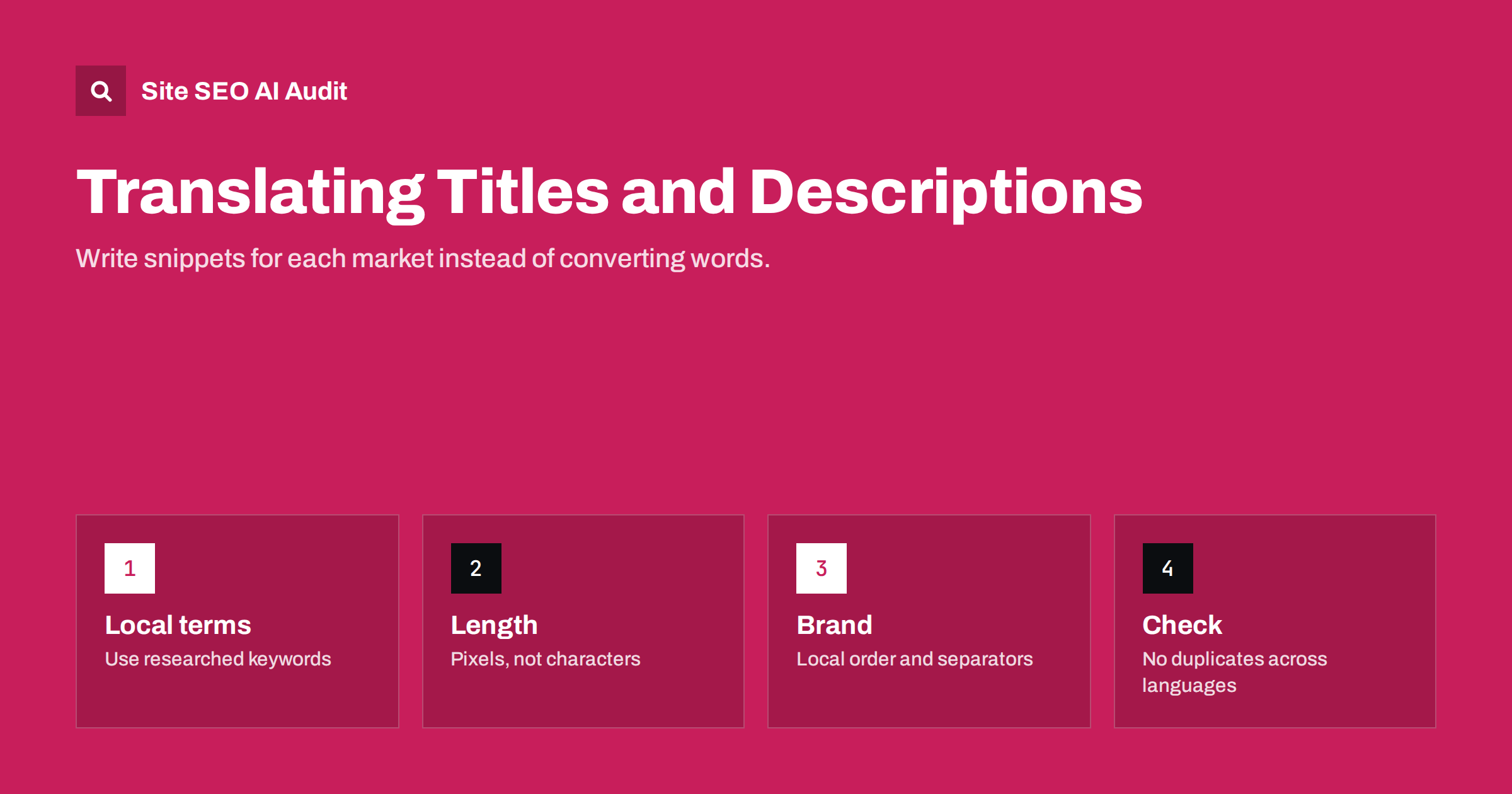
Short answer: Title tags and meta descriptions should be written for each language, not translated word for word. Start from the local keyword for the page, keep titles within the display width that search results allow in that script, put the most important words first, adapt the brand and separator style to local habits and write descriptions that answer what local searchers want. Then check that no language still carries the original titles, which is one of the most common gaps on multilingual sites.
Why titles and descriptions deserve special care
The title tag and meta description are what searchers see before they visit your site. In search results, the title is usually the largest, most prominent text, and the description, when search engines use it, fills the snippet below. Together they decide whether someone clicks.
On multilingual sites, these two fields are often the weakest part of a translation. They live in SEO plugin fields or templates, outside the main content, so translators may never see them. When they are translated, they are often converted literally from the original, which produces titles that are too long, miss the local keyword or read awkwardly. And sometimes they are not translated at all, leaving a German page with an English title in German search results.
Search engines can rewrite titles and generate snippets from page content when they consider the provided ones unhelpful, as Google explains in its guidance on title links. A title in the wrong language is a likely candidate for rewriting, which removes your control over how the page is presented.
Start with the local keyword, not the original title
A good title in the original language was probably built around a researched keyword. The translated title should be built the same way, around the keyword local searchers use:
- Look up the local keyword for the page from your keyword research for that market.
- Write a title that places that keyword early and describes the page clearly.
- Only then compare it with the original title, to make sure the promise of the page is the same.
Literal translation often misses. An English title such as “Free SEO Audit Tool” might be translated with a phrase that is correct but rarely searched, while local searchers use an English loanword or a different construction. The title is the single most important place to get the local term right.
Length works differently in other languages
Search results limit titles and descriptions by display width, measured in pixels, rather than by a fixed number of characters. That means character counts that work in English do not transfer directly:
- Longer languages. German, Finnish, Dutch and many others often need more characters for the same meaning. Titles translated from English frequently become too long and get truncated.
- Wide characters. Chinese, Japanese and Korean characters are wider than Latin letters, so far fewer characters fit, but each carries more meaning.
- Script differences. Arabic, Hebrew, Thai, Cyrillic and other scripts have their own widths and conventions.
Rather than applying one character limit to all languages, preview titles with a snippet tool that measures width, or check the actual search results in each market. Put the most important words first, so truncation, if it happens, removes only the least important part.
Brand names and separators
Many sites append the brand to every title, such as “SEO Audit Guide | Brand”. On multilingual sites, decide per language:
- Whether to include the brand at all. In long languages, the brand may push important words out of view. It can be shortened or left out on deep pages.
- Where to put it. Most sites place it at the end. In some markets, local habits differ; check how leading local sites do it.
- Which separator to use. A vertical bar, a hyphen or a dash all work. Keep it consistent within each language.
- Whether the brand has a local form. If your brand is used differently in some markets, use the local form consistently.
In right-to-left languages, check how separators and Latin brand names display at the end of the title, since mixed-direction text can move them.
Writing meta descriptions for each market
Meta descriptions do not directly affect rankings, but they influence clicks when search engines show them. For each language:
- Summarise what the page offers in the local reader’s terms, including the local keyword where it fits naturally.
- Mention details that matter locally: local delivery, local currency, local support, local regulations.
- Match the tone of the market. Some languages and cultures prefer a more formal register; others are comfortable with direct calls to action.
- Keep within the display width, which, like titles, varies by script.
- Avoid copying the same description across many pages; each page deserves its own.
Templates for archives, categories and the home page
Titles and descriptions for many pages are generated from templates, for example “%category% Archives | %site%” or “Page %number% of %title%”. These templates live in SEO plugin settings or theme files and are easily forgotten during translation.
- Translate every title and description template per language, including words such as “Archives”, “Page” and “Search results”.
- Translate the site name or tagline if they are used in titles.
- Check the home page title and description separately; they are often set in a global setting.
- Check pagination, tag, author and date archives, which are often indexed and show template text in search results.
How to find untranslated or weak snippets
Untranslated titles and descriptions follow predictable patterns, which makes them easy to find with a crawl:
- Identical titles across languages. If a German page and an English page have exactly the same title, the German one was probably never translated.
- Duplicate titles within a language. Many pages sharing one title often point to a template that falls back to the site name.
- Missing descriptions in translated sections, where fields were left empty.
- Titles that are too long in longer languages.
- Low click-through rate in one language in Search Console, compared with similar pages in other languages.
Site SEO AI Audit crawls the whole site like a search engine and flags duplicate titles, missing or duplicate descriptions and missing H1s in its on-page area, alongside hreflang and lang checks in its Languages area. Issues are weighted by how many pages they affect, and on WordPress sites each comes with fix steps for the SEO plugin. You can start with a free audit.
Worked examples
A few examples show the difference between converting a title and writing it for a market.
Same language, different country. An English shop page titled “Men’s Sneakers on Sale | Brand” for the US store would, for the UK store, more naturally become “Men’s Trainers in the Sale | Brand”. The meaning is the same, but UK shoppers search for trainers, and “in the sale” is the common British phrasing. A literal copy would keep the US word and miss the UK search term.
A longer language. An English title such as “Free Website SEO Check | Brand” might become “Kostenloser SEO-Check für Ihre Website | Brand” in German. The German version is noticeably longer. If it gets truncated, dropping the brand on this page, or shortening the phrase, keeps the key words visible.
A description with local details. An English description that says “Fast shipping worldwide and easy returns” says little to a customer in Austria. A localized version would name delivery times to Austria and the return period that applies there, which is what that customer wants to know before clicking.
In each case, the localized version starts from what the local searcher types and needs, and only then checks that it still matches the page. That order, keyword and reader first, original second, is what separates localized snippets from translated ones.
A workflow that keeps snippets localized
- Give translators the title and description fields together with the content, not as an afterthought.
- Provide the local keyword and a width limit for each page.
- Have a native reviewer check titles and descriptions of the most important pages.
- After each translation batch, crawl the site and look for identical titles across languages.
- Review click-through rates per language every few months and rewrite weak snippets.
Related reading
- How to write title tags: length, wording and examples
- How to write meta descriptions that earn the click
- Multilingual keyword research: finding real local search terms
The bottom line
Titles and meta descriptions are the first thing local searchers see, so they should be written for each market, not converted from the original. Build them around local keywords, respect display width in each script, place the key words first, adapt brand and separator conventions, translate every template, and use crawls and click-through data to find the pages where the original snippets are still showing.
KKK
Should I translate title tags literally?
No. Write each title around the local keyword and the local reader’s needs, then check that it matches the page’s promise. Literal translations often miss the terms people search for.
How long should titles be in German or Japanese?
Search results limit titles by display width, not a fixed character count. German titles often need to be shortened, while Japanese fits fewer but more meaningful characters. Preview titles in each script.
Why does Google show my English title for a German page?
Usually the German page’s title field was never translated, or a template falls back to the original. Check the page source and the SEO plugin settings for that language.
Do meta descriptions affect rankings?
Not directly. They affect how the snippet looks and therefore whether people click, which makes them worth localizing for important pages.
Should the brand name appear in every title?
It is common but not required. In long languages, consider shortening or omitting it on deep pages so the descriptive words stay visible.