ENEnglish
 LTLietuviškai
 DEDeutsch
 FRFrançais
 RUРусский
 ESEspañol
 PLPolski
 ITItaliano
 UKУкраїнська
 CSČeština
 PTPortuguês
 JA日本語
JA日本語 LVLatviešu valoda
 ETEesti
 HUMagyar
 IDBahasa Indonesia
 TRTürkçe
 HIहिन्दी
 ELΕλληνικά
 ARالعربية
 THไทย
THไทย VITiếng Việt
 RORomână
 MSBahasa Melayu
 BNবাংলা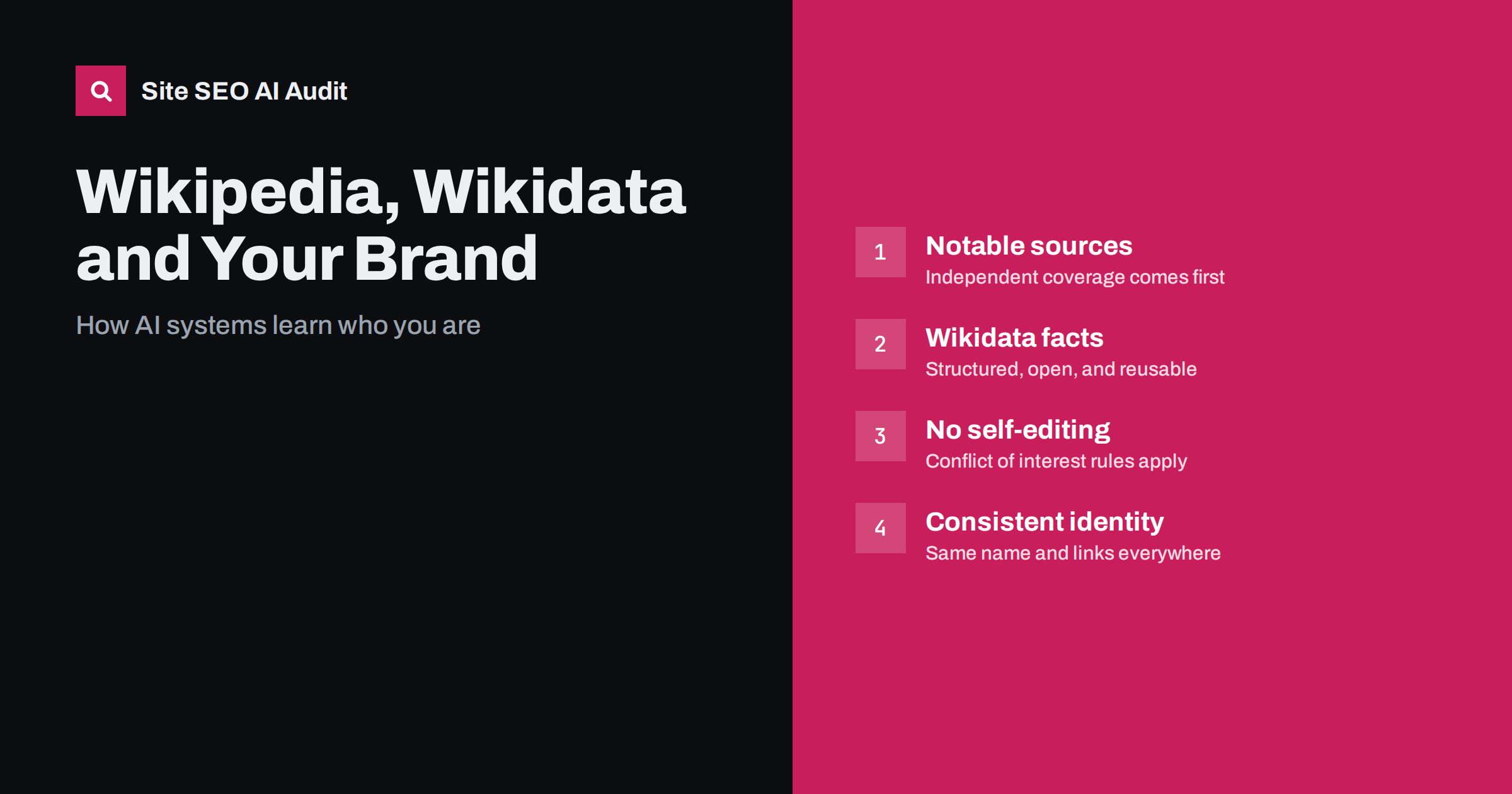
Short answer: Wikipedia and Wikidata are among the sources that search engines and AI systems use to recognise people, companies and places, so an accurate entry can help a brand be understood correctly. But you cannot simply create one: Wikipedia requires independent, reliable coverage to show notability and discourages editing by the subject itself. For most businesses, the practical route is to build real third-party coverage, keep your own facts consistent across your site and profiles, and let an entry follow if the brand qualifies.
When an AI assistant answers a question about a company, it needs to know which company is meant, what it does and whether the sources agree. Public knowledge bases help with that. Because of this, many owners ask whether they should create a Wikipedia page or a Wikidata item for their brand. The honest answer is more careful than a yes or a no, and the wrong approach can damage a reputation instead of improving it.
How knowledge bases support AI search
Search engines have long used structured knowledge to build panels and connect names to real-world things. AI systems use similar signals, among many others, to decide whether two mentions refer to the same entity. Wikipedia and Wikidata matter for three reasons:
- They are widely read and widely linked. Many other sites quote or reference them, which spreads the facts.
- They have editorial rules. Claims need sources, which makes the content more reliable than a random page.
- They are structured. Wikidata stores facts as items and properties that software can read directly.
No one outside these systems knows exactly how much weight any source receives, so avoid promises of the kind “a Wikipedia page guarantees citations”. It is one signal in a larger picture that we describe in our guide to entity SEO for AI search.
Wikipedia and Wikidata are different things
People often treat them as one. They are separate projects with different rules:
- Wikipedia is an encyclopedia written as articles. A subject needs notability, which means significant coverage in reliable sources that are independent of it. Press releases, your own website and paid placements do not count.
- Wikidata is a database of structured facts, such as the official website, the founding date, the headquarters and identifiers in other systems. Its threshold for inclusion is lower, but items still need references and a clear reason to exist.
A brand can have a Wikidata item without a Wikipedia article. A Wikipedia article almost always has a matching Wikidata item.
Notability: the real requirement
Wikipedia’s guidelines for companies ask for substantial coverage in independent, reliable publications such as national news outlets, trade journals with editorial standards or books. A listing in a directory, a short mention, a funding announcement rewritten from a press release and your own blog do not demonstrate it.
Before thinking about an entry, ask a simple question: if a neutral editor searched for your brand, would they find several in-depth articles written by people who do not work for you? If not, the effort is better spent on earning that coverage in the first place. It benefits you regardless of Wikipedia, because the same coverage builds trust with readers and with AI systems.
Conflict of interest: what not to do
The most common mistake is writing your own page. Wikipedia asks people with a close connection to a subject to disclose it and to avoid direct editing of the article. Promotional wording, copied marketing text and undisclosed paid editing are likely to be removed, and an article deleted for those reasons is hard to recreate. In serious cases, the story about the removal can become part of your online reputation.
Safer options for a business include:
- Suggesting corrections on the article’s talk page, with sources, if it exists and contains errors.
- Disclosing your connection openly when you take part.
- Providing public, citable facts on your own site, such as a clear About page, so that independent editors can verify them.
Read the current community policies before you act, as they are updated by volunteers and are enforced strictly.
Wikidata for businesses and organisations
Because Wikidata is a database, its facts are easier to keep neutral. A typical item for an organisation may include its name in several languages, its official website, a short description, the country, the inception date and links to other identifiers. Each statement should have a reference, ideally from a reliable independent source.
If your organisation is clearly notable, an item may be appropriate. If it is not, do not create items only to gain visibility; they may be deleted. The Wikidata notability policy explains what is acceptable. Treat any item as public property: others can edit it, and wrong data can spread to other tools that reuse it.
What to do on your own site
You control one important source: your own website. Many AI systems and search engines read it first to understand who you are. Make it easy to verify:
- A clear About page with the legal name, location, founding date, what you do and how to contact you. See our advice on About page SEO.
- Organization structured data on the homepage, with name, logo, official website and links to your real profiles. Our article on Organization schema for AI shows what to include.
- Consistent naming. Use the same business name, spelling and description in your site, social profiles and business listings.
- Accurate profiles on platforms you control, so that the facts do not conflict.
Conflicting facts are a major cause of wrong AI answers. If a model finds three founding years for your company, it may pick any of them. Keeping every public profile in agreement removes that guesswork.
Build the evidence that editors and AI systems trust
Instead of chasing an entry, build the things that make one possible and useful whether or not it ever appears:
- Publish original information that others cite, such as data, research or genuinely helpful guides. See original research and AI citations.
- Earn independent coverage from industry publications and local media by giving them something worth reporting.
- Be present where people discuss your field honestly and without spam.
- Track mentions of your brand and correct factual errors where you can.
Over time this creates a consistent, verifiable footprint. If your brand then qualifies for a Wikipedia article, independent editors can write it from the sources that exist.
A realistic plan for a small or medium business
Most companies will never have a Wikipedia article, and that is perfectly normal. Plenty of well-run businesses are described accurately by AI systems because their own sources are clear. A realistic plan looks like this:
- Audit what is public today. Search for your brand name and read the first two pages of results, then ask a few AI assistants what they know about you. Note every fact that is wrong, missing or inconsistent.
- Fix the sources you control. Update your About page, your Organization markup, your social profiles and your business listings so that they agree on name, description, location and website.
- Create something worth citing. A study, a data summary, a clear explanation of a topic you know well. Independent writers cite what is easy to reference.
- Pitch it honestly. Offer journalists and industry writers real information, not a request for a link.
- Review again every few months. Repeat the check and see whether the descriptions have improved.
This plan costs time rather than money, and every step has value even if no encyclopedia ever mentions you. If an entry does eventually appear, treat it as a public record: watch it for errors and respond through the proper channels instead of editing it yourself.
One more caution: be wary of agencies that promise to create or “guarantee” an encyclopedia page for a fee. Undisclosed paid editing breaks the rules of these projects, and the results are frequently deleted. Ask any provider how they comply with the disclosure policies before you hire them.
Checking the basics on your own pages
The signals you fully control are on your site: structured data, titles, headings, crawlable text and whether AI crawlers can read your pages at all. Site SEO AI Audit crawls your whole website like a search engine and scores it across seven areas, including AI visibility and structured data, with a fix list ranked by how many points each fix adds. The first audit of up to 200 pages is free.
Related reading
The bottom line
Wikipedia and Wikidata can help AI systems recognise a brand, but they are earned by independent coverage, not created on demand. Do not write your own article or use promotional edits. Keep your own site and profiles accurate and consistent, publish things that others cite, and let a knowledge base entry follow only when the brand genuinely qualifies.
KKK
Can I create a Wikipedia page for my company?
You can try, but it will probably be deleted unless the company has significant independent coverage. If you have a connection to the subject, you should disclose it and avoid writing the article yourself.
Is a Wikidata item easier to get than a Wikipedia article?
The threshold is lower, but items still need references and a clear purpose. Creating items only to increase visibility can lead to deletion. Make sure every statement is sourced and neutral.
Do AI assistants only use Wikipedia to describe brands?
No. They use many sources, including your own website, news articles, reviews and business profiles. Wikipedia is one source among many, and its influence varies from one system to another.
What if my Wikipedia article contains errors?
Use the article’s talk page to suggest a correction, include reliable sources and disclose your connection. Do not edit the article to promote the company.
What is the best first step for a small business?
Make your own site clear and consistent: an accurate About page, Organization structured data, and matching profiles elsewhere. Then work on earning independent coverage, which helps in every channel.