ENEnglish
 LTLietuviškai
 DEDeutsch
 FRFrançais
 RUРусский
 ESEspañol
 PLPolski
 ITItaliano
 UKУкраїнська
 CSČeština
 PTPortuguês
 JA日本語
 LVLatviešu valoda
 ETEesti
 HUMagyar
 IDBahasa Indonesia
 TRTürkçe
 HIहिन्दी
 ELΕλληνικά
 ARالعربية
 THไทย
 VITiếng Việt
 RORomână
 MSBahasa Melayu
 BNবাংলা
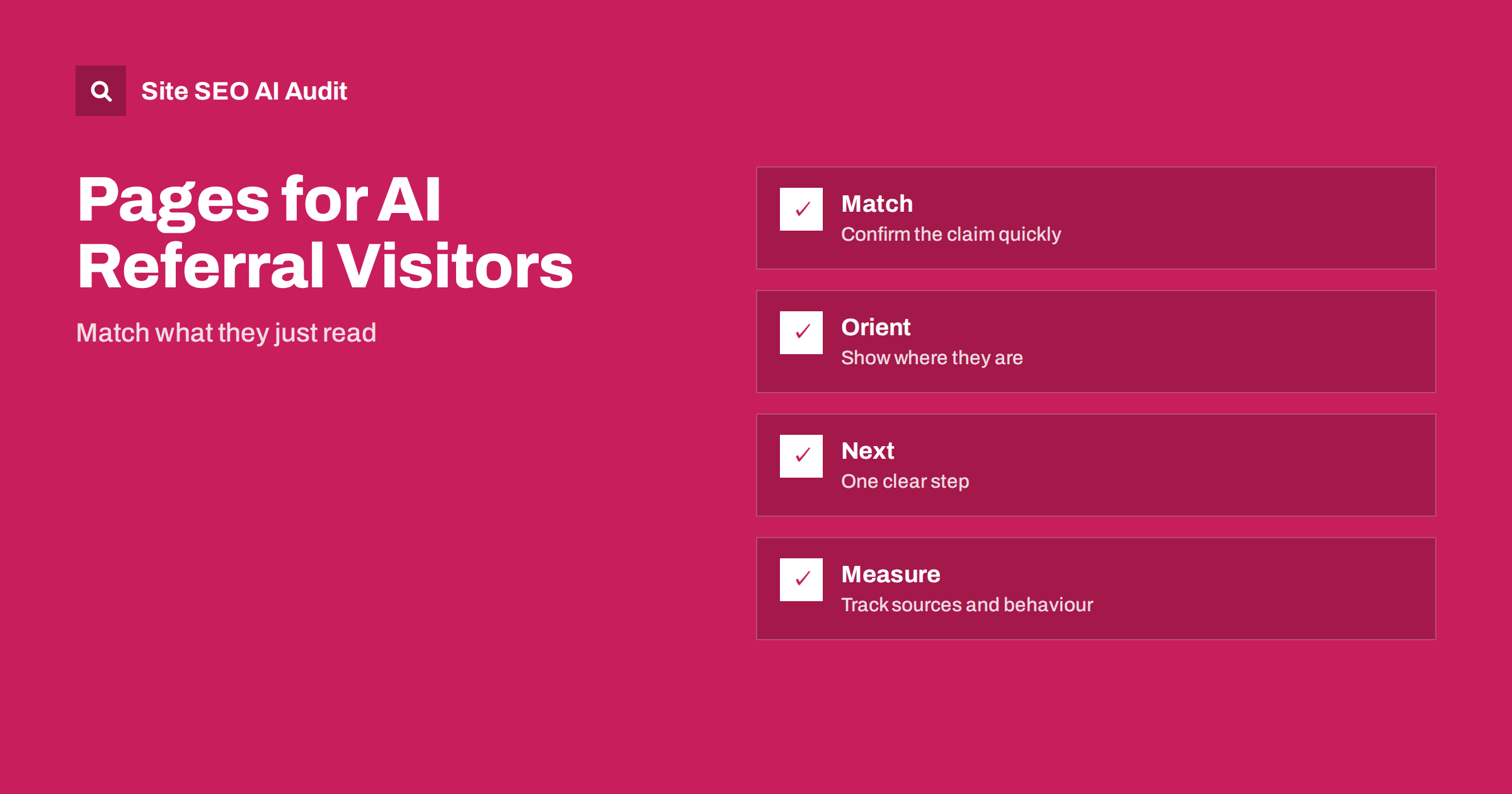
Short answer: People who click from an AI answer have already read a summary of your page, so they arrive with a specific question and some trust. Prepare for them by confirming the claim they read in the first screen, making the page easy to scan, giving one clear next step, keeping facts current and tracking visits from AI sources separately. Do not promise higher conversion rates, since the numbers vary widely by site and topic.
Most advice about AI search focuses on being cited. The next question is what happens after the click. A visitor who arrives from an assistant is different from one who clicked a search result: they have seen a condensed answer, they may have seen your name quoted, and they often click to verify or to take action. If the page does not match what they expected, they leave. This guide explains how to design for these visitors without making the page worse for everyone else. For measurement, see tracking AI referral traffic in GA4.
Understand what the visitor already knows
A visitor from an AI answer has usually read one or two sentences taken from your page, or a paraphrase of them. They may want to check the source, learn more detail, compare options or complete a task. They know less about your brand than a returning customer, but they know the specific claim. Look at the questions your pages are likely to answer, and imagine what the answer said. The first thing they should see is a clear confirmation: the heading, the opening sentence and the key fact that matches the question.
Put the answer where they land
Many visitors arrive at the top of the page, but some are taken to a specific section through a fragment link. Make sure that both entry points work. The top of the page should state the answer in plain words, and each section should begin with its own answer, a habit explained in the guide to answer-first introductions. Avoid large banners, pop-ups and cookie walls that push the answer out of sight. A visitor who must scroll past an advertisement to find the sentence they were promised may decide that the page is wrong.
Keep facts accurate and dated
AI answers may repeat facts from your pages for months, long after you change them. If your price, policy, availability or specification changes, the old fact may still be in circulation. Show the date of the last review on the page, update pages promptly and make the current facts easy to find. If the answer quoted an old price, give the visitor a clear note about the change instead of hiding it. The guide on content dates and freshness explains how to show dates honestly.
Help people orient themselves
A visitor from a distant answer may not know what your company does. Make the page name, the topic and the brand clear without long introductions: a visible site name, a short line about who you are and a link to learn more. Use headings and a short table of contents on long pages, so that people can find the part they need. Do not force a login or a form before showing the content they came for. If some content must be gated, show a useful summary first, as discussed in the guide to gated content and AI search.
Offer one clear next step
People who click through often want to do something: compare, buy, book, download, read the details or contact you. Decide the most useful next step for each page and make it visible without hiding the content. For a guide, it may be a related guide or a free tool; for a product page, it may be the price and a button; for a service page, it may be a short form or a phone number. Offer one primary action and a few secondary links. Too many choices distract, and too few leave people with nowhere to go.
Respect trust and honesty
Do not change the page to look different for visitors from AI sources, and do not show them special content that crawlers cannot see. That is cloaking, and it harms trust and may break the rules of search engines, as described in the guide to AI cloaking and hidden text. Design one page that works for everyone. Avoid exaggeration, and make sure the page supports every claim that an answer is likely to attribute to you. If you cannot support a claim, remove it from the page before it spreads.
Check speed and usability on phones
Many AI answers are read on phones and in apps, and the click opens an in-app browser. Test your pages in those conditions: slow connections, small screens and limited memory. Make sure the page loads fast, the text is readable without zooming and buttons are easy to tap. Avoid layouts that jump while loading. A page that is slow or hard to use will lose visitors that an AI answer worked to send. The guide to mobile usability lists the checks.
Measure what they do
Create a segment in your analytics for visits from AI assistants and answer engines, using the referral sources that appear in your reports. Compare it with organic search and direct visits: pages viewed, time on page, scroll depth, clicks on the main action and conversions. Expect small numbers at first and wide variation, and avoid conclusions from a few visits. Some AI visits arrive without a referrer and appear as direct traffic, so the segment shows only a part of the picture. Keep notes of changes and results, and review them each month.
Use what you learn to improve pages. If visitors from AI sources leave quickly from a page, compare the opening of the page with the likely question and adjust it. If they click a certain link often, move it higher. If they land on pages that you never meant as entry points, such as old posts, update them or add clear links to current content. Treat the data as feedback on clarity, not as a way to chase a single metric.
Keep the work proportional. Most sites do not need special pages for AI visitors. Clear writing, accurate facts, fast pages and a visible next step help all readers, and AI visitors are one more group who benefit. Start with the ten pages that receive the most AI referrals or that you most want to be cited, and improve them before looking at the rest.
A short example makes this concrete. A software company publishes a guide on exporting data. An assistant summarises it as: you can export a report as a spreadsheet from the settings menu. A visitor clicks to confirm, and lands on a page that starts with a long story about the history of data formats. The visitor scrolls, cannot find the menu name and leaves. After a rewrite, the page opens with a sentence that names the menu and the file type, followed by numbered steps with a screenshot description and a note about which plan includes the feature. The next visitor finds the answer in five seconds and then reads on. The content did not change much; the order did.
Another example is a local service. An assistant mentions that a company offers same-day repairs. The visitor lands on the home page, which shows a generic slogan, and has to search for the service page. A better setup links directly from the cited page to the booking form, shows the opening hours and the area served near the top, and keeps the phone number visible on mobile. Every unnecessary click costs visitors, and visitors from an answer have less patience than those who searched for your brand name.
Review your most cited pages regularly. Ask a few assistants the questions that those pages answer, read what they say, and open your page as a visitor would. Does the page support each statement the assistant made? Is anything misleading or out of date? Does the next step make sense for that visitor? This simple routine, done once a month, finds more problems than any report, and the fixes are usually small edits to headings, openings and links.
Site SEO AI Audit crawls your site and checks titles, descriptions, headings, page speed indicators, structured data, broken links and AI crawler access, so you can see whether your key pages are clear and reachable for both people and machines. It does not measure traffic or conversions. The first audit of up to 200 pages is free; larger sites can see the pricing page.
Related reading
The bottom line
Confirm the answer where visitors land, keep facts current, offer one clear next step, serve everyone the same fast page and track AI visits as their own segment.
FAQ
Do AI visitors convert better than search visitors?
It varies by site and topic. Measure your own data and avoid assuming a result.
Should I build separate pages for AI visitors?
No. Improve the pages that already answer the question, and show everyone the same content.
How do I find AI referral traffic?
Look at referral sources in your analytics for assistant and answer engine domains, knowing that some visits appear as direct.
What if an answer quotes an old fact?
Update the page, show the review date and, where useful, note the change clearly for visitors.
Which pages should I improve first?
Start with pages that already receive AI referrals or that answer your most important questions.