ENEnglish
 LTLietuviškai
 DEDeutsch
 FRFrançais
 RUРусский
 ESEspañol
 PLPolski
 ITItaliano
 UKУкраїнська
 CSČeština
 PTPortuguês
 JA日本語
 LVLatviešu valoda
 ETEesti
 HUMagyar
 IDBahasa Indonesia
 TRTürkçe
 HIहिन्दी
 ELΕλληνικά
 ARالعربية
 THไทย
 VITiếng Việt
 RORomână
 MSBahasa Melayu
 BNবাংলা
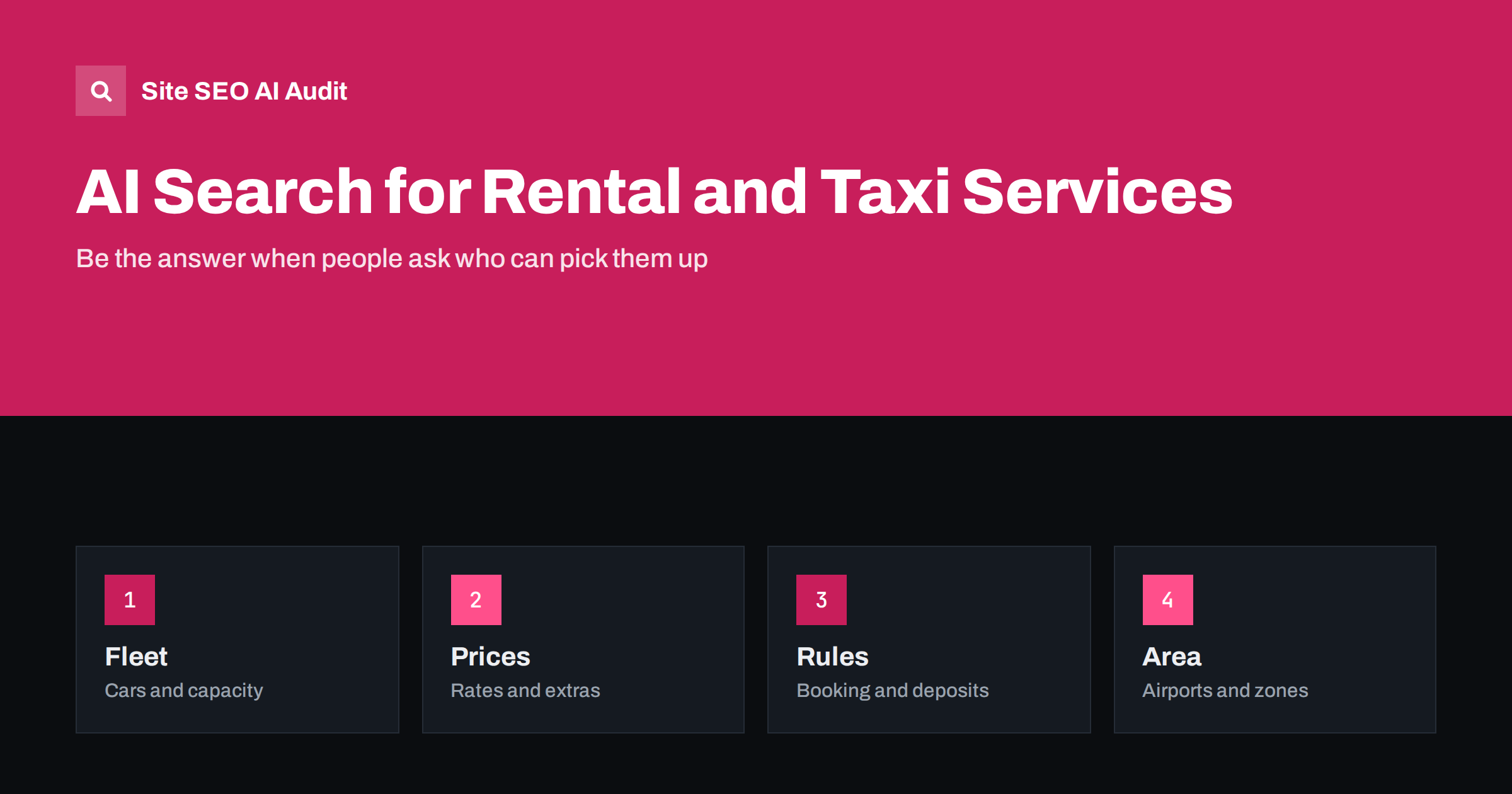
Short answer: People now ask assistants “which company rents a van at the airport”, “how much is a taxi from the station to the hotel” or “who offers a chauffeur for a wedding”. To be named, a car rental, taxi or limousine company needs clear pages for each service, exact coverage areas, transparent prices and extras, booking and deposit rules, fleet details, licences and safety information, and accurate local data in plain text that machines can read.
Mobility is a high-intent, time-sensitive market. Travellers arriving at an airport, families planning a trip and event organisers need a clear answer quickly, and they often ask by voice or in a chat. Assistants favour companies that publish specifics: exactly where the desk is, what the deposit is, how a booking is cancelled. This guide shows how to organise such a website for people and for AI systems. For general principles, read the guide to local business AI search, and for tourist demand see the article on travel and hotels in AI search.
What customers ask before booking
Common questions for rental firms are “what is the minimum driver age”, “is a deposit needed and how much”, “is mileage unlimited”, “can I take the car abroad”, “do you accept debit cards”, “what insurance is included” and “can I return it at another location”. For taxi and limousine services, people ask “how much is the fare to the airport”, “can I book a child seat”, “do you track flights”, “is there a fixed price” and “do you serve weddings and corporate events”.
Collect these questions from the phone, e-mail, chat logs and booking notes. Use customers’ own wording as headings. Each question deserves a short, direct answer, followed by detail and, where rules differ, a clear statement of the conditions.
Describe the fleet so it can be compared
Create a page for each vehicle class or model, with passengers, luggage capacity, doors, transmission, fuel type, features and age range of the fleet. Photograph the vehicles and write alt text that names what is shown. Be careful with promises: if you say “or similar”, explain what similar means. If vehicles for chauffeur services have particular amenities, such as water, child seats or wheelchair access, list them.
| Class | Passengers | Luggage | Good for |
|---|---|---|---|
| Compact | Up to 4 | Two small bags | City trips |
| Estate or SUV | Up to 5 | Several large bags | Families, longer drives |
| Minivan | Up to 8 | Group luggage | Groups, airport transfers |
| Executive sedan | Up to 3 | Two suitcases | Business, weddings |
Replace the sample values with your real fleet. A table like this is easy to read for people and easy for machines to extract.
Publish transparent prices and extras
Few industries suffer as much from mistrust about the final bill, so openness here is a competitive advantage rather than a risk.
Prices are the first thing people compare. For rentals, show the daily rate, weekly discount, mileage allowance, insurance levels, young-driver or additional-driver fees, one-way fees, airport surcharges, fuel policy, cleaning fees and the deposit amount. For taxis and limousines, give fixed fares for popular routes, the meter rate, waiting-time charges, night and holiday supplements and extras such as child seats or luggage.
State what is included in every price and what is optional. Hidden fees are the main reason for complaints in this industry, and assistants and review sites repeat those complaints. A page that says plainly “the deposit is held on a credit card and released within a set number of days after return” does more for trust than any slogan. Add a date of last review.
Explain booking, payment and cancellation
Describe how to book online, by phone or by message, how far ahead you recommend booking, which documents are required and which payment methods you accept. List cancellation and no-show rules, what happens if a flight is delayed and how changes are handled. For rentals, explain what the customer must bring at pickup, such as a licence held for a minimum period, an identity document and a payment card in the driver’s name.
Put these rules in a dedicated page and link to it from every service page. Do not bury important conditions in a PDF only; keep the text in the HTML, and offer the PDF as a convenience. If you serve several countries or languages, translate the page carefully, because small differences in a legal term can create disputes.
Define your coverage and locations
Customers rarely search for a company in the abstract; they search for a place and a moment, such as the airport arrivals hall on Friday evening. Your pages should speak in those terms.
Name every airport, station, port, city and district you serve, and say what each service costs and how pickup works. For airport pickups, explain where the driver waits, how the customer finds them and what happens if the flight is late. For rental desks, give the exact address, opening hours, after-hours key return and parking details with a map link and photo of the entrance.
Create a page for each location or route with its own details rather than one general page. Mark them with local business structured data and keep the information identical to your map listings. Inconsistent hours across sources make assistants hesitate, and a traveller who arrives at a closed desk will not give a second chance.
Show licences, insurance and safety
Trust is the deciding factor when a stranger will drive you or hand you a car. State your operating licence or registration with its number or a link to the official register where this is possible. Describe insurance cover in plain words, mention vehicle inspection and maintenance routines, driver vetting, training and any accessibility features. If your vehicles are electric or hybrid, explain charging arrangements for renters.
Be careful with legal and safety statements. Cite the authority for rules about licences, age limits and cross-border travel, and update the page when rules change. If something depends on the customer’s situation, say so and suggest how to check. The principles in the article on E-E-A-T and AI search apply directly to businesses in which the customer’s safety is involved.
Serve business, event and tourist customers
Different customers need different pages. Corporate clients want invoicing, account booking, reliable punctuality and reports. Wedding and event customers want package descriptions, photos, decoration options and timing. Tourists want itineraries, multi-day tours with a driver, sample prices and advice on parking and local rules. Write a short page for each group, with real examples such as “airport to city centre for four passengers with luggage”.
Seasonal peaks deserve their own content: festival weeks, ski seasons, summer holidays and holiday periods. State the lead time for booking and how availability is handled. Update the page after the season so that it does not promise what you can no longer supply.
Publish guides that answer practical questions
Beyond service pages, short guides capture people who are still planning. Useful topics include how to rent a car for the first time, what to check when collecting a vehicle, how to read a rental agreement, which documents foreign drivers need, how tolls and parking work in your area, what to do after an accident or breakdown and how to get from the airport to the city by taxi, train or bus. Be fair about alternatives; honest advice is more likely to be quoted than a sales pitch.
Write each guide with a direct answer in the first lines, steps in plain language and a date. Link from the guide to the relevant service or booking page, so the reader who is ready to act can do so at once. For taxi and limousine businesses, a page on what to expect from a ride, including how drivers identify themselves, how fares are calculated and how to report a problem, builds confidence for first-time customers.
Avoid copying text from manufacturers or other rental firms. Original photographs, route maps and real examples make your guides different from thousands of similar pages and give assistants a reason to cite you.
Reviews and machine readability
Reviews influence which company is recommended. Invite feedback after each rental or ride, respond politely to complaints and never write reviews yourself. The relationship is explained in the guide to reviews and AI recommendations.
Finally, check that machines can read your site. Booking widgets often hide prices and availability inside scripts, so repeat the essential facts in text. Make sure robots.txt does not block crawlers you want to allow, that pages load quickly on a phone and that structured data matches the visible text. A crawl with Site SEO AI Audit shows blocked pages, missing descriptions, broken links and structured data errors, and the first audit of up to 200 pages is free.
Related reading
The bottom line
Publish exact fleet, price, booking and coverage facts in plain text, show licences and insurance, and keep local data consistent.
FAQ
Should a rental company publish its deposit amount?
Yes. Deposit, payment method and release timing are among the most asked questions, and clear answers prevent complaints.
Can a taxi company show fixed fares?
Yes, for popular routes. State what the fare includes and the extras, such as night supplements or waiting time.
Do I need a page for each airport?
Yes. Pickup points, waiting rules and prices differ, so a dedicated page answers travellers’ questions more precisely.
Which structured data should I use?
Use local business markup for each location and keep it identical to the visible address, hours and phone number.
How should I handle outdated prices?
Review rates before each season, show the date of the last update and remove expired offers from the site.