ENEnglish
 LTLietuviškai
 DEDeutsch
 FRFrançais
 RUРусский
 ESEspañol
 PLPolski
 ITItaliano
 UKУкраїнська
 CSČeština
 PTPortuguês
 JA日本語
 LVLatviešu valoda
 ETEesti
 HUMagyar
 IDBahasa Indonesia
 TRTürkçe
 HIहिन्दी
 ELΕλληνικά
 ARالعربية
 THไทย
 VITiếng Việt
 RORomână
 MSBahasa Melayu
 BNবাংলা
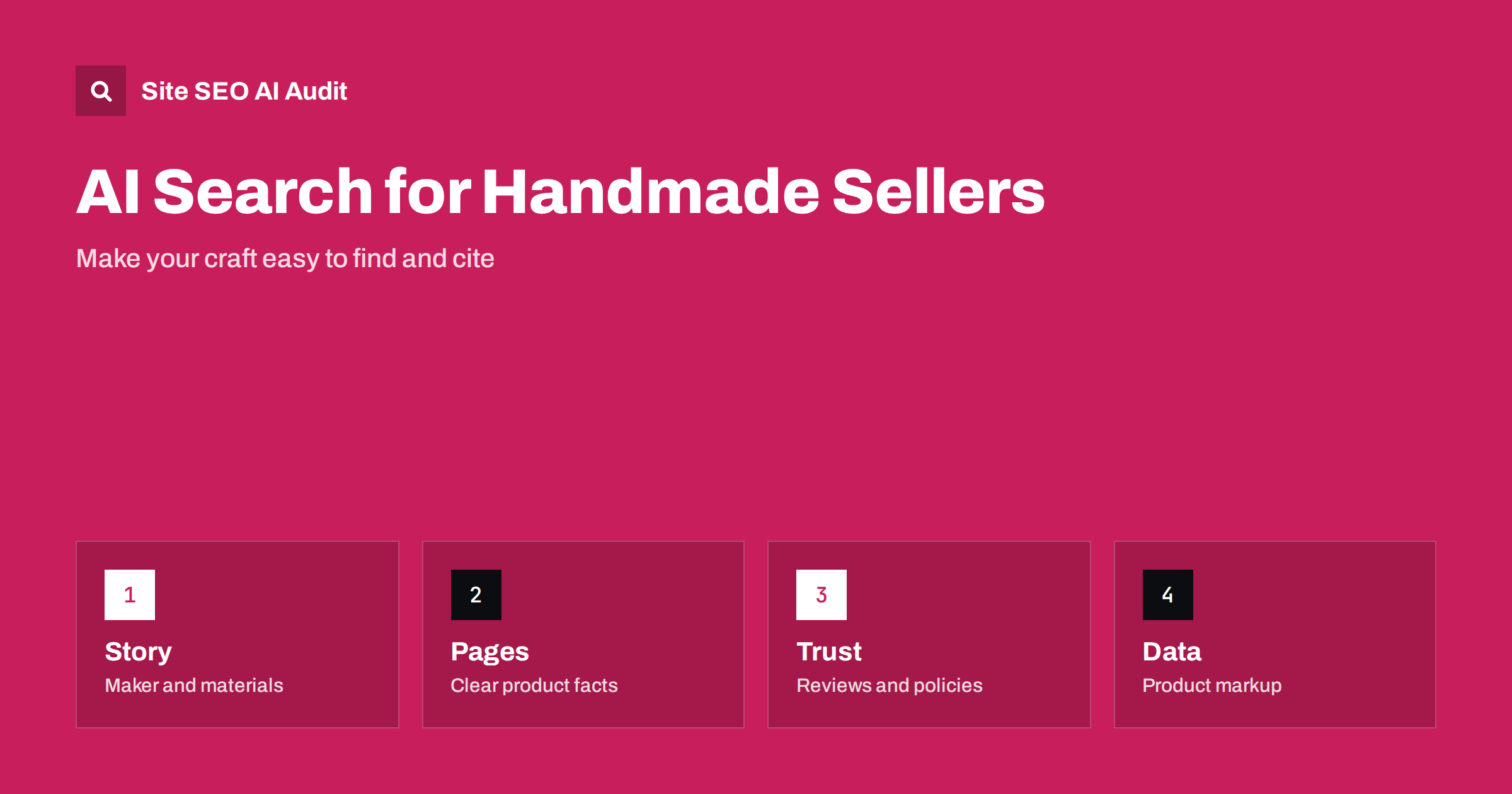
Short answer: Handmade and craft sellers appear in AI answers when their pages state exactly what an item is, what it is made from, how it is made, who makes it, what it costs and how it ships, in plain text that assistants can quote. Add product structured data, honest reviews, clear policies and a maker story that is specific rather than poetic, and keep the same facts on your own site and on every marketplace listing. Specific, consistent facts beat generic marketing language.
People increasingly ask assistants for things like a hand-thrown mug set, a leather notebook made in small batches or a wedding gift that is not mass produced. The assistant then builds an answer from pages it can read and trust. Many craft shops lose out because their pages rely on photos and feeling: a beautiful picture, a short title and a line about passion. Assistants cannot see the beauty, and a line about passion contains nothing to quote. A seller who writes down the clay, the firing temperature range, the dimensions, the care instructions and the lead time gives the assistant material it can use. This guide shows how to turn craftsmanship into clear, findable information. For the wider picture, see the AI search visibility checklist.
Why handmade sellers are well placed
Craft businesses have an advantage that large retailers lack: real, specific stories. A maker knows why a glaze behaves as it does, which wood was chosen and why, how long an item takes and what can be customised. Assistants prefer answers that sound concrete and checkable, and a seller who explains the process is often more useful to the reader than a catalogue with identical descriptions across thousands of products. The difficulty is that this knowledge often lives in the maker’s head, on social media or in packaging inserts, not on the product page. Moving it onto the page is the main task.
Write product pages that answer real questions
Start with the questions buyers ask by message: is it food safe, can it go in a dishwasher, what are the exact measurements, how much does it weigh, is it suitable as a gift, how long until it ships, can the name be added. Put the answers on the page in short sentences near the top, not hidden in images. Begin the description with a plain statement of what the item is, for example a stoneware mug with a handle, holding about three hundred millilitres, glazed inside and out. Then list the materials, the size, the colour options and the care steps. Avoid vague words such as unique or artisanal unless a fact follows. If every piece differs slightly, say how, and show the range with photos. Product page basics are covered in the product page SEO guide.
Describe materials, process and origin
For handmade goods, material and process are the facts that set you apart, and they are exactly what shoppers and assistants compare. Name the materials precisely: solid oak, vegetable-tanned leather, soy wax, recycled silver, organic cotton. State where the item is made and, if it matters, where the materials come from. Describe the process in a few clear steps, such as hand-carved, kiln-fired or poured in small batches. Do not claim certifications or origins that you cannot prove, because a false claim damages trust and can create legal trouble. If you do hold a certificate or belong to a trade association, name it and link to the source. Consistent naming helps too: use the same material name in titles, descriptions and tags.
Tell the maker story with facts
An about page and a short maker note on product pages support both customers and assistants. Write who you are, where you work, how long you have made the products and what you make and do not make. Include a studio location or region if you are comfortable doing so, a real name and a photograph of the workshop. These details form an identity that assistants can connect across pages and sources, which is the idea behind entity signals, explained in entity SEO for AI search. Avoid long personal essays with no facts. A short story with concrete details is more convincing and more quotable than a long one with none.
Add structured data for products and policies
Structured data states the same facts in a form machines read reliably. Mark up each product with its name, description, image, price, currency, availability and, where you have them, reviews. Add your return policy and shipping details if your platform supports it, and mark up your business as an organisation with its name, logo and contact details. The markup must match what visitors see on the page, so do not add ratings or prices that are absent from the page. Most shop platforms and plugins can output the basics; check the result with a testing tool and fix errors. The field-by-field detail is in the product schema guide, and the wider case is made in structured data and AI search.
Handle variations and custom orders
Craft shops often sell items in many sizes and colours, or make to order. Give each important variation its own clear information, and avoid creating many near-identical pages with the same text. Where options are bound to one product, keep them on one page and show the choices clearly, with price changes visible. For custom orders, explain the process: what you need from the buyer, how many revisions are included, how long production takes, what the price depends on and how payment and shipping work. A clear page on custom work often becomes the page an assistant quotes when a user asks whether a seller makes personalised items. Duplicate variants are discussed in product variants and SEO.
Reviews, photos and trust signals
Assistants weigh what other people say. Collect honest reviews with details such as how the item is used, how it has lasted and how the seller handled questions, and show them on the product page, not only on a marketplace. Photos should show scale, texture and use in daily life, and each should have a descriptive file name and alt text that says what is shown. Display your policies for shipping, returns, damaged items and custom orders in clear text. Never buy reviews or invent testimonials, since both break platform rules and can be detected. The relationship between reputation and recommendations is explained in reviews, reputation and AI recommendations.
Keep your site and marketplaces consistent
Many makers sell on a marketplace and on their own site. Assistants may see both, and conflicting facts weaken confidence: a different size, a different material name or a different price. Keep one master description for each product and copy the core facts to every channel. Use your own site as the place with the fullest information, link to it from your marketplace profile and use the same shop name everywhere. Marketplaces can be powerful sources of recommendations, so improve those listings too, as discussed in AI search for marketplaces and directories. If your shop name resembles other brands, see brand name confusion.
Measure, review and improve
Every month, ask several assistants the questions your customers ask, such as where to buy a hand-poured candle gift set or who makes custom leather wallets, and note whether your shop appears, which pages are cited and which facts are repeated incorrectly. Fix gaps on your pages first. Check that product pages are crawlable, titles and descriptions are unique and images load fast. Seasonal peaks matter for gifts, so update key pages a few weeks before the busy period. Keep a short list of facts for each product so any change in price, material or shipping time is made everywhere at once.
Site SEO AI Audit crawls your shop like a search engine and checks titles, descriptions, headings, images without alt text, broken links, structured data and AI visibility, then ranks fixes by the points they add. It does not read your photos or judge your craft, so use it for the technical foundation. The first audit of up to 200 pages is free; larger shops can see the pricing page.
Related reading
- Product Pages and AI Shopping Answers
- Image SEO: File Names and Captions
- FAQ Sections and AI Answers
- AI Search for Furniture and Home Decor
The bottom line
Handmade sellers win in AI search by writing down what makes their work real: materials, process, size, price, policies and the maker behind it. Add product markup, honest reviews and consistent facts across your site and marketplaces, then test the questions customers ask.
FAQ
Do handmade sellers need their own website for AI search?
It helps. A marketplace listing can be cited, but your own site lets you give complete, consistent facts and tell the maker story in full.
What is the most useful detail to add to a craft product page?
Precise facts: materials, measurements, weight, care instructions, lead time and shipping. These answer the questions buyers ask and give assistants something to quote.
Should I add product structured data?
Yes, if the data matches the visible page. It states price, availability and reviews in a form machines read reliably, though it does not guarantee a recommendation.
How do I handle items that differ slightly from piece to piece?
Say so plainly, explain what varies and show examples in photos. Honest variation is a selling point and avoids disappointed buyers and returns.
How often should I check my visibility in AI answers?
Monthly is enough for most shops, plus a check a few weeks before a gifting season. Note which pages are cited and fix wrong facts at the source.