ENEnglish
 LTLietuviškai
 DEDeutsch
 FRFrançais
 RUРусский
 ESEspañol
 PLPolski
 ITItaliano
 UKУкраїнська
 CSČeština
 PTPortuguês
 JA日本語
 LVLatviešu valoda
 ETEesti
 HUMagyar
 IDBahasa Indonesia
 TRTürkçe
 HIहिन्दी
 ELΕλληνικά
 ARالعربية
 THไทย
 VITiếng Việt
 RORomână
 MSBahasa Melayu
 BNবাংলা
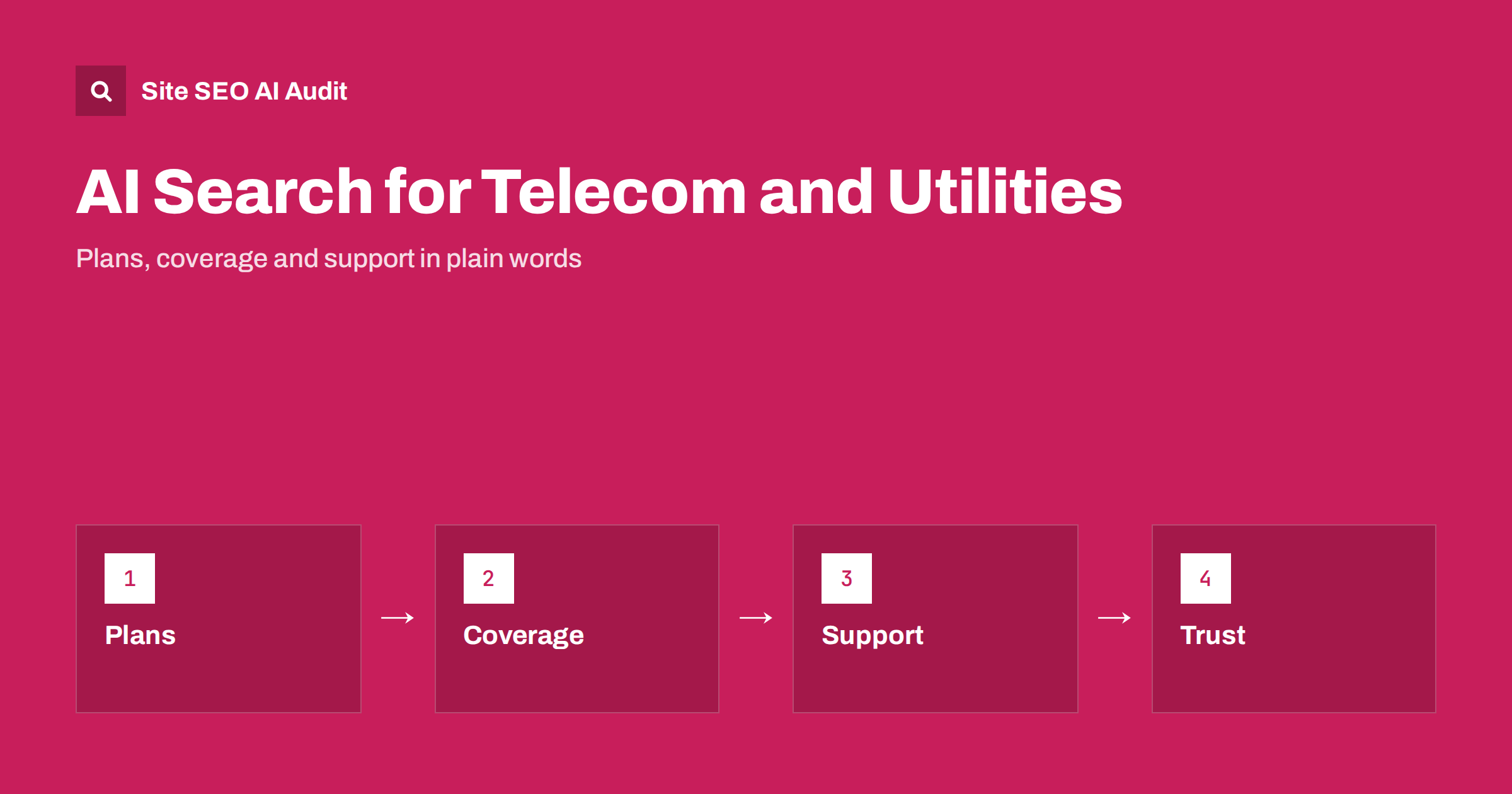
Short answer: Telecom and utility providers appear in AI answers when their websites state plan details, coverage, contract terms and support steps in clear, current, easy-to-extract text. Give each product and service area its own page, show the conditions that matter, such as contract length, fees and availability, publish step-by-step help for common problems, keep information consistent across the site and external profiles, mark up pages accurately and make sure the crawlers you want can read them. Outdated or hidden terms lead to wrong answers and unhappy customers.
Internet, mobile, energy, water and other utility services are compared often and used daily. People ask assistants which plan suits a family, whether a service is available at an address, how to read a bill, what to do during an outage or how to switch provider. The answers shape which companies are considered and which are blamed for confusion. Providers have an advantage, because they hold the official facts. They lose it when those facts are buried in documents, images, or pages that change without notice. This guide explains how to publish them so that people and systems can use them. For the mechanics, see how AI search engines work.
Understand what customers ask
Questions fall into a few groups. Before buying, people ask about plans, speeds, data allowances, tariffs, contract length, setup fees, equipment and coverage. While using the service, they ask how to read the bill, how to change a plan, how to move house, how to fix a connection or how to report a fault. Before leaving, they ask about cancellation, notice periods and switching. Collect real questions from support tickets, chat logs, social media and the search queries that reach your site, then group them by topic and decide which page answers each one. A single page that tries to cover everything answers nothing well. A set of focused pages with clear titles is easier to read, to rank and to quote.
Describe plans and terms plainly
Give every plan or tariff a page with the facts in text near the top: what is included, the price and what it covers, the contract length, any one-off and recurring fees, how and when prices change, the conditions for promotions and how to cancel. Use a table where it helps comparison, for example for plan features, and keep it in HTML, not in an image or a downloadable file only. Put the date of the last update on each page and keep older terms accessible for existing customers who need them. Hidden conditions erode trust, and assistants that quote a headline price without the conditions create complaints. Honest, complete descriptions protect your brand. If regulation requires certain information, present it visibly and in plain language. The structure is similar to pricing page SEO.
Make coverage and availability clear
Availability is a core question. Publish coverage information that can be read without a login: the regions, towns or postcodes you serve, the technologies available in each area and how to check an address. If you provide an address checker, make sure that the surrounding page explains in text what it does, which data it uses and what the results mean, and consider static pages for the main areas, because a tool that needs a form submission cannot be read by crawlers. State limits honestly, such as areas with partial coverage or planned expansion, and date such statements. Use unique, useful content for each area page rather than near-identical pages with only the place changed, a pitfall described in location pages and SEO.
Publish support content that solves problems
Support questions are among the most searched topics for this sector, and assistants often answer them. Write step-by-step help pages for the most common situations: restarting a router, checking signal, setting up a mobile profile, understanding a bill, submitting a meter reading, reporting an outage, moving home and changing a payment method. Start each page with the short answer, then give numbered steps, a note about what to do if the steps fail and a link to contact support. Add the product models and versions where instructions differ. Keep screenshots up to date and describe them in text. Treat these pages as a product, with an owner and a review date, as explained in help centre pages that AI answers can use. Make sure the help pages are reachable by crawlers and are not hidden behind a login or a script-only widget.
Keep outage and status information honest
During disruptions, people search for answers fast. Maintain a status page that gives the current state, the affected areas, the expected recovery time when known and the time of the last update, in text. Keep an archive of recent incidents. After an incident, publish a short, factual summary of what happened and what changed, which also helps customers decide whether to trust the service. Avoid vague wording and avoid deleting old status information when the problem is resolved, because a visible history shows reliability. Provide a clear path to emergency contacts for situations such as gas or electricity faults, where safety matters, and put safety instructions at the top of the page.
Use structured data and consistent facts
Structured data helps systems identify who you are and what the page is about. Mark up the organisation with its name, logo, contact points and official profiles, mark up help pages with the question and answer format where the visible content matches and use appropriate types for products or offers only when the page shows the same facts. Do not mark up prices or terms that are not visible on the page. Keep the company name, address, customer service numbers, opening hours and service areas identical on the website and in directories, maps and regulator listings. Guidance is in structured data and AI search and organization schema for AI search. Where different brands or subsidiaries exist, explain their relationship, so that systems do not mix them up, see brand name confusion in AI search.
Handle multiple languages and regions
Many providers serve several languages or regions with different plans and rules. Give each version its own address, set the language attribute and use hreflang annotations that reference each version. Make sure the plans, prices and legal terms on each page match the audience of that version, and avoid sending visitors automatically by location without a way to change. Translate support content carefully and keep the translations updated when the original changes, because stale translations are a source of wrong answers. See the hreflang tags guide and AI search in other languages.
Allow the right crawlers and keep pages fast
Review robots.txt, firewall and bot-protection rules, because large providers often use strict security that blocks crawlers by mistake. Decide which crawlers to allow for search and answers, and which to restrict, write explicit rules and test them from outside your network, as described in AI crawlers and robots.txt. Serve the main content in the HTML, keep customer account areas private and out of the index and make sure that large scripts or chat widgets do not block the content. Check speed on mobile networks, since many customers visit while troubleshooting from a phone, with a poor connection, see page speed and AI crawlers.
Monitor answers and correct errors
Ask a fixed list of customer questions every month: the best plan for a given household, availability in a named area, how to fix a common fault, how to cancel and how your company compares with others. Record whether you appear, whether the plan and price details are correct and which sources are cited. Correct errors at the source by updating your pages, add clarifying text where a misunderstanding repeats and monitor the sources that are cited instead of you. Use the guide to wrong information about your business when answers are inaccurate. Share recurring findings with your support and product teams, because unclear plans cause confusing answers.
Site SEO AI Audit crawls your site, checks status codes, titles, structured data, orphan pages, speed and AI crawler rules, and lists the fixes ranked by the points they add. The first audit of up to 200 pages is free; larger sites can see the pricing page.
Related reading
- AI Search for Finance and Insurance
- AI Search for Logistics and Transport
- AI Search for Government and the Public Sector
- FAQ Sections for AI Answers
The bottom line
Telecom and utility customers want accurate plans, honest terms, clear coverage and quick help. Publish each product, area and support topic on its own page, keep terms and dates visible, mark up pages truthfully, allow the crawlers you want and review the answers every month. Clear official information is the best defence against wrong answers.
FAQ
Should plan prices be published as text or in a downloadable file?
Publish them as text on the page, with the date and conditions. A downloadable file can be offered as well, but crawlers and people read text on the page more easily.
How can I show coverage without exposing a tool behind a form?
Add static pages for main areas that explain the technologies available, with a link to the address checker, so that the information can be read without submitting a form.
Do help pages matter for AI answers?
Yes. Many questions are about support, and step-by-step pages with clear titles, current screenshots and a review date are often the sources that assistants quote.
What if an assistant quotes an old price?
Update the source page and show its date, check third-party listings and add clear text about the current terms. Then re-check the answers over the following weeks.
Do I need hreflang if I serve several regions with different plans?
Yes, if the pages are versions of each other in different languages or for different regions. Use unique addresses, the correct codes and return links on every version.