ENEnglish
 LTLietuviškai
 DEDeutsch
 FRFrançais
 RUРусский
 ESEspañol
 PLPolski
 ITItaliano
 UKУкраїнська
 CSČeština
 PTPortuguês
 JA日本語
 LVLatviešu valoda
 ETEesti
 HUMagyar
 IDBahasa Indonesia
 TRTürkçe
 HIहिन्दी
 ELΕλληνικά
 ARالعربية
 THไทย
 VITiếng Việt
 RORomână
 MSBahasa Melayu
 BNবাংলা
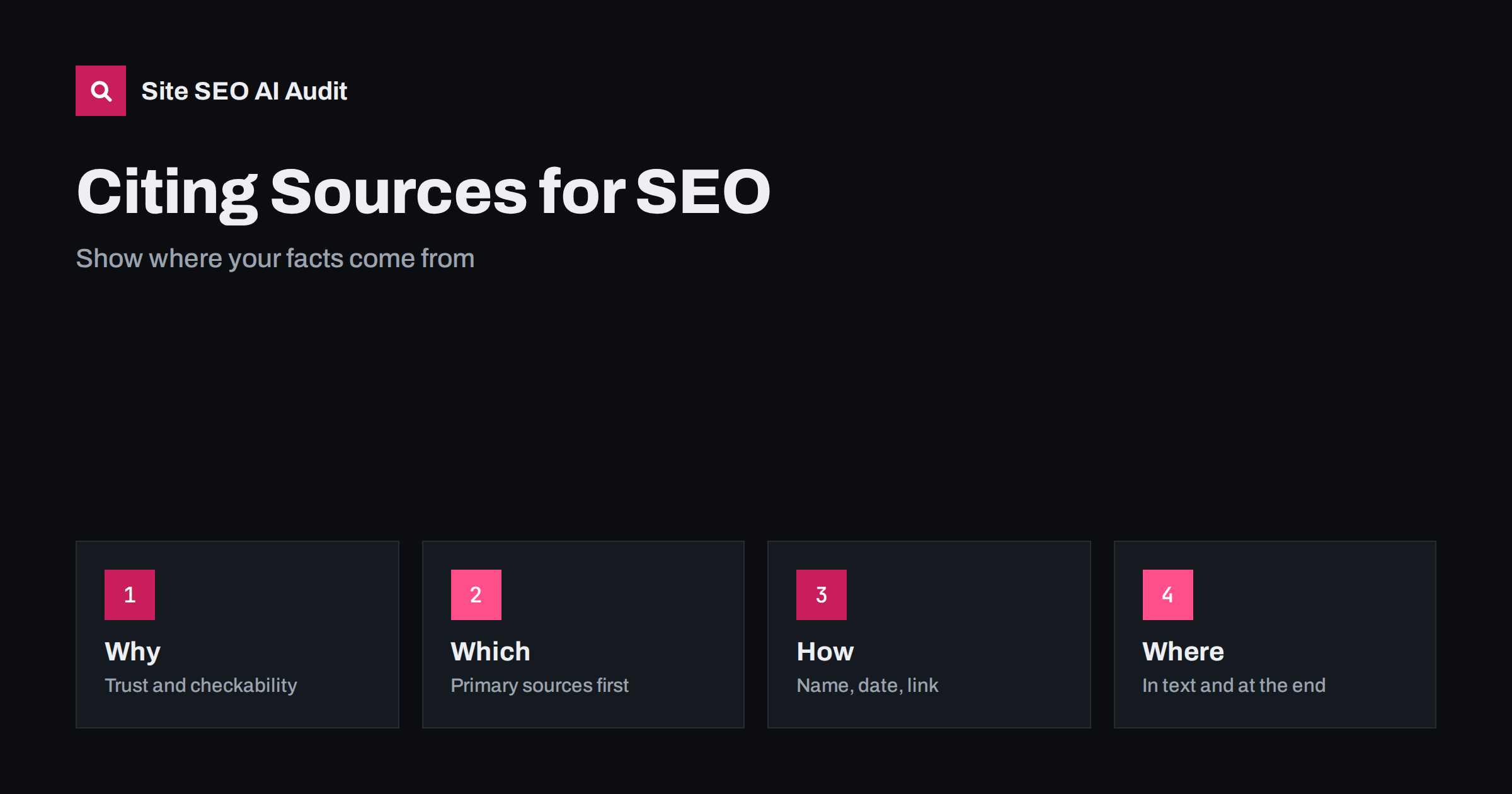
Short answer: Citing sources means telling readers where a fact, figure or claim comes from, ideally with the name of the source, the date and a link to the original. It makes content easier to verify, supports trust signals such as experience and expertise, and gives AI assistants clear statements to quote. Prefer primary sources, cite only what you have read, put the citation near the claim, avoid padding with irrelevant links, and keep references current. There is no fixed ranking bonus for outbound links, but credible, checkable content serves readers and search systems alike.
Readers have always trusted articles that show their evidence, and the habit matters more now that assistants summarise the web. A page that says a figure came from a named survey in a named year can be checked, quoted and corrected. A page that states the same figure without a source is a guess, and a careful system or a careful reader treats it as one. Many sites still publish confident claims with nothing behind them, or they scatter links that do not support the text. This guide explains why citations help, how to choose and present them and how to maintain them. For the wider idea of trust, see E-E-A-T and AI search.
Why citations matter for trust
A citation shows that the writer did the work. It lets a reader judge the evidence instead of taking your word, and it shows that you are willing to be checked. Search engines say that they evaluate the experience, expertise, authority and trustworthiness of content, and that trust is the most important of these. Citations are not a direct switch, and a link to a reputable source does not guarantee better rankings, but they are one visible way to demonstrate care, especially for topics where mistakes cost people money or health. Editors and journalists also prefer sources that make verification easy, which increases the chance that others cite you in return.
What needs a source
Not every sentence needs a footnote. Cite claims that a reasonable reader might doubt or want to check: statistics, research findings, legal or medical statements, quotations, dates of events, prices, product specifications and claims about what a company or authority said. General knowledge, your own experience and clearly marked opinions need no citation, though experience claims gain from detail. As a rule, if a number appears in your text, a source should be available. If you cannot find a reliable source, either remove the claim, soften it to what you can support or present it as your own estimate and explain how you made it.
Choose strong sources
Prefer primary sources: the original study, the official statistics, the law or regulation, the company’s own documentation, the standard or the dataset. Next come reputable secondary sources that report the primary one accurately. Weak sources include anonymous posts, pages that copy other pages and articles that give no evidence for their numbers. Check the date, the author and the method, and see whether other credible sources agree. Beware of circular citation, in which many pages repeat each other and none leads to the original. Follow the chain back until you find the first appearance, and cite that. For your own data, see original research and AI citations.
Write citations that are easy to check
A good citation contains enough information for a reader to find the source without searching: the name of the author or organisation, the title or description, the year or date, and a link where one exists. In running text, name the source in the sentence, for example by saying that a named agency reported a figure in a given year, and put the link on the descriptive words instead of on a phrase such as click here. Quote exactly when you quote, paraphrase honestly when you do not and never present a summary as a direct quotation. State the limits of the evidence when they matter, such as the sample size or the country, so that readers do not apply a finding more widely than it deserves.
Where to place references on the page
Put the citation as close to the claim as possible. For a handful of sources, links in the text are enough. For long articles with many sources, add a numbered reference list at the end, and link each number in the text to its entry, or use a short sources section under the relevant heading. Keep the format consistent across the site. If you embed a quotation or a chart, add a visible caption with the source. A reader should never have to guess which source supports which claim. If the page has an author and a last-updated date, readers also see who stands behind the statements and how fresh they are, as explained in author pages and bylines and content dates and freshness.
Handle outbound links correctly
Linking to sources is normal and healthy. Use ordinary links for sources you trust and cite on editorial grounds. Use the sponsored attribute for paid placements and the user-generated attribute for links in comments, as explained in the nofollow, sponsored and UGC guide. There is no need to mark every outbound link as nofollow out of fear that it loses value; doing so across the board signals the opposite of confidence. Open links in the same window unless there is a reason, check that each one works and avoid linking to competitors’ sales pages when a neutral source exists. The planning of outbound links is covered in the outbound links guide.
Be careful on sensitive topics
For topics that affect health, money, safety or legal status, standards are higher. Cite official, current and authoritative sources, name the reviewer or qualified author, show the date of the last review and avoid absolute promises. Separate general information from personal advice, and do not cite studies that you do not fully understand. If sources disagree, say so and explain which you trust and why. Assistants treat such topics with more care, and a page that shows its evidence has a better chance of being used. More on high-stakes subjects is in the guide to YMYL topics and AI search.
Keep references alive
Citations age. Links break, studies are replaced, statistics are updated and laws change. Schedule a review of your most valuable pages, check every link and replace outdated figures with current ones, noting the update date. When a source disappears, look for an archived copy or a replacement, or remove the claim. Maintain a short list of the sources you rely on most, so that updates are quick. Broken links in articles are a quality problem for readers and are easy to find with a crawl, as described in the broken links guide.
Common mistakes with citations
The most frequent mistake is the decorative link: a link added to a famous site only to look credible, though the page does not support the claim. Readers who click it notice, and trust falls. Another is the vague attribution, such as studies show or experts say, with nothing to check. Others include citing a press release as if it were research, quoting a figure from a summary that omits the conditions, using old data without a date, copying a citation from another article without opening the source and linking only to the home page of a publication instead of the exact page. Each of these can be avoided with a simple habit: open the source, read the part you rely on, record the title, date and address, and write the sentence so that it says only what the source supports. Put this habit in your editorial checklist, and ask reviewers to test a few links in every article before it is published.
It also helps to think about how citations look to a machine. A clear sentence that names the source, the year and the figure is easy to extract and attribute, while a paragraph of loosely connected claims with links at the end is not. When you write a key statistic, put the source in the same sentence, keep the figure and the context together and avoid splitting them across paragraphs. This habit makes your page more useful to readers who skim, to editors who reuse facts and to assistants that build answers from short passages.
Site SEO AI Audit crawls your pages like a search engine and checks broken internal and external links, links to redirects, titles, headings, structured data and the structure and dates that AI answers quote. It does not judge whether your sources are accurate, so fact-checking stays with you. The first audit of up to 200 pages is free; larger sites can see the pricing page.
Related reading
- Write Content That AI Answers Quote
- When AI Gets Your Business Wrong
- Readability and SEO Writing
- SEO Content Briefs for Writers
The bottom line
Cite what readers might doubt, prefer primary sources, name the source, date and link near each claim, label paid links properly and keep references current. Evidence is a trust signal for people and for AI answers.
FAQ
Do outbound links improve rankings?
There is no guaranteed bonus. Relevant, credible sources improve the reader’s experience and trust, which supports quality, but links alone do not rank a page.
Should I nofollow links to sources?
No, not by default. Use normal links for sources you cite editorially, and the sponsored or user-generated attributes where they apply.
How many sources should an article cite?
As many as its claims need. Every statistic or checkable claim should have a source, but adding links for decoration only weakens the page.
Can I cite my own data?
Yes, if you explain the method, sample and date. Original data is valuable when others can check how you produced it.
What if I cannot find the original source?
Remove the claim, soften it or label it as an estimate. Do not cite a source you have not read.