ENEnglish
 LTLietuviškai
 DEDeutsch
 FRFrançais
 RUРусский
 ESEspañol
 PLPolski
 ITItaliano
 UKУкраїнська
 CSČeština
 PTPortuguês
 JA日本語
 LVLatviešu valoda
 ETEesti
 HUMagyar
 IDBahasa Indonesia
 TRTürkçe
 HIहिन्दी
 ELΕλληνικά
 ARالعربية
 THไทย
 VITiếng Việt
 RORomână
 MSBahasa Melayu
 BNবাংলা
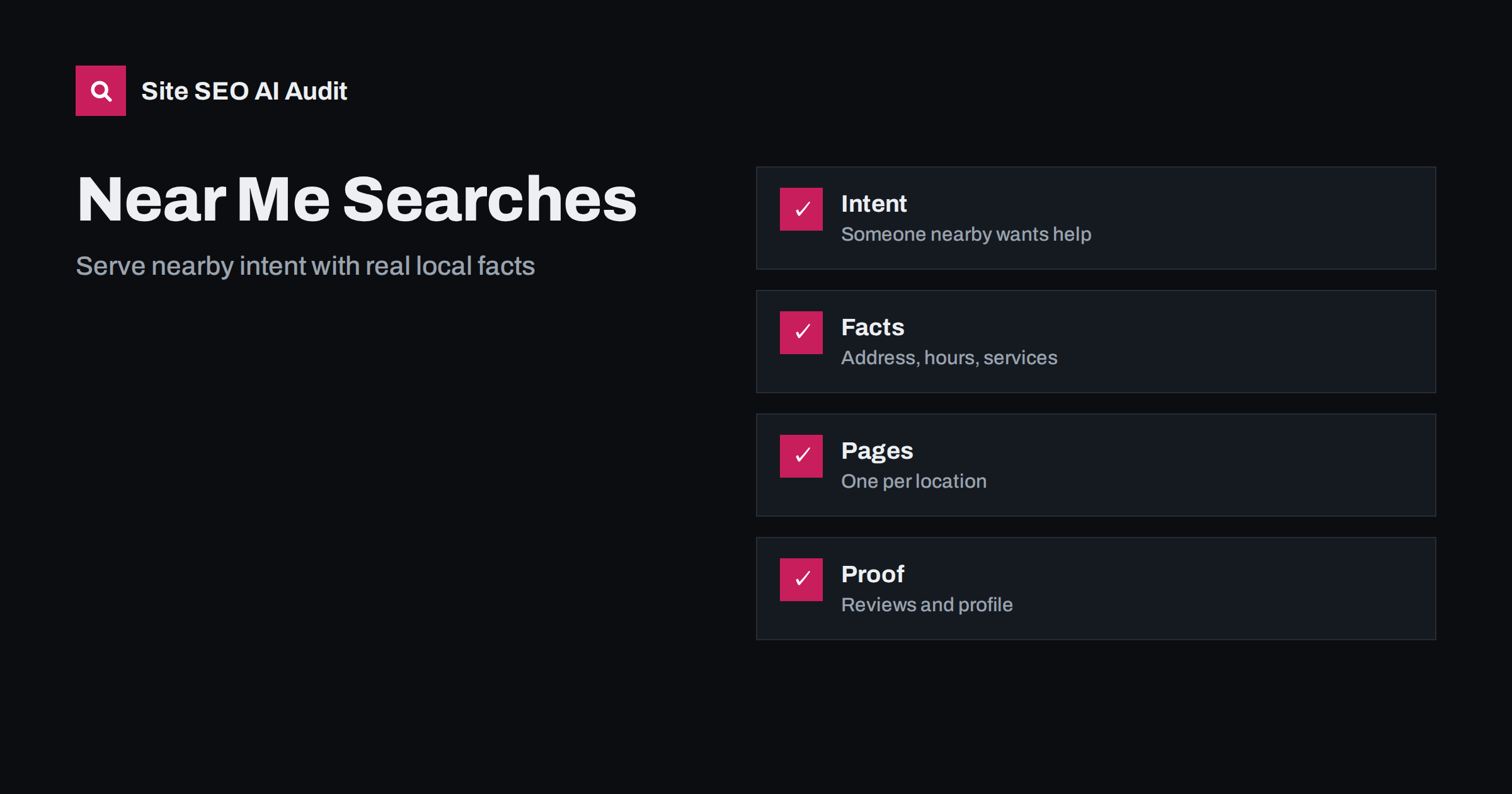
Short answer: People who type near me, or ask an assistant for something nearby, rarely mean the words literally. They expect the engine to use their location and show relevant businesses close by. You cannot rank for a phrase that has no place in it, so you serve this intent by being clearly relevant, easy to locate and trusted: accurate business profile data, location and service pages with real local detail, correct hours and contact information, consistent facts everywhere and honest reviews. Repeating near me on a page does not help.
Near me searches are common in everyday life: coffee near me, urgent care near me, bike repair open now. They are often made on a phone and often close to a decision. A business that is found at that moment can win a visit within minutes. Many site owners respond by adding the words near me to titles and paragraphs. This rarely works and often reads badly. The search engine already knows where the person is; what it needs from you is evidence that you are relevant to the need, that you are close and that you can be trusted. This guide explains how to provide that evidence. The wider local picture is described in the guide to local business and AI search.
What the search really asks for
A near me query combines three things: a need, a place and a moment. The need is the service or product. The place is derived from the device, the account or a nearby address. The moment may be urgent, such as open now, or leisurely, such as a weekend plan. Different needs call for different answers. Someone who searches for a pharmacy wants the closest open one. Someone who searches for a wedding venue is researching, and will compare options across a wider area.
Because the place comes from the searcher, there is no single near me page that can serve every city. The result depends on where each person stands. That is why it is more productive to think about each location you serve than about the phrase. Understanding the type of intent is the starting point, as explained in the guide to search intent.
Relevance, distance and prominence
Local results are usually explained by three ideas: how well a business matches the need, how far it is from the searcher and how well known or trusted it is. You cannot change the distance, but you can influence the other two. Relevance comes from clear categories, service descriptions and content that match what people look for. Prominence comes from your reputation online: reviews, mentions, links, the completeness of your profile and the quality of your site. A very close business with an empty profile can lose to a slightly farther one with complete and trusted information.
The practical lesson is to build the strongest possible evidence for each location rather than chase a keyword. A nearby customer who cannot find your opening hours or your service list will go elsewhere, and so will an assistant that cannot verify them.
Get the business profile right first
For many near me results, the business profile on maps and local listings matters more than the website. Check the name, the address, the phone number, the categories, the service list, the opening hours including holidays, the website link, the photos and the attributes such as parking or accessibility. Keep the data identical to what your website shows. Differences in how the address is written or in the hours confuse systems that compare sources. The process of keeping them aligned is described in the guide to business profile and website alignment.
Update special hours before holidays, not after. An open now result that turns out to be wrong creates a bad review and teaches the system that your data is unreliable.
Build a page for each location and service
If you have several locations, give each its own page with a unique address, a map, directions, parking, opening hours, the local team and the services offered there. Avoid copying one template and only swapping the town name. Add details that only someone who knows the place would write, such as the nearest landmark, public transport stops or the entrance. A weak page with a changed name is a typical thin page, and the advice on how to avoid it is in the guide to location pages.
If you serve customers at their address, describe the area you serve honestly, with the towns or districts you actually cover and typical travel times, and avoid listing hundreds of places in a block of text. Link each service to its own page, as in the guide to service page SEO. For businesses working in several countries, add the points in the guide to multi-country local SEO.
Use structured data and clear text for the key facts
Show the address, the phone number and the hours as normal text on the page, not only in an image or a script. Add LocalBusiness markup that matches the visible content, following the guide to LocalBusiness schema. Put the telephone number in a link that works on mobile and make the directions link easy to tap. Many near me visitors are on a phone, so the page must load fast and be usable with one hand, as covered in the guide to mobile usability.
Do not add schema for things that are not visible or true, such as opening hours that you do not keep or ratings that you do not display. Mismatches reduce trust and may cause the markup to be ignored.
Earn reviews and local trust signals
Reviews are a major part of prominence. Ask real customers to leave honest reviews, make it easy by sending a direct link, and respond to each review with courtesy. Mention specific services and places naturally in your replies, but do not stuff them. Show recent reviews on your own site with proper attribution. Avoid buying or inventing reviews, which can lead to penalties and damages trust. See the guide to reviews and reputation and the guide to local trust signals.
Mentions in local news, associations, schools or charities also help. They are signs that the business is part of the community, and they often come with links that are worth more than a pile of directory entries.
Cover the questions behind the search
A person who searches for something nearby usually has a follow-up question before they set out. Is it open now? Do I need an appointment? Can I park? Is there a step at the door? Does it accept walk-ins, cards or a certain insurance? Is it suitable for children or pets? Put these answers where they are easy to find, near the top of the location page and in the profile attributes. A short block of facts with plain labels is easier for both people and machines to read than a long story.
Think also about the situations that make people search in a hurry: a broken item, a sudden need, bad weather or a late hour. If you offer an emergency or same-day service, say exactly what it covers and when, without exaggeration. If you cannot help at once, state your normal waiting time. Honest expectations bring better reviews and fewer wasted calls.
Review your phone and message flow as well. If a visitor taps the number and nobody answers during the hours you list, the effort spent on visibility is lost. Make sure the opening hours on the page are the same hours at which the phone is answered, and offer a simple form or a messaging option for after-hours questions.
Think about voice and assistant questions
Many near me questions are spoken: where is the nearest open pharmacy, find a plumber who can come today. Assistants answer from maps data and from pages that state the facts clearly. Short, direct statements work better than marketing copy, for example: we are open until 21:00 on weekdays, the entrance is on the left side of the building, and there are six parking spaces. The approach is related to the guide to voice assistants and AI search.
Measure what happens
Track calls, direction requests, clicks to the site and visits by location. Compare them by month and by location, and look for patterns: which locations gain, which lose, which services bring the most contacts. Search Console shows queries that include place names and may show variations of near me, though the actual location of each searcher is not shown. Use the data to decide where to improve the pages or the profile, and avoid drawing conclusions from a few days of numbers.
Site SEO AI Audit crawls your website and checks status codes, titles, descriptions, headings, broken links, structured data, duplicate content, page speed and AI visibility settings, which helps you find weak or duplicated location pages. It does not manage your business profile or listings. The first audit of up to 200 pages is free, and larger sites can see the pricing page.
Related reading
The bottom line
Do not chase the phrase; be the clearest, most accurate and most trusted answer near the searcher.
FAQ
Should I put near me in my title tags?
No. The phrase has no fixed place, and it reads poorly. Use your real service and the actual area you serve.
Why does my business appear for some people and not others?
Local results depend on the searcher’s location, so two people at different places see different lists.
Is the website or the business profile more important?
Both matter. The profile often drives the first result, and the website provides depth, proof and a place to convert the visit.
Do I need a page for each town I serve?
Only if you can add real local content. Thin pages that change only the town name add little and can harm quality.
How quickly can I see results?
Profile fixes can show quickly, while reviews and local reputation grow over months. Avoid expecting a fixed timeline.