ENEnglish
 LTLietuviškai
 DEDeutsch
 FRFrançais
 RUРусский
 ESEspañol
 PLPolski
 ITItaliano
 UKУкраїнська
 CSČeština
 PTPortuguês
 JA日本語
 LVLatviešu valoda
 ETEesti
 HUMagyar
 IDBahasa Indonesia
 TRTürkçe
 HIहिन्दी
 ELΕλληνικά
 ARالعربية
 THไทย
 VITiếng Việt
 RORomână
 MSBahasa Melayu
 BNবাংলা
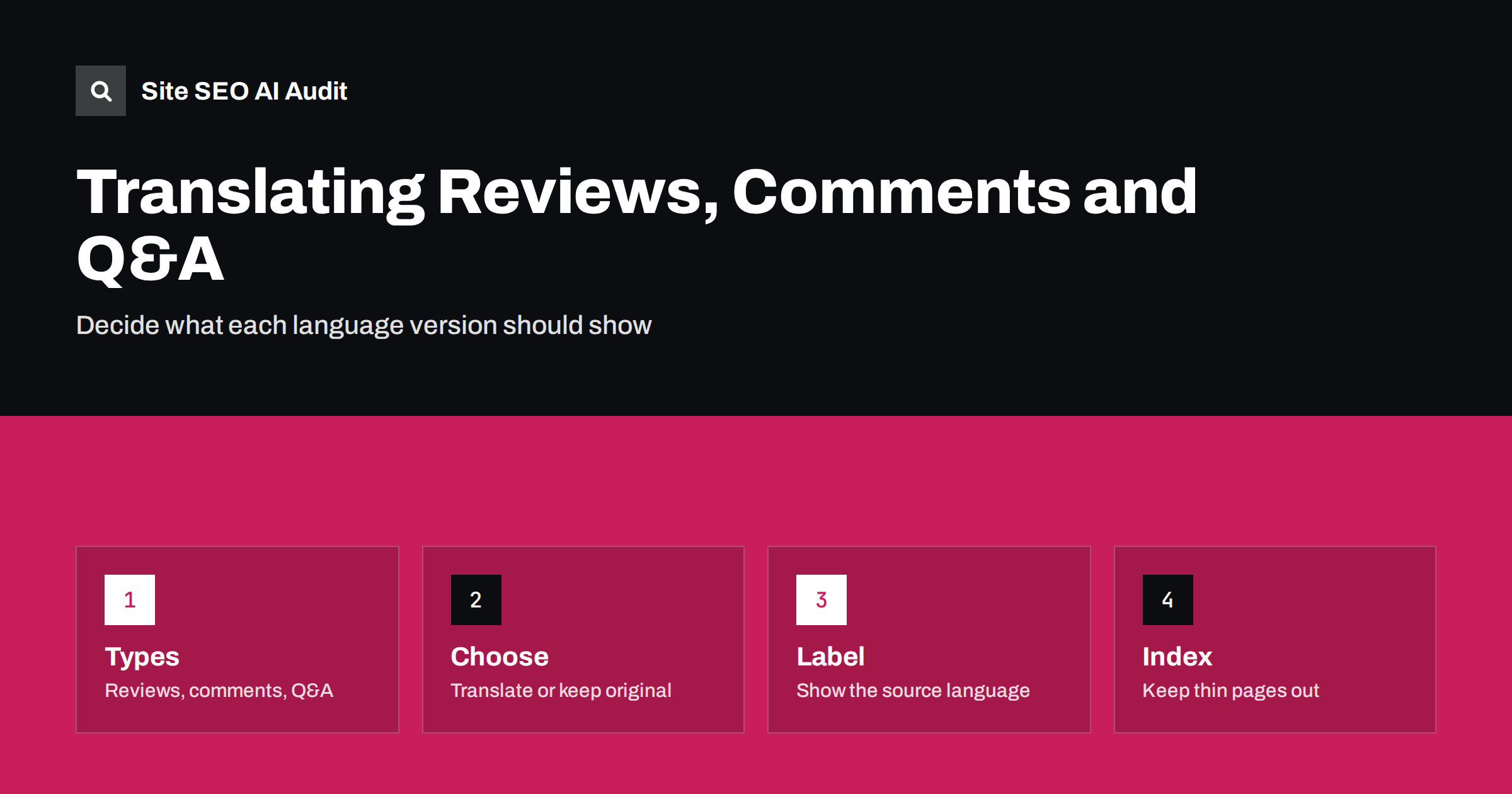
Short answer: Translate user-generated content only when it helps readers of that language and you can do it accurately. Reviews and questions that carry facts about the product are good candidates; casual comments and long threads usually are not. Keep the original text, label machine translations clearly, do not alter the meaning of a review, and do not create indexable pages whose only content is a pile of translated comments. Each language version should stand on its own without relying on borrowed text.
On a multilingual shop or service site, customer reviews, comments and question-and-answer sections can be a large share of the text on a page. They add fresh content and trust, but they usually arrive in the language of the customer. Should a French page show a German review, a translation or nothing at all? The answer affects trust, legal safety and search results. This guide helps you decide, building on the guide to comments and reviews and machine translation and SEO.
Know what counts as user-generated content
The term covers product and service reviews, star ratings, blog comments, forum threads, questions and answers on product pages, testimonials sent by email and social posts embedded on pages. They differ in value. A detailed review that mentions sizing or battery life helps a buyer in any language. A comment that says thanks adds little. A forum thread of fifty replies may be useful in the original language and unreadable in a rough translation. Sort the content by how much it helps a reader who has not seen the original, and decide each type separately.
Start with the reader, not the search engine
Ask what a visitor on the Spanish version of a product page needs. They want to know how real buyers rate the item and what problems were reported. A short summary of the main points of reviews, translated carefully, may serve them better than a long list of raw text. If the shop has many reviews in the local language already, show those first. If there are none yet, a clear note that the reviews come from customers of the international shop is more honest than hiding the origin. Search engines reward pages that help people, and padding a page with translated filler does not.
Translate the useful, summarise the rest
For reviews, translate those that contain concrete, factual points and show them in a separate group with a label such as “translated from German”. For questions and answers, translate pairs that help buyers decide and that are likely to stay true. For long threads, write a short summary in each language by a person who understands the topic. Never change the meaning, remove criticism or invent praise, because that moves from translation into manipulation and can break consumer protection rules. Keep an eye on personal data: do not publish a translated version that shows names or details people did not agree to share in that form.
Label automatic translations honestly
If you use machine translation, say so near the text, offer a link to the original and give readers a way to report a poor translation. Let people see the original text on request. A quick visual cue, such as a small note or a toggle, builds trust. Use a quality check for key phrases such as product names, measurements and warnings, where a mistake could cause harm. Do not present machine output as written by the customer. Keep the original language marked in the markup so that tools know what each block is.
Handle ratings and structured data carefully
Review markup must reflect reviews that are visible on the page and that come from real customers. Do not copy the ratings of the English page to every language version unless the same reviews are shown there. If you show an aggregate rating, the number of reviews and the average must match what the visitor sees. Do not mark up translated reviews as if they were written in the target language by local customers. Follow the rules of the search engine for review snippets, and leave the markup out where you are not sure. The guide to review schema and star ratings lists the main rules.
Decide what to index
A page made mostly of translated comments is thin content with little original value. Keep community content on the main page where it supports the content around it, and avoid creating a separate indexable page for each translated thread or each translated review. If you offer a page for all reviews, give it a clear purpose, a summary and a sensible structure, or keep it out of the index. Use canonical tags and noindex with care, and remember that hreflang pairs should connect pages that are real equivalents. See the thin content guide for how to judge a page.
Respect language, law and platform terms
Check the terms under which customers submit content. Some platforms and review services do not allow reuse or translation outside their widgets. Privacy rules may limit how names and personal details can be shown. Some countries have rules about how reviews are collected, labelled and moderated, including a ban on fake reviews and on hiding negative ones. Ask a lawyer where the stakes are high. Keep moderation consistent across languages: if you remove abusive comments in one language, apply the same standard in all of them, and keep records of what was removed and why.
Plan the workflow
Treat translated community content as an ongoing process. Decide who selects what is translated, who checks it and how often it is updated. Make sure that new reviews reach every language version without breaking links, and that deleted reviews disappear everywhere. Agree on a short style guide for the tone and key terms, and share it with translators. The routines described in keeping translations in sync apply here as well: a stale translation of a review that has been edited or removed is worse than no translation at all.
Think about how readers move through the site. A visitor who arrives from a search in Italian expects the page, the navigation and the proof of quality to speak Italian. If the product page has local content but the reviews appear in a mix of languages without labels, the page feels unfinished. A simple filter that lets readers choose reviews in their language, with a clearly labelled option to see all, solves that for many sites without extra translation work. Show how many reviews exist in each language so the choice is honest.
Measure what happens. Compare conversion rates, time on page and support questions for language versions before and after you add translated community content. Look for complaints about bad translations, and check Search Console for the queries that bring visitors to those pages. If translated text brings traffic but not sales, it may attract the wrong queries; if it lowers sales, readers may distrust it. Adjust accordingly. A small, careful set of useful translated content nearly always beats a large automatic dump.
A practical example helps. Suppose a camera shop sells in English, German and Polish. The English product page has two hundred reviews, the German page has thirty and the Polish page has five. Showing only five reviews on the Polish page may look weak, yet copying two hundred untranslated English reviews would be overwhelming. A balanced solution is to show the five local reviews first, add a short translated summary of the most common points from all markets, such as image quality and battery life, and offer a link to read more reviews in other languages. The page stays honest, readable and useful, and it avoids the risk of misleading anyone about who wrote what.
Questions and answers need similar care. A question about whether a lens fits a certain body is valuable in every language, so a translated and verified answer can be shown on each version, labelled with its source. A question about delivery to one country is relevant only there and should stay on that version. Have an editor review translated answers for facts that depend on the market, such as prices, taxes, warranty and delivery times, because a correct statement in one country can be wrong in another. Remove or update translated answers when the original changes.
Finally, think about moderation across languages. Spam and abuse arrive in every language, and a moderation team that reads only one language will miss most of it. Decide how you will review comments in each market, use automatic filters as a first step and keep a clear policy for removal that is applied equally. Spam links in comments can harm trust and rankings, so use the nofollow or ugc attribute on links in user content and consider holding first-time commenters for review.
Site SEO AI Audit crawls your site and checks hreflang annotations, language attributes, thin and duplicate pages, titles, structured data and broken links across your language versions, so you can see where community pages are weak or poorly connected. It does not judge the quality of translations or the truth of reviews. The first audit of up to 200 pages is free; larger sites can see the pricing page.
Related reading
- Untranslated Pages: What to Do on Multilingual Sites
- Structured Data on Multilingual Sites
- What Is hreflang? A Plain-English Guide
The bottom line
Translate user-generated content selectively, label it honestly, keep ratings and markup truthful and avoid thin pages built from translated comments, so every language version earns its place.
FAQ
Do I have to translate every review?
No. Translate the ones that help buyers, summarise the rest and show local-language reviews first where you have them.
Is machine translation of reviews acceptable?
It can be, if it is labelled, the original is available and key facts are checked. Do not present it as written by the customer.
Can I copy star ratings to other language versions?
Only if the same reviews are visible on each page. The markup must match what the visitor can see.
Should translated comments get their own pages?
Usually not. Pages made only of translated comments are thin and rarely help searchers.
Who owns the content customers post?
Check your terms and local law. Translating or reusing reviews may need a licence or permission.