ENEnglish
 LTLietuviškai
 DEDeutsch
 FRFrançais
 RUРусский
 ESEspañol
 PLPolski
 ITItaliano
 UKУкраїнська
 CSČeština
 PTPortuguês
 JA日本語
 LVLatviešu valoda
 ETEesti
 HUMagyar
 IDBahasa Indonesia
 TRTürkçe
 HIहिन्दी
 ELΕλληνικά
 ARالعربية
 THไทย
 VITiếng Việt
 RORomână
 MSBahasa Melayu
 BNবাংলা
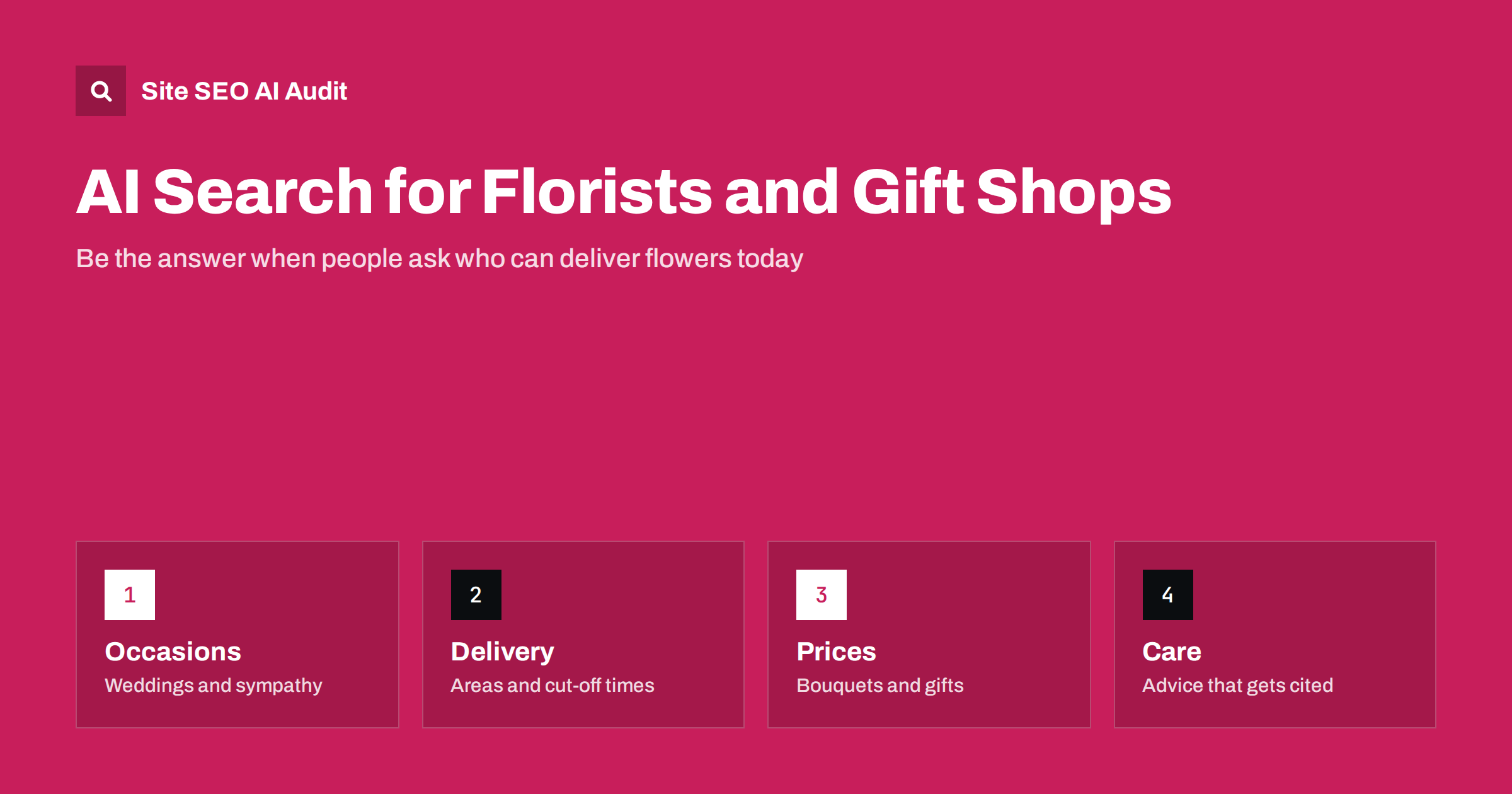
Short answer: People now ask assistants questions such as “who can deliver a bouquet this afternoon”, “what flowers suit a sympathy card” or “where can I order a gift basket for Saturday”. To be named in the answer, a florist or gift shop needs clear pages for each occasion, exact delivery areas and cut-off times, visible prices, short care advice and honest reviews, all readable without scripts. Accurate local details matter more than long marketing text.
Flowers and gifts are bought under time pressure and for emotional reasons, which makes the questions people ask very specific. A customer wants to know whether you deliver to a hospital, whether same-day orders are possible after lunch and how much a modest bouquet costs. AI assistants and AI search features try to answer these questions in one reply, and they favour businesses whose websites state the facts plainly. This guide explains what to publish and how to keep it correct. For the wider picture, start with the guide to local business AI search.
What people ask about flowers and gifts
Questions usually combine an occasion, a place and a deadline: “same-day flowers in the city centre”, “funeral wreath delivery tomorrow”, “birthday gift for a colleague under a modest budget” or “which flowers last longest in a vase”. Collect real questions from phone calls, messages and the notes customers write at checkout. Those notes are valuable because they show the exact words people use for situations such as a hospital ward, a wedding venue or a retirement party.
Group the questions into four themes: occasion, delivery, price and care. Each theme should have its own page or clearly marked section, so a retrieval system can find the passage that answers one question without reading everything on the site.
Look also at the questions that come before the purchase. People ask what to write on a card, how much is reasonable to spend on a colleague or a teacher, and which flowers carry a particular meaning in their culture. A short advice page on each of these themes brings you readers who are about to order, and it shows the experience that assistants look for when they decide whose advice to repeat.
Build a page for every occasion
Create separate pages for weddings, sympathy and funerals, birthdays, anniversaries, new babies, corporate orders and seasonal peaks such as Valentine’s Day or Mother’s Day. Open each page with a short answer: what you offer for that occasion, typical price range, how far ahead to order and how delivery works. Then add details such as popular choices, colours and cards.
Sympathy orders need particular care. Use a calm, respectful tone, explain how to address a funeral home or a family, and state the latest time you can deliver to a ceremony. Wedding pages should explain consultations, what a quote includes and how far in advance dates book out. Avoid vague promises; a sentence such as “We can usually arrange a consultation within a week” is only useful if it is true.
Publish delivery areas, times and cut-offs
Delivery is the most common reason a customer chooses one shop over another, so make it impossible to misread. List the towns, districts or postcodes you serve, the delivery fee for each zone, the cut-off time for same-day orders and what happens on Sundays and public holidays. Say whether you deliver to hospitals, offices and cemeteries, and whether the recipient must be present.
Keep a separate, plain page for this information and link to it from product pages and the checkout. If the cut-off changes in busy weeks, update the page the same day. An assistant that quotes an outdated cut-off sends a disappointed customer to you, and an angry review follows.
Show prices and what is included
Flowers are sold by description, so state what is in a bouquet: the main stems, approximate stem count, wrapping and whether a vase or card is included. Show the price on the page, not in an image. For arrangements that depend on the season, explain that substitutions of similar value are made and how you tell the customer.
Use Product structured data with accurate name, image, price, currency and availability, following the principles in the guide to product pages and AI shopping. Gift shops with many items should group them by recipient and budget, for example “gifts for a new home” or “small thank-you gifts”, because that is how people phrase their searches.
Write care advice that answers real questions
Short care guides are among the most citable content a florist can publish. Explain how to cut stems, how often to change water, which flowers last longest and what to keep away from fruit or heaters. Write each tip as a clear sentence with a reason, and add a simple table if you compare flower types. Name a plant by its common name and, where useful, by its botanical name.
| Topic | What to explain |
|---|---|
| Cut flowers | Trimming, water changes, expected vase life, placement |
| Potted plants | Light, watering, repotting, pet safety |
| Wedding flowers | Storage before the event, timing, buttonholes and corsages |
| Gifts | Allergies, food contents, shelf life, returns |
Only give safety advice you can stand behind, such as which plants are harmful to cats. If you are unsure, say so and suggest consulting a vet.
Get the local details exactly right
For every shop, publish the address, map link, phone number, opening hours including holidays, parking notes and a photo of the entrance. Mark the page with local business structured data and keep it identical to your business profiles on maps and directories. Inconsistent opening hours are one of the most common reasons assistants hedge or leave a business out.
If you deliver from a workshop that customers cannot visit, say that clearly and describe where you operate, so nobody travels to a closed door. Collection points and partner pickup locations deserve their own short section, and so does any wheelchair access or parking information that helps a visitor plan the trip.
Reviews, trust and policies
Customers want proof that flowers arrive fresh and on time. Invite feedback after delivery, respond politely to complaints and never buy or fake reviews. Quote a few genuine comments with permission, and link to the review source. The way reputation influences recommendations is explained in the article on reviews and AI recommendations.
State your freshness promise, substitution policy, refund conditions and what you do when a recipient is not at home. Clear policies reduce disputes and give assistants safe, specific facts to quote.
Plan for seasonal peaks and corporate orders
Florists earn a large share of their year in a few days: Valentine’s Day, Mother’s Day, graduation season and the weeks before winter holidays. Create a page for each peak well before it starts and keep the same address every year, so the page can build a history instead of starting from zero. State the order deadline, the limited menu you offer in peak week, any delivery windows and how substitutions work when a flower is scarce. After the peak, update the page rather than deleting it, and note when ordering reopens.
Businesses that buy flowers regularly, such as hotels, restaurants, offices and funeral homes, ask different questions: invoicing, standing orders, delivery to reception and a named contact. A short corporate page that explains these points, with the minimum order and typical lead time, answers them and brings in repeat customers. Gift shops can do the same for corporate gifts, with quantities, branding options and delivery to several addresses.
Pictures matter too, because customers judge a bouquet by its photograph. Use original photographs taken in daylight and show the arrangement from more than one side. Give each image a descriptive file name and alt text that says what it shows, such as “pink peonies and white roses in a hand-tied bouquet”, rather than “bouquet1”. Name products consistently across your site, your shop feed and your social profiles, because assistants match names across sources. If an arrangement changes with the season, show the current version and note that photos are examples.
Check that machines can read your shop
Many florist sites rely on pop-ups, scripts and image-based menus. Make sure delivery rules, prices and opening hours are real text in the HTML, that your robots.txt does not block AI crawlers you want to allow and that product pages load quickly on a phone. A crawl with Site SEO AI Audit shows blocked pages, missing descriptions, broken links and structured data errors, and the first audit of up to 200 pages is free.
Related reading
The bottom line
Publish exact delivery rules, visible prices and calm occasion pages, keep local details consistent and let genuine reviews carry the trust.
GYIK
Should a florist show prices online?
Yes. Show a price or a clear range for each bouquet and gift, with what is included. Prices that exist only in images or on request are hard for assistants to quote.
How do I show same-day delivery to assistants?
Put the cut-off time, delivery zones and fees in plain text on a dedicated delivery page and link to it from product pages. Update it whenever the rules change.
Do I need a separate page for sympathy flowers?
Yes. Sympathy orders involve different questions, such as timing for a ceremony and wording on a card, so a dedicated, respectful page answers them better than a general page.
Which structured data suits a flower shop?
Use local business markup for each shop and Product markup for items with price and availability. Everything in the markup must match the visible page.
How often should I review my pages?
Check delivery rules, opening hours and prices before every seasonal peak and whenever anything changes. A short monthly review is enough for the rest of the year.