ENEnglish
 LTLietuviškai
 DEDeutsch
 FRFrançais
 RUРусский
 ESEspañol
 PLPolski
 ITItaliano
 UKУкраїнська
 CSČeština
 PTPortuguês
 JA日本語
JA日本語 LVLatviešu valoda
 ETEesti
 HUMagyar
 IDBahasa Indonesia
 TRTürkçe
 HIहिन्दी
 ELΕλληνικά
 ARالعربية
 THไทย
THไทย VITiếng Việt
 RORomână
 MSBahasa Melayu
 BNবাংলা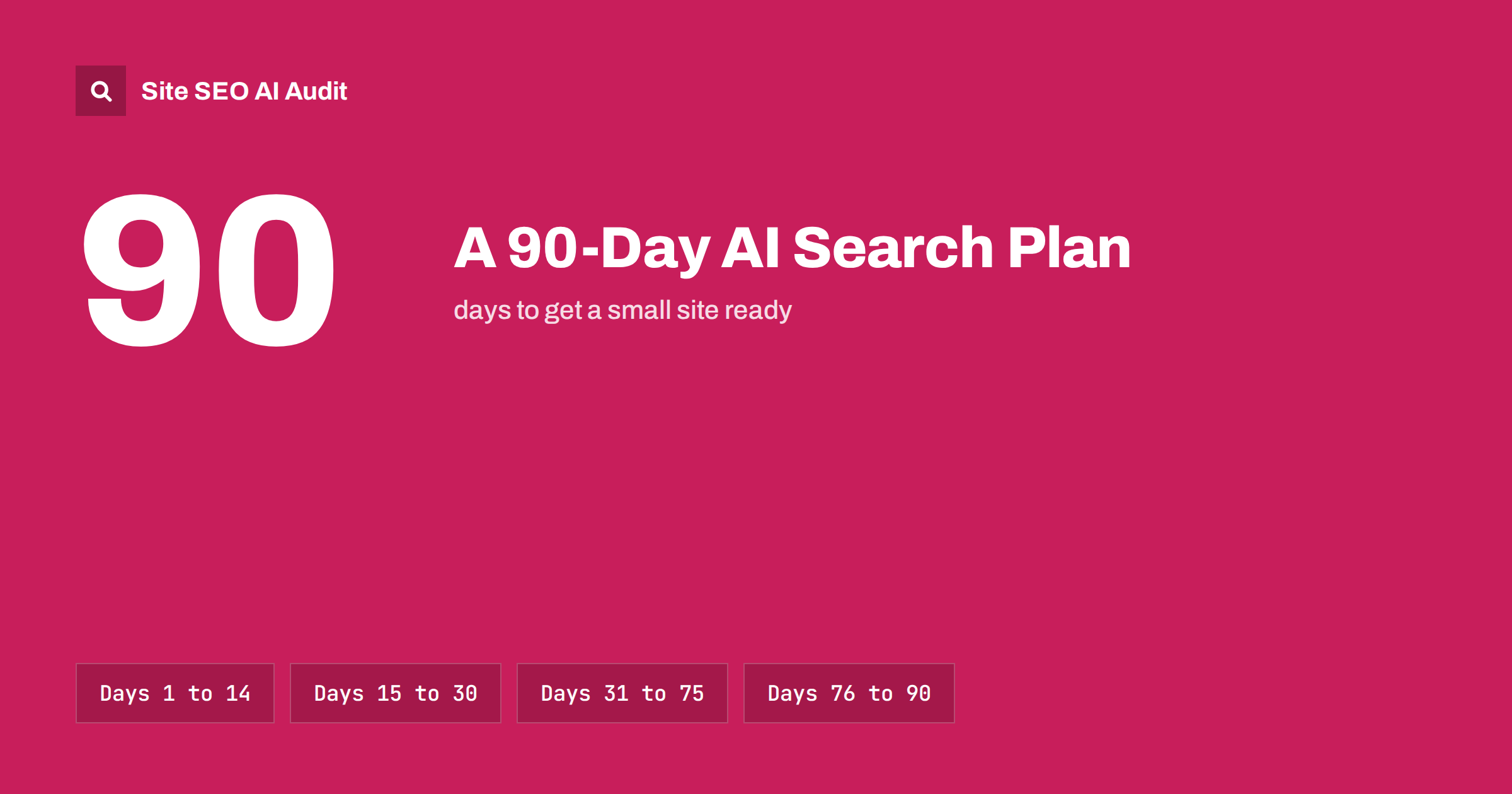
Short answer: A small business can get its site ready for AI search in about 90 days of part-time work. Spend the first two weeks making sure AI and search crawlers can reach and read the site, the next two weeks on indexing and technical basics, the following six weeks improving the five to ten pages that matter most and aligning your business facts across the web, and the last two weeks setting up measurement. Then repeat the cycle each quarter with smaller steps.
Before you start
This plan assumes a typical small business: a website with tens to a few hundred pages, one person responsible for it part-time, perhaps with help from a developer or agency for technical changes. It works for local service businesses, small shops and B2B companies alike, with small adjustments.
Prepare three things before day one:
- Access to your website admin, hosting control panel, CDN if any, Google Search Console, Bing Webmaster Tools and analytics.
- A list of your key pages: home, main services or product categories, pricing, about, contact and the three to five pages that bring most enquiries or sales.
- A fact sheet: your official business name, address, phone, hours, services and short description, written exactly as they should appear everywhere.
Keep a simple log of every change you make with its date. It will help you understand results later.
Days 1 to 14: make sure crawlers can get in
Access problems are the most damaging and the quickest to fix, so they come first.
- Read your robots.txt at yourdomain.com/robots.txt. Check whether it blocks any AI search crawlers such as OAI-SearchBot or PerplexityBot, and decide deliberately on training crawlers.
- Check your CDN and security plugin for AI bot blocking, aggressive rate limits or challenge pages.
- Look at server logs or ask your host whether AI crawlers receive errors.
- View the page source of your key pages and confirm that the main text, prices and contact details appear without JavaScript.
- Confirm search engine visibility is switched on in your CMS settings, especially if the site was recently rebuilt.
By the end of week two, you should know that nothing technical stops crawlers from reaching and reading your site.
If you find a block, fix it immediately and write down what you changed, where and why. Access fixes are the single biggest lever in this plan, and they are also the easiest to undo by accident during a later update.
Days 15 to 30: indexing and technical basics
Next, make sure your pages are in the indexes that AI systems use.
- Review the page indexing report in Google Search Console and fix unexpected exclusions.
- Verify your site in Bing Webmaster Tools, submit your sitemap and check coverage.
- Check that key pages are self-canonical and not marked noindex.
- Fix broken internal links and redirect chains on important paths.
- Make sure your XML sitemap lists only canonical, indexable pages.
- Check mobile loading speed on your key pages and fix obvious problems, such as huge images.
A full site audit speeds this phase up considerably, because it lists every issue with the pages it affects.
Keep a note of every issue you decide not to fix yet. Some problems are not worth the effort for a small site, and a written list prevents the same question from coming back every quarter.
Days 31 to 60: improve the pages that matter
Now turn to content. Work on five to ten key pages, not the whole site. For each page:
- Add a direct answer at the top: what you offer, for whom, where, and the most important condition or price.
- Restructure with descriptive headings that match the questions customers ask.
- Replace vague claims with specifics: service steps, time frames, prices or price ranges, areas served, requirements.
- Answer common follow-up questions in a short FAQ section, based on real customer questions.
- Add an author or responsible person and a visible updated date where the page gives advice.
- Remove or update outdated information, including old prices and discontinued services.
If you have time left, write one genuinely useful guide based on your own experience, such as the most common question customers ask before buying, answered properly.
Prioritise pages by business value, not by traffic alone. A service page that brings two enquiries a week matters more than a blog post that brings many visits but no customers.
Days 61 to 75: align your brand facts
AI answers draw on what the whole web says about you, not only your site. Use your fact sheet to align:
| Where | What to check |
|---|---|
| Google Business Profile, Bing Places | Name, address, phone, hours, categories, services, description |
| Social profiles | Name, description, website link |
| Directories and industry listings | Outdated addresses, phone numbers, former names |
| Review platforms | Listing details; a routine for asking customers for reviews |
| Your website structured data | Organization or LocalBusiness markup matching the fact sheet |
Also ask two or three AI assistants what they know about your business, and note any errors to trace and correct.
Do not rush this phase. Directory updates can take days to be approved, and some platforms require verification by phone or post. Start the requests early in the window and follow up at the end. Where you find duplicate listings for your business, ask the platform to merge or remove them rather than leaving several versions online.
Days 76 to 90: set up measurement
- Create an “AI assistants” channel in your analytics for visits from chatgpt.com, perplexity.ai, copilot.microsoft.com, gemini.google.com and similar sources.
- Write a list of twenty realistic customer questions and check them monthly in the main assistants, recording mentions, citations and errors.
- Add “AI assistant” as an option to any “how did you hear about us” question.
- Note your baseline: organic clicks and impressions, AI referrals, enquiries, and the results of your question checks.
Share the baseline with whoever makes decisions about the website. A one-page summary of where you started makes the next quarter’s conversation about progress much easier and far more concrete.
Common obstacles and how to handle them
Small businesses tend to hit the same obstacles along the way. Knowing them in advance keeps the plan on track:
- No access to the hosting or CDN account. Sites built by a former agency or freelancer often have accounts nobody can log into. Recover access early, because several steps depend on it.
- Nobody knows which plugin controls what. Make a list of installed plugins and their purpose before changing settings, and remove plugins nobody uses.
- Developer time is scarce. Group technical fixes into one request with clear priorities, rather than sending them one by one.
- Content work stalls. Ask the person who talks to customers every day for the ten most common questions, and write answers from their notes.
- Results feel slow. Look at leading indicators, such as crawler activity in logs, indexed pages and impressions, before expecting enquiries to change.
None of these obstacles is unusual, and none is a reason to abandon the plan. They simply mean some steps take longer than planned.
After 90 days: the quarterly routine
AI search work is not a one-off project. Each quarter, repeat a lighter version: recheck crawler access and robots.txt after updates, improve three to five more pages, review your business facts, rerun your question set and compare results with the baseline. Expect gradual change rather than sudden jumps; technical fixes can show effects within weeks, while content and brand improvements typically take months.
As a rough guide, the first cycle takes most small businesses a few hours per week. Later cycles take less, because the foundations are in place.
How Site SEO AI Audit helps
Site SEO AI Audit fits into days 1 to 30 of this plan. One crawl shows AI crawler access in robots.txt, content that depends on JavaScript, indexing problems, broken links, redirect chains, missing titles and headings, structured data errors and slow pages, ranked by how many points each fix adds. On WordPress, each issue comes with exact fix steps. Paid plans add re-audits for the quarterly routine; see the pricing page.
Related reading
- AI Search Visibility Checklist: 25 Things to Audit
- AI Search for Local Businesses: What to Fix First
- How to Measure Your Brand’s Visibility in AI Answers
- AI Search Readiness for WordPress: A Practical Setup
The bottom line
You do not need a large budget to prepare for AI search. Fix access and rendering first, then indexing and technical basics, then improve your most important pages, align your business facts and set up simple measurement. Ninety days of focused part-time work, followed by a light quarterly routine, puts a small business in a strong position.
GYIK
How much time does this plan take?
For most small businesses, a few hours per week over three months, plus some developer time for technical fixes. Later quarterly cycles take less time.
What if I can only do one thing?
Check that AI and search crawlers can reach your site and read your main content in the HTML. Access problems make every other improvement ineffective.
Do I need to rewrite my whole website?
No. Focus on five to ten pages that bring enquiries or sales. Improving them has far more effect than small changes to many minor pages.
When will I see results?
Technical fixes can show effects within weeks after recrawling. Content and brand improvements usually take several months, so compare results quarter by quarter.
Should I hire an agency for AI search?
Many small businesses can follow this plan themselves with occasional technical help. If you hire an agency, expect a clear audit, concrete fixes and honest measurement, not guaranteed placements.