ENEnglish
 LTLietuviškai
 DEDeutsch
 FRFrançais
 RUРусский
 ESEspañol
 PLPolski
 ITItaliano
 UKУкраїнська
 CSČeština
 PTPortuguês
 JA日本語
 LVLatviešu valoda
 ETEesti
 HUMagyar
 IDBahasa Indonesia
 TRTürkçe
 HIहिन्दी
 ELΕλληνικά
 ARالعربية
 THไทย
 VITiếng Việt
 RORomână
 MSBahasa Melayu
 BNবাংলা
Short answer: Broken link building means finding a page on another website that links to a dead URL, and politely suggesting your own relevant page as a replacement. It works only when you have a genuinely useful page that fits the missing resource, and the success rate is modest, so treat it as a slow, respectful tactic. Find broken links on relevant sites, check what the dead page used to contain, match it honestly, write a short helpful message and keep records.
Links remain one of the signals that search engines use to find and evaluate pages, and they also bring referral visitors. Yet most small sites have no budget for large campaigns and no desire to send hundreds of generic requests. Broken link building is attractive because it offers something to the other side: you help a webmaster remove an error from a page, and in return you suggest a useful replacement. This guide explains the method, where it fails and how to do it without spam. If you are still learning the basics, read the guide to link building for small sites first.
How the method works
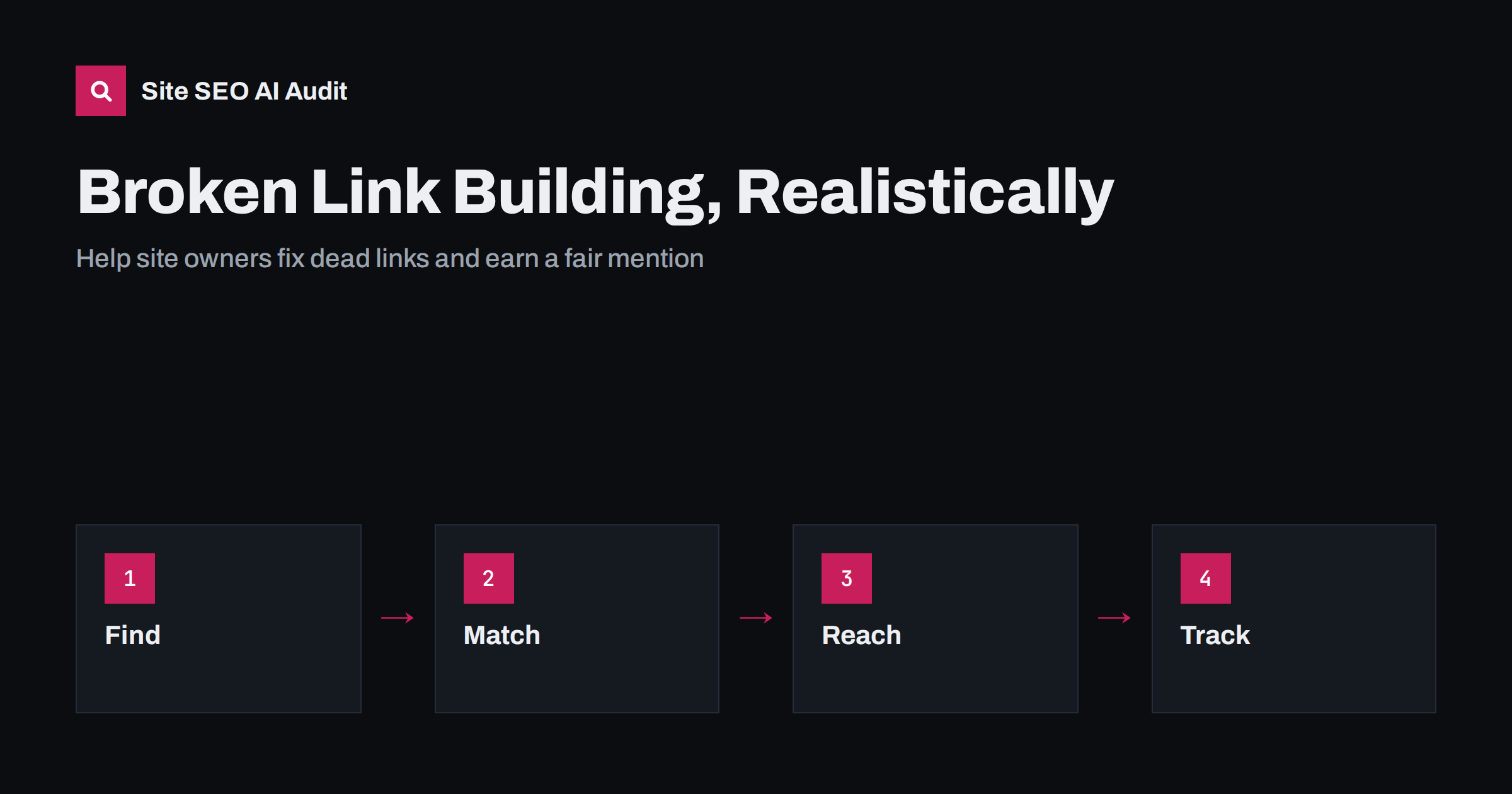
The idea has four steps. You locate a page that links out to a resource that no longer exists, you confirm the link really returns an error, you identify what the missing resource used to offer and you suggest your own page if it covers the same ground. If the site owner agrees, the dead link is replaced by a live one pointing to you.
The method is fair because everyone gains. The owner fixes a broken experience for their readers, the readers get a working link and you receive a relevant mention in a context where it makes sense. If your page does not fit, there is no reason to ask. Pushing an unrelated page onto a site is not broken link building; it is spam with an excuse.
When it is worth your time
It suits topics where resources come and go: industry guides, tools, statistics pages, local directories, event pages, studies and tutorials. These age, and companies close, merge or redesign their websites. It suits you when you already publish good reference content, or can create it, and when you have more time than money.
It is a poor fit if your content is thin, if your niche has few link-rich pages, or if you need quick results. Expect a small fraction of messages to produce a link, and several weeks before the first reply. A realistic goal for a small site is a handful of relevant links over a few months, not dozens in a week.
Find broken links on relevant pages
There are three practical routes. The first is to search for resource pages in your topic, with queries such as “useful links” combined with your subject, and to check each page’s outbound links with a link checker or a browser extension. The second is to use a backlink tool to find pages that link to a domain that has expired or a URL that now returns an error. The third is to look at your own competitors: if a competitor’s old guide has been removed and still has links pointing to it, your page may be a natural substitute.
Prefer pages that are alive, maintained and relevant to your readers. A dead link on an abandoned site that nobody reads will not bring value even if it is fixed. Check that the page is indexed and that the site shows signs of recent updates.
Check what the dead page contained
Before you write to anyone, find out what the missing page was about. An archive service that stores older copies of web pages can show the old content, and the anchor text of the link and the surrounding sentence reveal what the owner expected. Note the topic, the format and the main facts.
Then ask yourself honestly whether your page is as useful for the same purpose. If the old page was a free calculator and yours is an article about calculators, it is not a replacement. If it was a guide to a legal procedure and you have a current, accurate guide for the same procedure, it is a good match. When there is no suitable page, consider creating one. A strong replacement can attract links from many sites that pointed to the original, as long as the topic still matters.
Match the replacement to the context
| Situation | Reasonable action |
|---|---|
| Dead page was a guide, yours covers the same topic | Suggest your guide as a replacement |
| Dead page was a tool you do not offer | Do not pitch; suggest a different tool only if it is truly comparable |
| Domain expired, topic is still relevant | Offer a page that serves the same readers |
| Link points to a page that now redirects | Suggest updating to the new address, with no pitch |
The last row builds goodwill. Pointing out a link that goes to a redirect, without asking for anything, costs you a minute and may lead to a friendly reply and a future request.
Write outreach that respects people’s time
A good message is short and specific. Say who you are in one line, name the page and quote the broken link, say how you found it and add that you checked it returns an error. Then mention that you have a page on the same topic and give the address, leaving the decision to them. Avoid flattery, templates with the wrong name, false urgency and attachments.
Send one polite follow-up after a week or two, and then stop. Do not offer payments for links and do not pretend to be a reader who stumbled upon the error. Search engines treat paid or manipulative link schemes as a violation of their spam policies, as covered in the guide to Google spam policies, and honest outreach protects your reputation as well.
Prepare your own site first
Outreach sends people to your page, so make sure it deserves the visit. The page should load fast, be accurate and dated, have a clear author, and offer the information promised in your message. Check that it returns a normal status and is not blocked from crawling. A crawl with Site SEO AI Audit can reveal broken links, redirect chains and indexing problems on your own pages before you invite anyone to look at them, and the first audit of up to 200 pages is free.
It is also worth fixing your own broken outbound links. A site that keeps its references alive is more credible when it asks others to do the same.
Mistakes that waste time or damage trust
The most common mistake is mass sending. A list of three hundred addresses and a template with a changed first name produces few replies and can mark you as a nuisance. Ten carefully chosen targets usually beat three hundred random ones. Another mistake is exaggerating the match: calling your page “the perfect replacement” when it covers only a corner of the old topic. Webmasters notice, and they remember who wasted their time.
Do not ask for a link on a page that has no place for it, do not suggest replacing a working link with yours and do not use your message to hint at a payment. Do not chase the owner after a refusal. Finally, avoid measuring success only by the number of links. A mention in a respected publication that sends interested readers is more valuable than ten links on pages no one visits, and a friendly reply from a webmaster today may become a useful contact a year from now.
Keep in mind that the page you suggest should stay available. If you later move or delete it, set up a redirect so that the link keeps working, following the rules in the guide to 301 and 302 redirects. A link you earned with effort should not turn into the next broken link on someone else’s site.
Track results and learn
Keep a simple sheet with the target page, the dead link, the date, your proposed replacement, the reply and the outcome. After a few weeks, review which kinds of pages and messages worked. You will probably find that resource pages maintained by organisations and educators respond better than commercial blogs, and that short, specific messages do better than long ones.
Measure the effect with referral traffic and with the links report in your search tools, rather than by guessing. Remember that links are one signal among many, and a single link from a respected, relevant page is worth more than several from unrelated ones.
Related reading
The bottom line
Broken link building works when you offer a genuinely matching page, write briefly and honestly and accept a modest success rate.
GYIK
Is broken link building allowed by search engines?
Yes, when the link is editorial and relevant. Paying for links or using deceptive messages can break spam policies.
How many replies should I expect?
Only a small share of messages lead to a link. Quality of match and relevance of the target site matter more than volume.
What if I have no matching page?
Create one if the topic is worth it, or skip the opportunity. Do not suggest an unrelated page.
Should I tell the owner about links that only redirect?
You can, as a courtesy, without asking for anything. It builds goodwill and keeps their page tidy.
How long does it take to see results?
Plan on several weeks for the first replies and a few months for a meaningful number of links.