ENEnglish
 LTLietuviškai
 DEDeutsch
 FRFrançais
 RUРусский
 ESEspañol
 PLPolski
 ITItaliano
 UKУкраїнська
 CSČeština
 PTPortuguês
 JA日本語
JA日本語 LVLatviešu valoda
 ETEesti
 HUMagyar
 IDBahasa Indonesia
 TRTürkçe
 HIहिन्दी
 ELΕλληνικά
 ARالعربية
 THไทย
THไทย VITiếng Việt
 RORomână
 MSBahasa Melayu
 BNবাংলা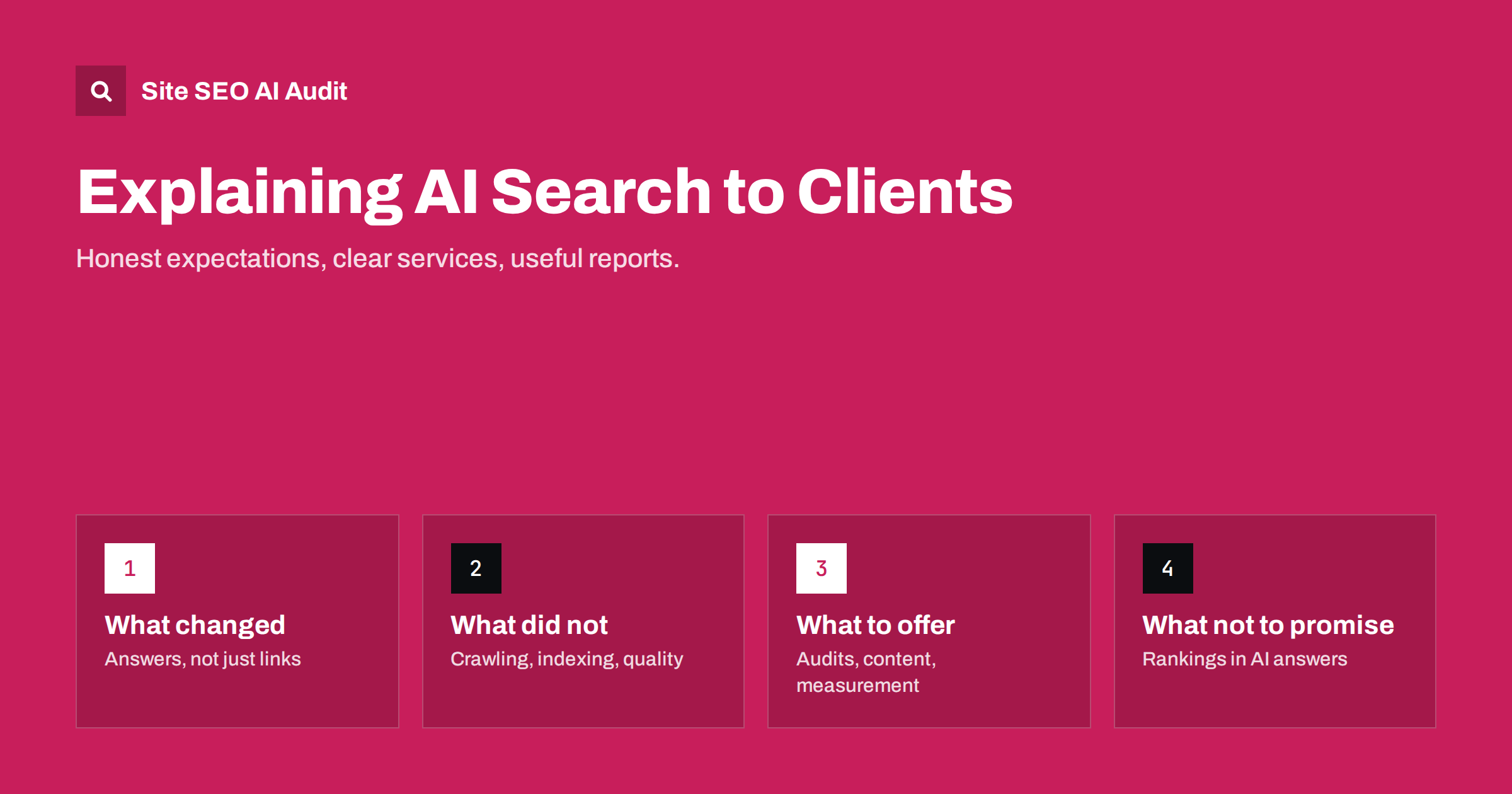
Short answer: Explain AI search to clients as a change in how search results are presented, not a replacement for SEO. Assistants and AI Overviews still depend on crawlable, indexed, trustworthy pages, so the foundations stay the same; what changes is that answers are summarised, clicks for simple questions fall, and brand mentions matter more. Offer concrete services such as AI visibility audits, answer-focused content and better measurement, and never promise placement in AI answers, because nobody controls it.
Why clients are asking
Most clients have now seen AI Overviews in Google and have tried an assistant for their own questions. Many have read headlines claiming that SEO is dead, or received sales emails offering “AI SEO” packages. They come to their agency with a mix of curiosity and worry: will we lose traffic, are we visible in these answers, should we do something different, and are we paying for the right things?
These are fair questions, and agencies that answer them clearly build trust. Agencies that avoid them, or that answer with jargon and new acronyms, leave room for competitors who promise more than they can deliver.
Different clients worry about different things. A publisher worries about losing informational traffic. A local business worries about whether assistants recommend it. An online shop wants to know about AI shopping answers. A B2B company wants to be on the shortlist when buyers ask for tools. Tailor the conversation to the client’s model rather than delivering the same presentation to everyone.
A simple explanation clients understand
A short, plain explanation usually works better than a technical deep dive. Something like this:
“Search engines and AI assistants now often answer questions directly, by reading several websites and summarising them. To be included, your pages still have to be found, understood and trusted, which is what our SEO work does. What changes is that people click less for simple questions, and being named in answers becomes a new kind of visibility. So we keep the foundations strong, make your content easy to quote, and measure more than just clicks.”
Follow with two or three examples from the client’s own industry: a question where an AI Overview appears, what it says, and which sites it cites. Concrete examples are more convincing than any chart.
Avoid burying the explanation in acronyms such as GEO, AEO and LLMO. Clients do not need new vocabulary; they need to know what to do and why.
What changed and what did not
| Still true | New or more important |
|---|---|
| Pages must be crawlable and indexed | AI crawlers and CDN settings must allow access |
| Content must match search intent | Passages must answer questions on their own |
| Quality and trust decide visibility | Consistent brand facts across the web matter more |
| Technical errors limit results | Content hidden behind JavaScript is riskier |
| Rankings and clicks are measurable | Mentions and citations need new measurement |
This table is often all a client needs to see that their existing investment is not wasted, and that the additional work is specific and limited.
Services agencies can offer
AI search does not require a completely new service line. It fits naturally into existing work:
- AI visibility audit. Check crawler access in robots.txt, CDN and firewall; JavaScript-dependent content; indexing in Google and Bing; structured data; and brand consistency.
- Content restructuring. Rewrite key pages with direct answers, clearer headings, specific facts and visible dates.
- Entity and brand work. Align business profiles, directories and structured data; correct outdated information.
- Measurement setup. Create an AI referral channel in analytics, a question tracking set and a monthly visibility log.
- Policy advice. Help the client decide which AI crawlers to allow, in writing.
Start each engagement with the audit, because it produces evidence. A client who sees that their CDN has been blocking AI search crawlers, or that their product descriptions only load with JavaScript, understands immediately why the work matters. Findings like these also give the agency quick, visible wins before the slower content and brand work begins to show results.
Scoping and pricing the work
Clients often ask what AI search work costs and how long it takes. A clear scope avoids disappointment on both sides:
- One-off audit and fixes. A defined deliverable: the audit report, a prioritised fix list and implementation of technical fixes such as crawler access and rendering problems. Usually measured in days or weeks.
- Content programme. Restructuring a defined number of key pages per month, with direct answers, clearer headings and updated facts. Ongoing, with a review after three to six months.
- Brand and entity clean-up. Aligning profiles and listings, correcting outdated information. Often a one-off project followed by quarterly checks.
- Measurement and reporting. Setup once, then a monthly report. Small effort, high value for trust.
Be explicit about what is outside your control, such as how assistants choose sources or how quickly models update, and write it into the proposal. Clear boundaries make the conversation easier when results take time.
How to report AI search results
Reporting is where expectations are won or lost. A good monthly report adds a few AI-specific items to the usual SEO metrics:
- Search Console impressions and clicks by query group, with a note on click-through changes where AI Overviews appear.
- AI referral sessions and conversions from assistant domains.
- Results of the question tracking set: mention rate, citation rate, errors found.
- Technical AI visibility status: crawler access, rendering issues, fixes completed.
- Actions taken and planned, linked to the findings.
Always include one line on limitations, for example that AI referrals are undercounted because many visits arrive without a referrer. Clients appreciate honesty about data more than impressive but fragile numbers.
Promises to avoid
AI search attracts overpromising. Protect your reputation by avoiding:
- Guaranteed placement in ChatGPT, AI Overviews or any assistant. No agency controls which sources are chosen.
- Precise “AI ranking” positions. Answers vary by user and session, so positions are not stable.
- Secret techniques such as hidden prompts or special files that supposedly force inclusion. They do not work reliably and may be treated as manipulation.
- Replacing SEO with “GEO”. The foundations are the same, and dropping them would harm both classic and AI visibility.
What you can promise is a process: remove obstacles, improve content quality, measure honestly and report transparently.
It also helps to educate clients about what they can do themselves. Business owners often hold the information that makes content quotable: real prices, real processes, real customer questions and first-hand experience. Ask them for it. Content built on that knowledge is harder for competitors to copy and more valuable to AI answers than anything written from desk research alone.
Handling difficult conversations
Some clients will see traffic fall for informational queries even when the work is good. Prepare for this conversation before it happens. Show the query-level analysis, separate informational from commercial queries, and highlight conversions and branded demand. Explain that some searches now end without a click for everyone in the industry, and that the goal is to be the named source and to win the searches where a visit matters. If the data shows a genuine problem, such as a technical issue or ranking loss, say so and present the plan to fix it.
Finally, keep the conversation going between reports. A short message when a notable change happens, such as a new AI feature in the client’s market or a competitor appearing in answers, shows that you are watching on their behalf and keeps AI search from becoming a source of anxiety.
How Site SEO AI Audit helps agencies
Site SEO AI Audit gives agencies a consistent way to show clients where they stand. Every report scores the site across seven areas, including AI visibility, with a fix list ranked by points gained. The Agency plan adds a white-label PDF with your logo and an embeddable audit form that you can use on your own site to generate leads. Details are on the pricing page.
Related reading
- How to Measure Your Brand’s Visibility in AI Answers
- Traffic Dropped After AI Overviews? How to Diagnose It
- AI Search Visibility Checklist: 25 Things to Audit
The bottom line
Clients need a clear, honest story about AI search: the foundations still matter, answers change how clicks happen, and being named and cited is a new form of visibility. Offer concrete services that fit your existing work, report with metrics that reflect the new reality, and avoid promises nobody can keep. That approach builds trust that lasts beyond the current hype.
GYIK
Should agencies sell AI search as a separate service?
It can be packaged separately, but it works best as an extension of existing SEO work: audits, content and measurement adapted to AI answers. Selling it as a replacement for SEO misleads clients.
Can an agency guarantee visibility in AI answers?
No. AI systems choose their sources, and answers vary between users. Agencies can remove obstacles and improve content, but not guarantee inclusion.
What is the first thing to check for a client?
Crawler access: robots.txt rules, CDN and firewall settings, and whether content appears in the HTML without JavaScript. These issues can make a site invisible to AI systems regardless of content quality.
How should AI results be shown in reports?
Add AI referral traffic, results from a fixed question tracking set, and technical AI visibility status to the usual SEO metrics, with a clear note on data limitations.
How do I explain a traffic drop caused by AI Overviews?
Show that impressions and positions are stable while click-through fell on informational queries, and highlight conversions and branded demand. Then explain the plan to focus on queries where visits matter.