ENEnglish
 LTLietuviškai
 DEDeutsch
 FRFrançais
 RUРусский
 ESEspañol
 PLPolski
 ITItaliano
 UKУкраїнська
 CSČeština
 PTPortuguês
 JA日本語
JA日本語 LVLatviešu valoda
 ETEesti
 HUMagyar
 IDBahasa Indonesia
 TRTürkçe
 HIहिन्दी
 ELΕλληνικά
 ARالعربية
 THไทย
THไทย VITiếng Việt
 RORomână
 MSBahasa Melayu
 BNবাংলা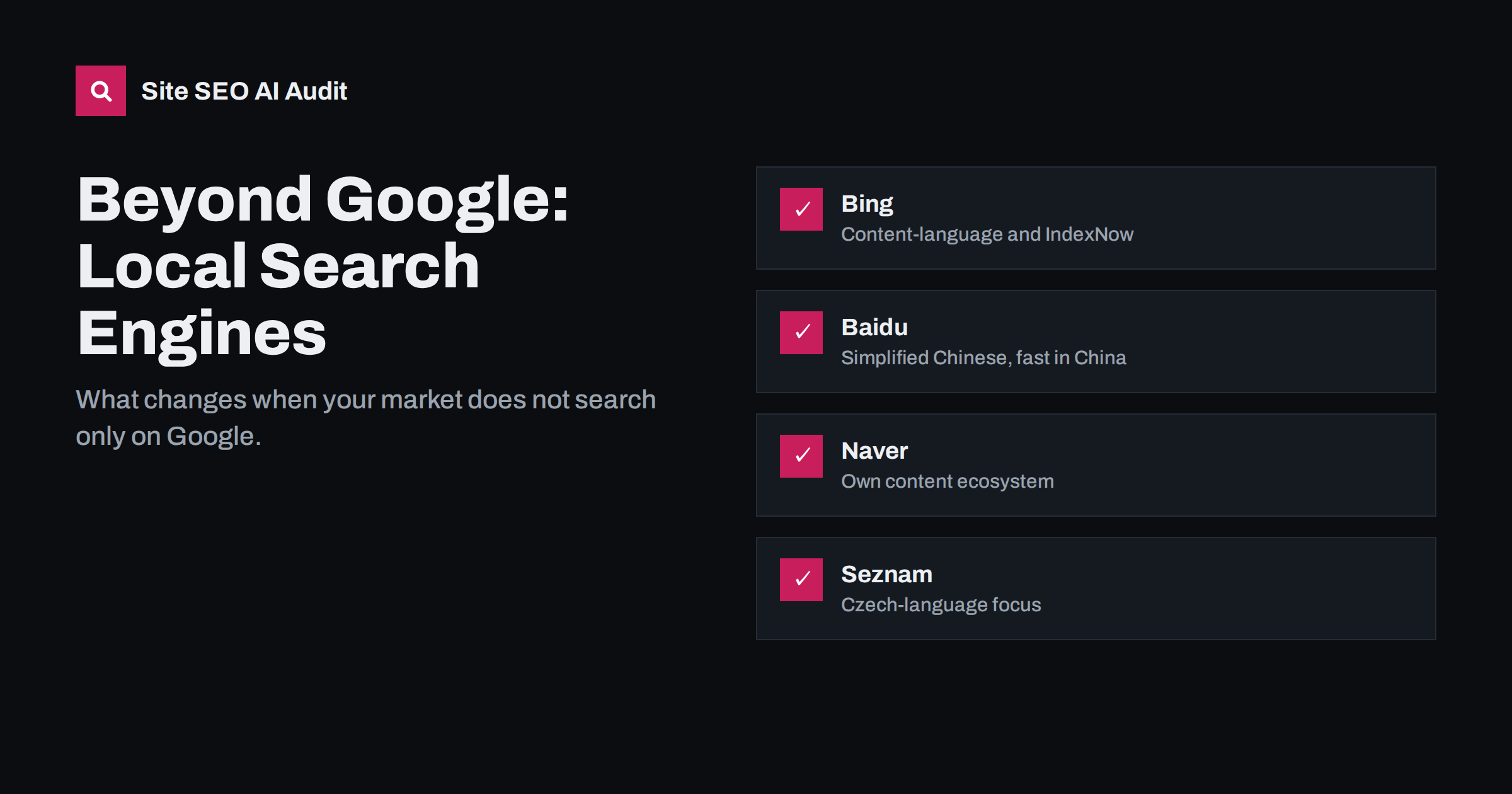
Short answer: Google dominates search in most countries, but not everywhere. Bing matters in many markets and powers other services; Baidu leads in mainland China; Naver is a major player in South Korea; Yandex is significant in Russia and some neighbouring countries; and Seznam has a notable share in Czechia. The fundamentals are the same everywhere: crawlable pages, clear language signals, useful local content. The differences are in which signals each engine reads, where it can reach your server from and which local platforms it favours.
Why look beyond Google at all
For most international sites, Google will remain the main source of organic traffic, and most of the work you do for Google helps everywhere. But in a few markets, ignoring other engines means ignoring a large part of the audience. In others, a smaller engine still brings valuable, often less competitive traffic.
Before investing, check your own data. Analytics referral reports show which search engines already send visitors from each country. Public statistics services that track search engine share can give an overall picture, but shares change over time and differ by device, so treat any single figure with caution. The decision should come from where your target customers actually search.
It is also worth remembering that search engines are no longer the only way people find information. AI assistants and answer engines increasingly rely on search indexes, including Bing’s, which gives some engines more indirect reach than their direct share suggests.
Bing
Bing is available worldwide and has a meaningful share in several markets, especially on desktop. Its index also supports other services that show web results. For international sites, a few points stand out:
- Language signals. Bing has said it looks at the content-language meta tag or HTTP header and HTML language attributes, alongside the text itself, to understand a page’s language and target region. Setting these consistently is cheap and helps.
- hreflang. Bing’s support for hreflang has historically been described as limited, so do not rely on it alone to separate country versions for Bing. Clear URLs and consistent language signals help.
- Bing Webmaster Tools. It offers sitemap submission, URL inspection, crawl information and site scanning, and is worth setting up for every international property.
- IndexNow. Bing supports the IndexNow protocol, which lets sites notify participating search engines immediately when URLs are added or changed. It is useful for large or fast-changing multilingual sites.
Baidu (mainland China)
Baidu is the leading search engine in mainland China, where Google’s services are not generally accessible. Ranking there is less about tags and more about accessibility and local presence:
- Language and script. Content should be in Simplified Chinese, written for mainland readers.
- Reachability and speed. Sites hosted outside mainland China can be slow or unreliable for Chinese users. Hosting inside mainland China generally requires an ICP licence, which in turn has local requirements.
- Blocked resources. Scripts, fonts and services from providers that are blocked in China can break pages or make them very slow.
- hreflang. Baidu is widely reported not to use hreflang. Separate, clearly Chinese URLs, and often a separate site, are the usual approach.
For most small and medium businesses, serious Baidu SEO is a significant project involving local partners. It should follow a clear business case for the Chinese market.
Naver (South Korea)
Naver is a major search portal in South Korea, alongside Google. It differs from Google in an important way: its results give prominent space to content from its own services, such as blogs, community cafés and knowledge Q&A, as well as to web documents.
- Register with Naver’s webmaster service to submit sitemaps and monitor crawling.
- Publish high-quality Korean content on your own site, and consider a presence on Naver’s own platforms, where much of the visibility is.
- Make sure your Korean pages are fully localized; Korean searchers expect native-quality text.
Naver’s results pages are organised differently from Google’s, with separate sections for different content types. It is worth searching your main Korean keywords on Naver to see which sections dominate before deciding where to invest. For some queries, your own website may be less visible than blog posts or community answers about your product.
Yandex and Seznam
Yandex is a significant search engine in Russia and some neighbouring countries. It supports hreflang and XML sitemaps and offers its own webmaster service with regional settings. As with any market, legal, business and payment realities should be assessed before investing in it.
Seznam is a Czech search engine and portal that has kept a notable share in Czechia alongside Google. It focuses on Czech-language content and offers webmaster tools for submitting sites and sitemaps. For businesses targeting Czech customers, checking visibility in Seznam is worthwhile.
Smaller national engines are easy to overlook because they rarely appear in global statistics. Yet for a business selling mainly in one country, a local engine with a modest share can still send a steady stream of visitors who are highly relevant, since everyone using it is by definition in that market. Checking your referral data for local engines once in a while costs nothing and occasionally reveals an overlooked channel.
In both cases, well-structured, crawlable, properly localized pages do most of the work. The specific webmaster tools mainly help with submission, diagnostics and regional settings.
Setting language signals that every engine can read
Because engines differ in which signals they use, the safest approach is to make every signal say the same thing. On a German page for Austria, that means:
- Visible text in German, including navigation, footer and metadata.
- The lang attribute on the html element set to
deorde-AT. - Optionally, a content-language value of
de-AT, sent as an HTTP header or a meta http-equiv tag, for engines that read it. - hreflang listing the page as
de-atwithin its cluster. - Local details such as euro prices, an Austrian address or phone number, and shipping terms for Austria.
None of these signals conflicts with the others, and each engine picks up the ones it uses. What causes trouble is disagreement: a page whose lang attribute says English, whose content-language says German and whose text is half translated gives every engine a different story.
A good habit is to generate all of these values from one setting per language version in your CMS. When the locale for a version is defined once and reused for the lang attribute, the content-language value, hreflang and formatting, they cannot drift apart.
What works for every search engine
Although each engine has its own quirks, the same technical foundation serves all of them:
| Foundation | Why it matters everywhere |
|---|---|
| One URL per language or country version | Every engine can crawl and index each version separately |
| Fully translated pages with one main language | Language detection works from the text in all engines |
| Correct lang attribute and, optionally, content-language | Some engines read these as direct signals |
| hreflang with return links | Used by Google and Yandex; harmless elsewhere |
| No forced geo-redirects | Crawlers from any location can reach every version |
| XML sitemaps per version | Supported by all major engines’ webmaster tools |
| Fast, reachable servers in each market | Crawlers and users alike depend on it |
A practical plan for a new market
- Check which search engines your target customers use, from your analytics and public statistics.
- Build the version on the shared foundation above.
- Register the site in the relevant webmaster tools and submit sitemaps.
- Test speed and reachability from the target country, especially for China.
- Add engine-specific steps, such as local platform presence for Naver or local hosting for Baidu, only where the market justifies it.
- Measure traffic by search engine and country, and adjust.
Checking the shared foundation
Most engine-specific work sits on top of the same technical base, so problems in that base affect every engine at once. Site SEO AI Audit crawls a site like a search engine, following robots.txt, and checks the areas every engine depends on: crawl and indexing, speed, links, on-page elements, structured data and Languages, including hreflang return links, broken language versions, x-default and lang attributes. The first audit is free.
Related reading
- How Google detects the language of a page, and why it matters
- The HTML lang attribute: what it does for SEO and users
- How to target a specific country in Google Search today
The bottom line
Google is the main engine in most markets, but Bing, Baidu, Naver, Yandex and Seznam matter in specific countries or contexts. Build every language version on a shared foundation of clean URLs, full localization, clear language signals and no forced redirects. Then add engine-specific steps only where your customers actually search, and measure results by engine and country.
GYIK
Does Bing use hreflang?
Bing’s support for hreflang has been described as limited, and it has said it looks at the content-language meta tag and HTML language attributes. Use consistent language signals and clear URLs rather than relying on hreflang alone for Bing.
Can a site hosted outside China rank on Baidu?
It can be indexed, but speed and reachability from mainland China are often poor. Serious Baidu visibility usually requires Simplified Chinese content and hosting or delivery that performs well inside China.
Do I need a separate strategy for Naver?
If South Korea is an important market, yes. Naver gives prominent space to its own blog and community platforms, so a presence there often matters alongside your own site.
Is IndexNow useful for multilingual sites?
It can be. IndexNow lets you notify participating search engines, including Bing, when URLs change, which helps large or fast-changing multilingual sites get updates indexed sooner.
Should I optimise for every local search engine?
No. Build a solid shared foundation first, then add engine-specific work only in markets where your customers use that engine.